Category Archives: Whisky Reviews & Tasting Notes

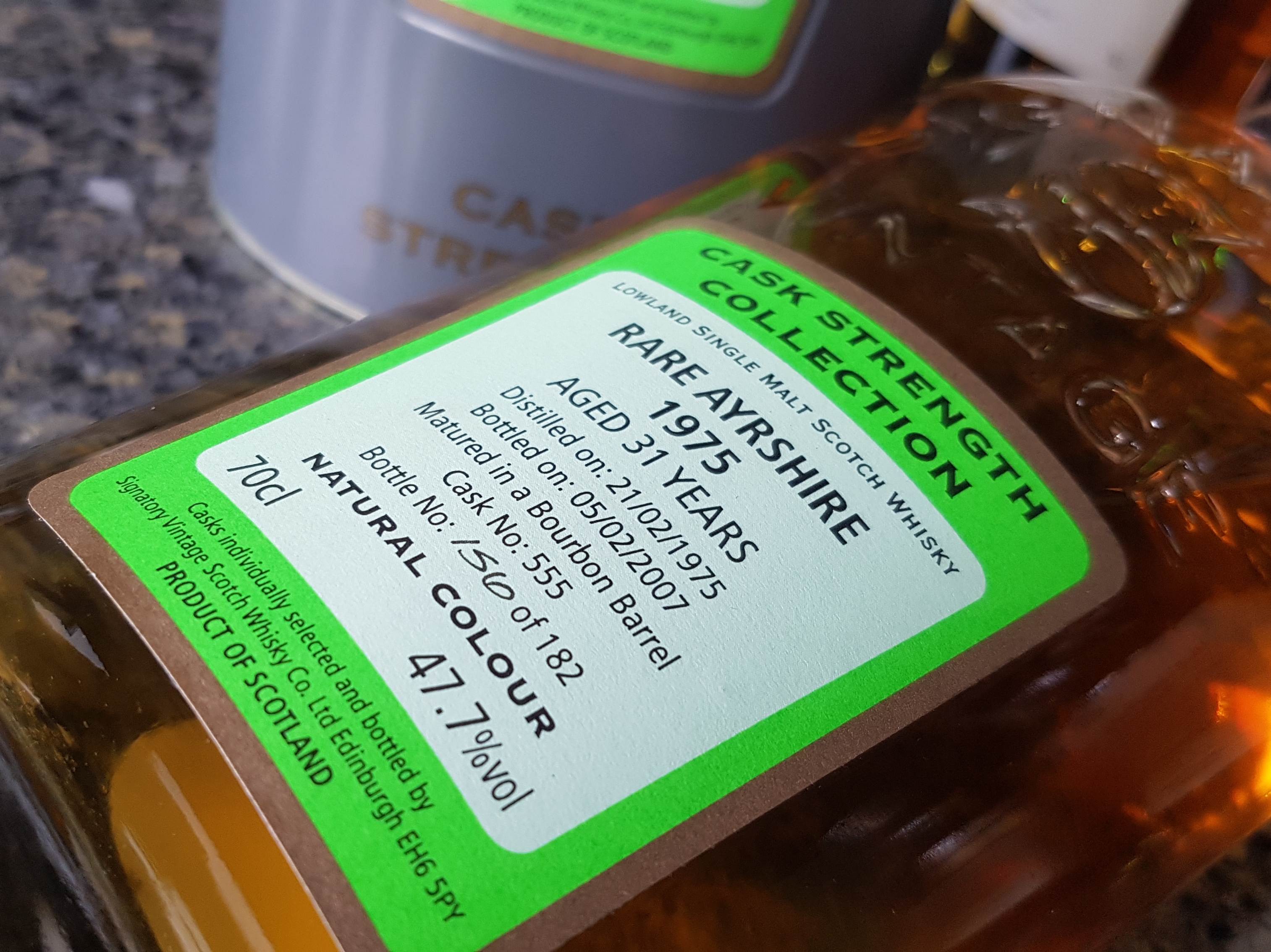
Rare Ayrshire 1975 (Signatory Cask No: 555) Review

Yet another bit of absolute malt insanity. These are the sorts of whiskies I live for.

If you know your barley juice quite well, you may know that Ayrshire is another name for the infamous Lowlander, Ladyburn. With less than ten years production, Ladyburn is one of the scarcest malts in the whiskysphere. It’s also another of those uber-singular whiskies that was produced at a distillery within a distillery. There were a few of these anomalous set-ups, of course, but we’ll save the ramblings on the others for future days, lest we drag on too long here, only to spoil the narrative later. Ladyburn was produced within the Girvan distillery between 1966 and 1975. So, as you can tell by the photo below (or just by reading the review title), this particular ex-bourbon barrel was filled in the last year of the distillery’s existence. It was one of (at least) a couple of sister casks released by Signatory in 2007. Cool stuff, aye?

Enough preamble, though. Let’s jump into some tasting notes. That’s why we’re here, after all.

This 31 year old Ayrshire is a bit of a mishmash. It hits some very cool high notes, but they’re kind of outliers in a whole that seems a bit murky. And not just murky, but also sort of befuddled. It’s a malt that really has no cohesion, but has an intrinsic niftiness that keeps pulling me back in. Hard to explain. At its heart, though, its a whisky that matters more for just being here than for what it actually is. It ain’t pretty, but it in its own way it is actually sort of beautiful.

Sincere thanks to my mate Brett Tanaka for the opportunity to taste this. The range of bottles he’s been opening for what we’ll call ‘The Brett Sessions’ are simply beyond comprehension. And I am beyond humbled to be able to partake. I’ll be reviewing dozens of them in the coming weeks/months.

47.7% abv

Tasting Notes

Nose: Doughy, with a slight cheesy note. Salty dough, actually. And kinda footy, to boot (bad pun, I know). Nutty and putty-like. Faint peat with some muddled fruit mixed in for good measure. Damp burlap. Real apple juice. Cold coffee grounds. But the nuttiness is omnipresent.

Palate: Very hot and woody. Anise. Bitter chocolate. Walnut paste. Maybe some almond. Buckley’s cough syrup. Earthy and organic dried peat notes (as if it’s only just been lit). Cereal. Drywall mud.

Finish: Quite tannic. Mostly apple skins.

Thoughts: Overall? Quite challenging. Points could go up or down by a couple depending on time of day and how sentimental I’m feeling about these spectacular closed distillery bottlings.

80/100
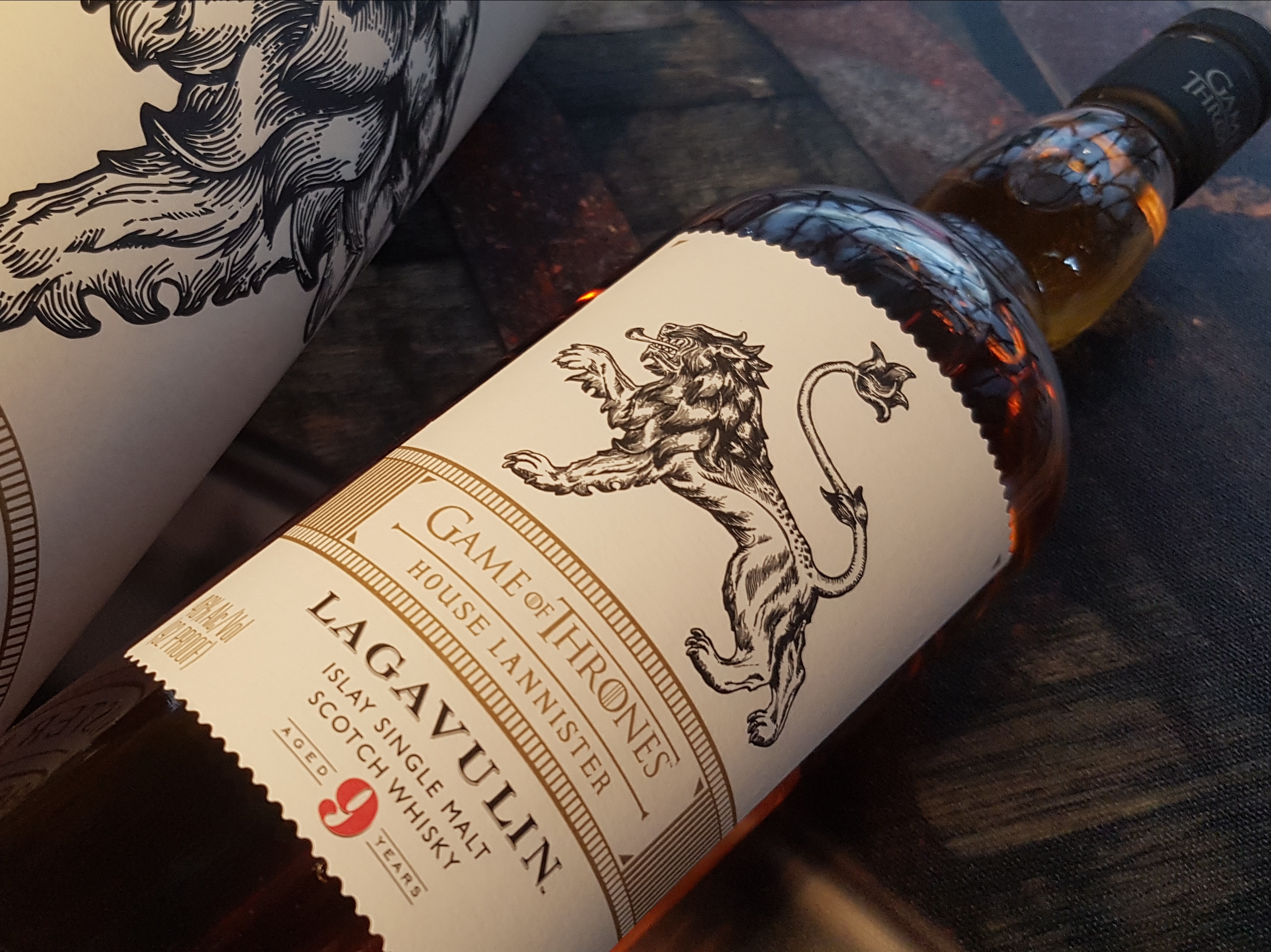
Lagavulin 9 y.o. Game of Thrones Edition Review

Yep. I hate to say it, but we still have yet to fully emerge from this age of ‘style over substance’. An entire range of (rather boring) entry level malts from the mighty Diageo hyped up by the runaway success of the monolithic Game of Thrones franchise. Marketing BS at its apex. All I can say? Blech. The concept, I mean. Not necessarily the whiskies. Maybe it’s simply wishful thinking on my part, but I do believe we’re starting to see some light at the end of the tunnel. Age statements are making a comeback (including from the rather confrontation Macallan family), prices are seeing small true-ups (looking at you, Mortlach) and less goofy-named releases are bogging down headlines on the whisky wire. Fingers crossed that sanity is finally prevailing.

But this GoT Laga? Well…what can I say? It is unquestionably a part of the overarching dough-headedness, but at the same time, it is at least being offered a) at a fair price; b) at a decent abv; and c) with an age statement. I guess we’ll cut a little slack here, aye?

This isn’t bad whisky. In fact, bad whisky is a relative scarcity from Islay’s Rolls Royce of distilleries. And we should all know by now that peated malts are quite tasty when they’re served up this young and hot, right? Yup. But I can’t say I’m in love with the casks chosen for this vatting. I get a bit romantic for Lagavulin. Can’t help it. I love the history behind it and the tales of resilience that backstop some of these archaic and beloved distilleries. But even a profound bias in favor of the producer isn’t enough to make me want to actually buy one of these. It takes a bit more than the crushing weight of the marketing machine’s wheels to make me part with my shekels these days.

But…credit where credit is due: they did at least give it to us at 46%. Well done, Diageo. (But how sweet would it be if they opted to up the bottling strength of the iconic 16 y.o. to 46% as well? Sigh. A dream. A very lovely dream.)

Tasting Notes

Nose: Sweet, malty gristy notes. Damp Band-Aids. Smoke (but not too pungent). Lime. A faint suggestion of pineapple. Honeydew. Green jelly beans. Pepper and powdered ginger. Starfruit. A nice briny-ness. Iodine. Decent spices and some minerality behind what feels like an almost artificial fruit sweetness.

Palate: Surprisingly prickly arrival. Very sweet, right up front, but immediately darkens into shades of black licorice and tar. Some more of those malty notes follow and weave throughout. Dirty, oily smoke. Brioche. Fresh smoked oysters. More citrus and some vanilla. Popsicle sticks. Ultimately, though…it seems kinda flat.

Finish: Slightly tannic, but just slightly. And surprisingly, a bit like heavy cream stirred into lemon curd. Then under ripe pear skins and oak. Reminds me of chewing on peated malt. Slightly ashy at the tail end. Decent mid length linger.

Thoughts: Much more impressive (and expressive!) nose than palate. Drinkable. Hard to love, though.

82/100

Elements of Islay BW7 Review

One of those reviews I parked a while back. Time to let ‘er fly…

We have Sukhinder Singh, the fine gent behind The Whisky Exchange, to thank for this nifty little range of malts. The Elements of Islay series is a bit goofy and irreverent on the surface, but make no mistake, these are serious drams where it counts. And where it counts is in the glass, of course. But hey, what can I say…I prefer a little austerity in packaging over quirky attempts to stand out from the herd. Maybe that’s just me. Either way, Sukhinder is probably one of the most knowledgeable and devoted whisky folks out there, so why would we expect anything less from him than expressions offered up small batch, cask strength, non-chill-filtered and uncolored? Easy answer: We wouldn’t.

In the Elements range, each brand has its own code that roughly translates to the distillery it represents. Bw=Bowmore, Ar=Ardbeg, Lp=Laphroaig, etc. And each distillery code is appended with a number that signifies the particular batch. Not too far off what the SMWS has been doing for a few decades now, when you think about it.

So, yes…this one is a Bowmore. A monster of a Bowmore, at that. Kinda Jekyll and Hyde-like, in a way. It’s massive, tingly and uber-rich in deep jammy sherry notes, macerated fruit, old potpourri, but it also comes bearing a nasty symbiotic co-host: sulphur. Sigh. Yup. And not only sulphur but also a slightly moist cardboardy note that hints at TCA (cork taint). In a somewhat paradoxical way of explaining, this malt is both lively and bright…and dead and muted. Tough to reconcile. And, if I’m being totally honest, I really don’t understand how whiskies like this get bottled. This kind of sulphur is a flaw. Period.

It has only been over the last couple years that these Elements expressions have made their way into Canada, hence my being a little late to the party on the review front (not to mention I sat on this review for the last year or so). And though I can’t be too kind to this particular release, I should note here that all of the other expressions that I’ve tried from Elements have definitely been worth having a run at.  Having said that, I’ll go on record as saying Bw7 is maybe one to avoid blowing your dough on.  ‘Less you like the smell of struck matches, that is.

53.2% abv

Tasting Notes

Nose: Blech. Sulphur. Sulphur and what almost seems like cork taint. Putty. Muted jam. Slightly weedy. Kinda like a Laimrig gone wrong. Old marzipan. Some floral tones too. In spite of these…less that flattering notes, this one is actually not awful, but it’s also not a great malt. With time it softens a bit, but doesn’t ever really get better.

Palate: Better than the nose lets on, but barely. Arrives okay, then immediately becomes flat. Dull almond notes. Cardboard or damp paper. Some salt licorice.  Brine. Rubber. Smoke, of course. Pulled pork with a very generic sauce. Some more fruit, but it’s all muddy and muffled.

Finish: Better than expected. Long and rather fruity. The matchsticks, fortunately, are largely forgotten.

Thoughts: A lot of wasted potential here. I know these are small batch vattings, but it seems like a bad butt ended up in here. Should have been left out.

74/100

Coleburn 1981 Gordon & MacPhail (2015) Review

I don’t even know if this is disputable anymore: Gordon & MacPhail have the greatest warehouses in Scotland. I think at some point we all just have to concede it. There are loads of brilliant independent bottlers all ’round the world – some, I’d argue, I even prefer to G&M when all factors are taken into account – but no one, I repeat, no one, has the depth and breadth of utterly mindboggling stocks that Gordon & MacPhail have been able to sock away throughout the decades. Especially when it comes to beautiful old Speyside malts.

But every great hero has his (or her) Achilles heel, no? For G&M, that has almost always been their propensity for high prices in return for criminally low bottling strengths. The high prices are easier to justify, in my mind anyway, as the quality is almost universally high (excepting some questionable wine-casking decisions). The low bottling strength? No pulling punches here: it’s greed. You can dress it up however you want, but at the end of the day it’s still lipstick on a pig. They’re stretching stocks. I’ve heard comments along the line of ‘we determined this was optimal drinking strength’, but that is – forgive me – bullshit. No one who is buying these sorts of great old ’60s, ’70s and ’80s whisky has ever preferred a chill-filtered 40% or 43%er to an oily, fully intact, 46% or cask strength offering. Read that last sentence again. Bold words, I know, but I stand behind them. Even if consumers opt to drink it at a lower strength, I can almost guarantee they’d prefer it was bottled at a higher proof so they could add their own water. You can always add water. You can’t add back the texture that you’ve been robbed of at 40% or so. It seems especially criminal with beautiful old drams like the one we’re discussing. Cutting it with water is simply dumbing it down.

Anyway, before this becomes an essay, let’s discuss Coleburn, another casualty of the downturn that gutted so much of the industry in the 1980s. Expressions of Coleburn are scarce, they’re dear and they’re really, really cool whiskies to try if the occasion arises. Unfortunately, it doesn’t very often anymore. So, instead we pause and take our time when a dram like this crosses our path. It took 34 long years to make, after all. The least we can do is let the clock stop for an hour or so while we enjoy it.

Last thought: Let’s just be grateful that this particular release was bottled at 46% abv. Maybe not left completely intact, but I can accept 46%.

Tasting Notes

Nose: A bowl of melons and papaya on a freshly polished sideboard. Old cigar box. Faded pressed flowers. Orange and dark chocolate. Waxed hardwood. Oily, dried tropical fruits. That truly singular antique-y style of G&M sherry wood. Scottish tablet. I could go on. And on. And on.

Palate: Very syrupy on the tongue. Velvety even. Tropical fruits meet freshly cut figs. Old and oaky. Mouthwatering, yet slightly tannic. Orange oil. Mango. Loads of grapefruit. Candied green walnut and griottines (boozy cherries). Brioche.

Finish: Long and warming. Barley and oak, as it should be.

Thoughts:  This is the sort of dram I could give up all others for. Beautiful.

92/100

Bruichladdich Black Art 6.1 Review

Black Art was always Jim McEwan’s baby. If you’ve ever been privy to one of his Bruichladdich tastings, you’d know he prizes this expression dearly. Said tastings also usually involved a recitation of a story involving Heidi Klum, but we’ll leave that one for Jim’s telling. The crux of the tale, though, is that the Black Art recipe is really not meant for mortal eyes. Everything about its mad design is hush hush, as the alchemy behind its creation was supposedly Jim’s most dearly held secret, meant for him and him alone. Until he took Laddie’s current head distiller, Adam Hannett, under his wing, that is. Now, a few years removed from Jim’s Bruichladdich exeunt, the Black Art magic lives on under Adam’s watchful eye.

So, what is the BA secret? Lemme see how best I can relate this (in typical cheeky fashion, of course)…

Can you imagine spending decades of your life working your way through the degrees of some Dan Brown Templar-esque secret society; pouring countless amounts of tithe money into the organization; sacrificing any precept of self-gratification through secret-slipping…and finally, finally, getting to the root of it all. Finally reaching that apex moment of great revelation only to discover it’s little more than…the Caramilk Secret? That’s kinda what we have here. I know we’re supposed to be wowed by this esoteric bit of alchemical concocting, but honestly…Bruichladdich’s Black Art is really just a cuvee of various wine casks. Yep. That’s the big secret. So be it. But hey…At least the packaging is cool.

And to be fair, in the typical Bruichladdich drive for transparency, we are given both vintage and age statement here. 1990 distillate, 26 years old. Of course, there could be older spirit in here, but it almost certainly wouldn’t be by much.

This is edition 6.1. And unlike the decimal series used for Octomore, the BA releases are limited to the .1’s. Ergo, this is the sixth version of Black Art we’ve seen, and the second version released since Jim McEwan moved on. Jim’s protege, Adam, is a talented dude, no two ways about it. He’s also got a little of the McEwan showman in him. But the spiel means nothing if the juice he’s barking about ain’t got the bite to back it up. And Black Art definitely has bite. While Jim’s creations (the large majority of them, anyway) tended to be all about bombast and boldness, there seems to be a little more nuance to Adam’s approach. In short, he might have a slightly more subtle palate than Jim. Easy, now…I said more subtle; I didn’t speak qualitatively on either distiller. I’m a junkie for Bruichladdich. You guys know that. I love both these cats.

But Black Art? Meh. Not my cup of wine-soaked whisky, if I’m being honest.

Tasting Notes

Nose: Always so jammy and sweet on the nose. But there is a faint hint of struck match too. Peppered berries. Raspberries in milk chocolate. A bit of artificial florality. Strawberry shortcake. The toasted (maybe crisped) top of a crème brulee. The fruit and spice are in nice harmony. And there is a neat old dusty, dunnage note buried in there too. It’s just the dissonance of too much wine that is like the squeal of an out of tune violin in an otherwise pleasant orchestral arrangement.

Palate: Sweet arrival, then wham! There’s the wine. A lot of fruit happening here. And less tannic than expected; in fact, it stays rather mouthwatering. That would be those bush berry flavours again (mostly raspberry again…what kind of wine casking was this?!) A brief hint of cedar (almost humidor-esque). Some more spice and some herb (cracked pepper and maybe a whiff of fennel). This is the softer side of the Laddie wine work, but it’s still too heavy for me.

Finish: Altogether too much of that weird, sour wine tang. And it takes way too long to fade. A little bit of green grape and oak at the end. Maybe some lychee.

Thoughts: These whiskies are lost on me. I appreciate some of the individual notes (especially those that scream of age!), but the whole is a bit of a cacophony for me.

80/100 (I concede it’s not awful, but it’s just not for me. 80 seems fair)

Killyloch 36 y.o. Review

Yes. For real. Killyloch. One of the most scarce single malt whiskies in the world. This 36 year old official bottling was a vatting of the last half dozen proprietary casks of Killyloch in the world. If you’re unfamiliar with the name (and yes, most of us are), Killyloch was produced at the Moffat complex in Airdrie. It was one of three single malts and a grain that were produced on site. The malts were Glen Flagler, Killyloch and Islebrae. The grain was Garnheath. All four are long gone now, of course, but Killyloch became the earliest casualty of the complex, when its stills – having only been christened in 1965 – were decommissioned just a few years later and absorbed by Glen Flagler. (Sounds a little like the Malt Mill / Lagavulin saga, aye?) In all, I’d guess there were maybe 6 or 8 years of production.

It’s a shame the abv on this 36 year old is a meager 40%, but the bottle actually says this is natural cask strength – and to be fair, it is quite decently oily – so let’s just assume honesty and transparency are to be taken at face value. And the whisky? Man…what can I say? This is the true definition of liquid history. It’s a relic, for sure. Tasting it nowadays is anachronistic to the point I kinda feel like I’ve stepped into an episode of the Twilight Zone. Fantastic stuff, and spectacularly special to be able to try. Now, if only there were a drop of Islebrae to be found…

Sincere thanks to my mate Brett Tanaka for the opportunity to taste this. The range of bottles he’s been opening for what we’ll call ‘The Brett Sessions’ are simply beyond comprehension. And I am beyond humbled to be able to partake. I’ll be reviewing dozens of them in the coming weeks/months.

Tasting Notes

Nose: Orange, peach and tangerine. Very fruity. Bourbon notes are strong here behind the rich, tropical notes. Cherry. Old dead wax. Polished church pews and other antique-y notes. A slight peatiness. White dough. White chocolate. A deep vein of spice running through the whole. Citrus oils.

Palate: Very soft arrival. Spicy, to the point of being almost rye-like. And yet, still sorta bourbon-esque too. A little peat (but soft). Lemon cream pie. Lemon Drops. A bit of licorice. Some marzipan. And more of those soft orange peachy tones.

Finish: Longer than expected. Lovely and creamy. Reminds of a creamsicle.

Thoughts: Stunned silence.

91/100 (could likely add an extra point or so just for the sheer enormity of what we’re tasting).

Ardbeg Drum Review

I wanted to love this. I really did. As soon as they announced this year’s Ardbeg Day release was going to be rum cask-matured I immediately went into mental damage control. It’s okay. Relax. It might still be good. You don’t much like wine casks, but Grooves was good, right? Rum, though? Really? And that name. I’ve mentioned the concept of jumping the shark before, and maybe this is finally it.

A few years ago, Diageo’s Nick Morgan made some ridiculous comment that fired up the cognoscenti. He was coming out in defense of NAS whiskies (or if you can read between the lines: being the human shield for the fatcats at Diageo HQ) and said something along the lines of running out of numbers for age statements. Silly, of course, but I’m hoping that the idea of ‘running out of’ anything is maybe a little more applicable on the NAS side of things. Especially as relates to Ardbeg, one of my most beloved of distilleries. Maybe they’ll run out of silly concepts, and go back to numbers. Can you imagine the buzz for a proper age-stated range of Ardbeg? I mean, a regular core range of 10, 17, 21 and 25 or something? That I could get behind.

Drum…well…not so much.

Is it bad? No. Not actively. Is it good? Meh. S’okay. Not much more. I find it oddly thin and lacking the swagger that Ardbeg usually has in spades. Anyway…

46% abv

Tasting Notes

Nose: Very young-ish. Smoky as hell, but…lacking the expected…I dunno…Ardbeg-iness? Licorice. Bicycle tires. Overripe banana. Caremalized pineapple sugars. Banana cream pie. A little Coke with lime. A bit of eucalyptus chest rub. Smells kinda like someone polished up a pair of Wellies. In all…meh. Underripe and out of balance.

Palate: Again…missing that Ardbeg character. Hot, youthful and spirity. Black wine gums. Sweet barley sugar notes. Sensens. More rummy rubber tones. Lemon. Plastic. Brackish water. Not bad; just not exciting either. It’s almost hard to find the real Ardbeg in there.

Finish: Long, as with all Ardbeg, but yet still somehow thin. Like a longheld reedy note in a symphony when you’re expected a tuba. Leaves behind fruit skins, licorice, toothpicks and a little bit of that plastic character.

Thoughts: You lost me on this one, Ardbeg. For the first time in memory, I’ve not bought bottles for myself. Can we please just have a regularly available, fairly priced 17 year old again? Please?

79/100 (and that might be being a tad generous, if I’m being honest.)

Port Ellen 22 y.o. (Rare Malts)

An absolutely iconic bottling from perhaps the most monolithic of closed distilleries. This 22 year old Rare Malts bottling (the earlier incarnation of Diageo’s official releases) is a towering example of what the Port Ellen distillery was capable of running off its stills in the late ’70s. Not to mention…1978 was a spectacular vintage (wink wink!).

These are the sort of drams we dream about. The kind that render preconceptions moot and make us recalibrate our systems for measuring quality (as subjective as that is, of course*). One simply can’t drink something like this and remain fundamentally unchanged. It is the sort of whisky that changes what we understand about what we understand, if that makes any since. The reasons are multifold. First, this is a volatile-compound-driven whisky. That means that the foremost flavor contributor is peat, and peat, by nature, is a volatile and changing component. It does not remain constant. In fact, it degrades. Those phenolic compounds we know and love will fade drastically given enough time in the barrel. Second, this was distilled in the late 1970s, a time when processes were different, yeast and barley strains were different, wood policies were not nearly so rigidly-enforced, etc. Third, this was produced at a time when demand was a mere fraction of what it is today, ergo vatting casks would have been a very different exercise. Fourth, the malt hit glass around the turn of the millennium. It has been sitting in a bottle for almost 20 years. Oxidizing. Let that sink in for a moment. For those that believe that maturation stops at bottling, think again. The whole concept of Old Bottle Effect (OBE) probably now has enough evidence out there to support the fact that it is indeed a reality. Cork breathes. Breathing, of course, is not just exhaling, but inhaling as well. The neck level of this bottle (and a substantial proportion of older bottles, for that matter) tells us that this whisky has been slowly evaporating over the years. So what fills that void in the bottle? (Because we all know nature abhors a vacuum, aye?) Oxygen. Exactly. And that is bound to change the whisky.

Where I’m going with this is, this is not contemporary peated whisky. It is a relic. A beautiful antique. Something from a bygone age, that, in all likelihood, will never be replicated. And it is utterly stunning.

The ‘Rare Malt’ appellation doesn’t even begin to describe this one nowadays.

60.5% abv.

Sincere thanks to my mate Brett Tanaka for the opportunity to taste this. The range of bottles he’s been opening for what we’ll call ‘The Brett Sessions’ are simply beyond comprehension. And I am beyond humbled to be able to partake. I’ll be reviewing dozens of them in the coming weeks/months.

*Let’s not delve into Pirsig asides on the Metaphysics of Quality, my contrarian friends. And I know there are a few of you out there.

Tasting Notes

Nose: Peat and smoke, as you’d expect, and a fair amount, too. All of that expected oceanic brininess and iconic PE tarry character is in full effect here. Citrus (lemon, primarily). Notes of iodine and ammonia. Seared scallops and oyster liquor. Fuel (kerosene maybe? Not quite?). Fennel and tarragon. Salt licorice. Like sitting on the beach near the maltings, for those that have ever experienced that. Or like the morning air in the village of Bowmore when the breeze is blowing in off Loch Indaal.

Palate: Bombastic and fantastic. Smoky and salty, with threads of dark, oily vanilla. Herbaceous notes of green tea. Grapefruit and lime. Super fruity behind all the smoke. Some orange and melon. There is something almost ‘burnt tropical’ about it too. Slick and dark and wonderful.

Finish: Exquisitely long and throbbing (easy now, kids). Kinda seafoody.  Kinda lemony.

Thoughts: This is a knockout dram. Unquestionably one of the all time greats, and one of the best expressions of Port Ellen I’ve ever tasted.

93.5/100 (But is that enough???)

Ardbeg Grooves Review

Ardbeg Grooves

46% abv

Score:  91/100


Past due here, I know, I know.  Betcha thought I’d be jumping at the bit to share a few words on the latest Ardbeg.  Being a so-called ‘fanboy’ and all.  Every time I review one of these releases I kinda feel like I have to duck and cover.  So be it.  I hold steady to my opinion that no distillery in the world is putting out this high a level of distillate year upon year.  Not every release is a knockout, but not a single one is bad.  Ever.  Actually, not one is ever less than really good.  Contentious, I know.

Some out there are saying that this profile is a little too ‘manufactured’ (or some such sentiment), but this deep fruitiness is spectacular with the big smoke behind it.  Really.  Think smoke-infused jam or something of that ilk.

Grooves was matured in charred ex-wine barrels.  As opposed to that wet-fill wine casking that all too often results in that weird sour winey tang at the back end of the development, in this case the sugars have been caramelized into the wood and come forth in a beautiful charry sweetness.  Gotta say, I think Grooves is probably my favorite of the recent Ardbeg releases.

Nose:  Surprisingly soft and jammy fruits behind big smoke and savoury BBQ notes.  Charred pork in some sort of berry reduction.  Smoked apricot (if only there were such a thing).  Some ashy, sooty notes.  A whiff of caramel.  Jam on well-toasted bread.  Damp smoke (as from wet wood).  Hard cherry candies and real vanilla bean.  With enough time in the glass…a whiff of well-toasted marshmallow.

Palate:  Coastal and, yes, very Ardbeggian (that is a word.  I refuse to hear otherwise!).  Warm rubber and salt licorice.  Dry and dark.  Ash again.  Smoked meat bark.  Beautifully gooey and sweet.

Thoughts:  Love it.  No two ways about it.


 – Image & words:  Curt

Elements of Islay Lp8 Review

Elements of Islay Lp8

53.5% abv

Score:  89.5/100


I know there’s a fair bit of interest in these Elements of Islay releases, so let’s dig in to a rather juicy little specimen from Laphroaig.

If you’re feeling a little out of the loop as to what these austerely packaged little oddballs actually are let’s see if we can’t first catch you up a bit before we discuss the dram at hand.

Elements of Islay is the brainchild of Sukhinder Singh, he of The Whisky Exchange fame.  The man behind Elixir Distillers.  The evil genius who tempts us with the Port Askaig expressions.  Yeah…that guy.  Elements are small batch releases from the distilleries of the land of peat and smoke.  Each distillery is given a two digit alpha code appended with a numeric.  The alphas hint at the distillery (i.e. Lp = Laphroaig) while the numerics reveal the batch number.  As you can see, then, this would be the eighth release of Laphroaig.  Easy as pie, right?

Up until recently the only place I had been able to sample these malts was on forays across to the motherland.  Thankfully the good folks at Pacific Wine & Spirits have been bringing ’em into Alberta for the past few months.  We’ve seen some super cool Octomore, Bunnahabhain, Bowmore and a couple versions of the much-lauded ‘Peat’ land on our shores.  Cool stuff, and I am definitely a big fan of this range.  It does seem odd, however, that one of the whisky world’s greatest and most experienced personalities would opt for NAS releases.  I assume it has to do with these vattings being a mix of largely mature stocks, for a decent degree of complexity, and a younger barrel or two thrown in for vibrancy and heftier smoke profile.  That’s just speculation, though.  Otherwise, the only rationale I could come up with would be that the age statements associated simply don’t support the price point.  I hate to think that’s reason.  But at $280 for a 500 mL bottle?  Who knows?

Discounting that sad little truth, however…great dram, this.  Gooey, chewy and utterly delicious.  Jammy Laphroaig in this style is a treat.

Nose: Hmmm.  Smells like sherried Laphroaig.  Vinegary BBQ note.  Charred rib ends.  Sweet, tangy berry coulis.  Mint jelly smashed headlong into raspberry jam and smeared on slightly burnt toast.  Cherry cordials.  Nice and lively.  And uber smoky.  No sulphur to be found!

Palate: Sharp and punchy.  Love it!  Sweet, gooey and mouthwatering.  Berry jams again, on almost-burnt toast.  And again, saucy meaty tones.  Almost Ardbeggian.  Like smushing a red, black and green ju-jube in your mouth at the same time.

Thoughts: Right in my wheelhouse.  Great style.  Not a great price, unfortunately.  Nearly $300 for a 50cl bottle.  Ouch.  If you have some restraint (in terms of speed of consumption) and deep enough pockets…a really good score, however.


– Image & words:  Curt