Category Archives: Whisky Features

The Cure For What Ails Ye

All right, hill people!

Come forth and claim your rightful accolades.  From the Appalachian moonshiners to the Scottish excise-dodgers, we raise a glass in salutation to the tenacity of those who have fought through the ages, allowing the spirit to flow and soothe the souls of savages.

Through the years countless examples of clever folk (from toothless backwooders to the heads of organized crime) have found ways to duck the heavy hand of the law in a noble crusade to bring alcohol to the working man (and woman).  Arguably the worst hit region was America, where prohibition blotted out reason from 1920 through 1933.  Al Capone did his piece, smuggling Canadian Club whisky across the line from Ontario into Michigan.  Granny Clampett did her bit as well, passing around her jug of “Roomatiz Medicine”.  Most importantly though, at least to us scotch whisky snobs, Ian Hunter, owner of Laphroaig in the 1920s, did his part.  Legend has it, Mr. Hunter passed US authorities samples of his enormously iodine-laden and peaty Laphroaig, and due to its medicinal qualities, was able to elude the net of prohibition.  If rumor speaks any truth, apparently Laphroaig was actually even attainable by prescription.

Hmmmm…<cough cough> Feel a bit of a cold coming on.

One final note:  In recent years, Laphroaig has pioneered a move to quarter-cask maturation.  These quarter casks, as the name suggests, are smaller than standard whisky barrels.  Ideal for…yep, you guessed it…smuggling.  Many, many moons ago, a beast of burden would be laden with quarter cask on either haunch and used to move spirit discreetly and easily (well…maybe not so easily if you were the horse or mule).  In recent years, this quarter cask idea has proven ridiculously profitable and utterly successful in creating bold and charming malts.

So…glasses high to our friends at Laphroaig, who, since 1815, have worked to keep the chill off my bones…the cough from my throat and sobriety at a respectable distance.  Slainte!


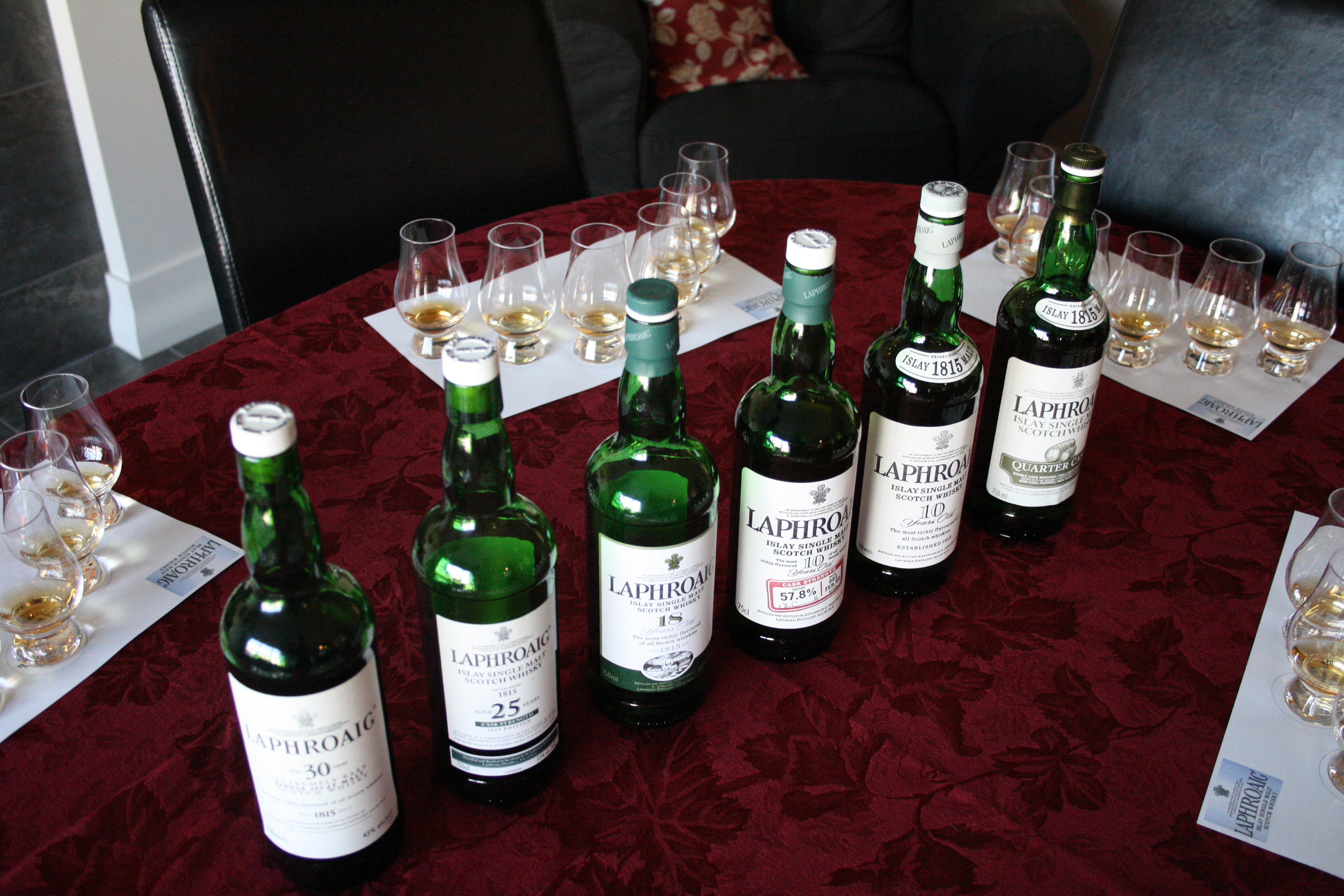
Without further ado, a few members of The Collective gathered to pay homage to the might bog beast…


Laphroaig


Laphroaig Quarter Cask – 48% abv

Nose:  Playfully youthful.  Smoky and raw.  Briny and citric.  Sharp and prickly.  Earthy and woody.  Anise.  Sweet peated barley.

Palate:  Dry earthy peat.  Baker’s chocolate.  Smoke and dirt.

Finish:  Drying and earthy with burnt wood.  Lingering and large.

Assessment:  One of the best young whiskies on the market.  Absolutely epitomizes the Laphroaig profile.


Laphroaig 10 y.o. – 43% abv

Nose:  Green apple.  Smoked peach.  Grains.  Weed-like pungency.  Jolly Ranchers.  Fruity soap.  Crab apple jelly.  Seaside froth.  Tarry.

Palate:  More Jolly Ranchers candy, but stale and short of the fruit promised on the nose.  Thick barley and green grass.

Finish:  Mouthcoatingly oily and dense.  Surprising for 43%.

Assessment:  Much better than the old 40%’er, but still falls just a hair short in a stable full of brilliant expressions.


Laphroaig


Laphroaig 10 y.o. Cask Strength – 58.7% abv

Nose:  Smoke.  Brine.  Crème brulee.  Cacao.  Pink chewing gum.  Honey and white chocolate.  Mild spice.  Cured meat.  Charcoal ash.  Floral minty tones and a hint of pickle.

Palate:  Green grass.  Kippers and anise.

Finish:  Very drying with tobacco and clean smoke.

Assessment:  Yes!  Chock full of nifty notes and nuances, surprisingly none of which are buried by peat or alcohol.


Laphroaig 18 y.o. – 48% abv

Nose:  Orange and chocolate.  Cedar.  Fruity.  Heavy vanilla and black licorice flavored jujubes.  Pear drops.  Sambuca and fruit bowl with dominant bananas.

Palate:  Poached and caramelized white fruits.  Floral smoke.  Some dark chocolate and Worther’s Originals.

Finish:  Drying with tobacco and clean smoke.

Assessment:  Mild and overwhelmed by the others in this range.  When not stacked up against scorching young peat, cask strength aggression or the untouchable austere beauty of the 30 year old, this is a phenomenal dram.  Sadly…it was nearly lost tonight.


Laphroaig 18 y.o. SMWS 29.72 “Not Pink and Fluffy”– 54.5% abv

Nose:  Buttery.  Sharp sherry.  Nut.  Syrupy.  Maple smoked bacon.  Fishy.  Red berry fruits.  Dried tobacco.  Fruit leather.

Palate:  Treacle and bacon.  Cigar smoke.  Nutty and leathery notes with more fruit leather.

Finish:  Bacon.  Caramelized brown sugar.  Brine and cigar leaf.

Assessment:  Just moving towards subtle maturity.  A very unique and atypical cask.  The dominant ‘breakfast’ notes in this one are almost a caricature.  Neat…not bad…not a favorite.


Laphroaig 25 y.o. Cask Strength – 51% abv

Nose:  Smoke.  Licorice.  Pepper.  Iodine.  Lime.  Orange.  Chocolate and caramel.  Dry hay.  Green and weedy.  Cream toffee.  Soft melon fruits.  Fishy.  Vanilla cream-filled chocolates.  Coconut rum and canned pineapple.

Palate:  White chocolate and macadamia nut cookies.  Dark chunky peat.  Hard dark chocolate.  Spotted dick and honey.  Fleeting glimpse of red licorice as it first crosses the palate.

Finish:  Honeyed and creamy.  Lingering melon.

Assessment:  Oh my.  This is it.


Laphroaig 30 y.o. – 43% abv

Nose:  Peach and melon.  Tar and rubber.  Citrus.  Blueberry.  Fruit compote.  Cask dust and wood influence.  Waxy.  Cherry.  Wisps of smoke…but much mellowed.  Cream and maple syrup.

Palate:  Creamy and fruity.  Burnt fruits.  Warm scones and homemade butter.  Soft and oily.  Dried apricots and other fruits.

Finish:  Drying with more fruits and honeyed melon.

Assessment:  Swirling depths of flavor.  Keeps changing in a myriad of fruits and complexities.   One could get lost in this one.  Best of the bunch and absolutely exudes sexy maturity.


Tasting notes courtesy of the Collective.


Until next,

– ATW

Compass Box – The Building of an Empire

Compass Box – The Building of an Empire


The Compass Box empire, like many others throughout history, has been built upon the bedrock of ideas bigger than those its competition.  And like any empire keen on expansion and growth, it has smashed boundaries and razed the old infrastructures to the ground.  This type of forward-thinking and innovation is the stuff most often met with extreme resistance at first, and often made lore in years to come.  Generally a movement such as this is led by an individual of character and charisma.  (I hasten to add, he/she is sadly often martyred!  Thankfully we live in slightly more…forgiving…times.)

As emperor of this young empire, John Glaser now finds himself lording over legions from the far-flung regions of Scotland.  He has taken these small holdings and merged and bent them to his benevolent will.  Fortunately, after a few bitter early battles, John’s vision has been met with not only acceptance, but accolade.

Upon the backs and genius of distillers from all corners of Scotland, Glaser has risen with a new force of daring and might.  This young empire shows no sign of slowing its forward march and progression through the ages.

In honor…ATW takes a brief survey of some of the breeds that make up the Compass Box empire:


Photo courtesy of Pat


Asyla – 40%

Nose:  Oak, and vanilla.  Lilac, heather and honey.  Orange.

Palate:  Silky delivery of vanilla and firm grains.  Light fresh fruit.

Finish:  It is the woods that linger.  …But not overly long

Assessment:  Mild and beautifully balanced.  Hints of a very mild and aged Laphroaig (?!?  I know!).  While exceptional and unique, still epitomizes Scotch whisky.  Great beginner’s malt.  Would make an excellent aperatif dram as well.


Photo courtesy of Pat


Oak Cross – 43%

Nose:  Touch of spice.  Mild and homey sweetness.  Toasted grain.  Strong vanilla bean and lavender.  Citrus rind.

Palate:  Depth of wood notes and oak-infused flavors.  A touch of dry tartness.

Finish:  Sweet, but still spicy.  Dries toward the back.

Assessment:  Any day…any time.  Nowhere near the best of the bunch, but that only speaks to the quality of the others…not any lack in this expression.


Photo courtesy of Pat


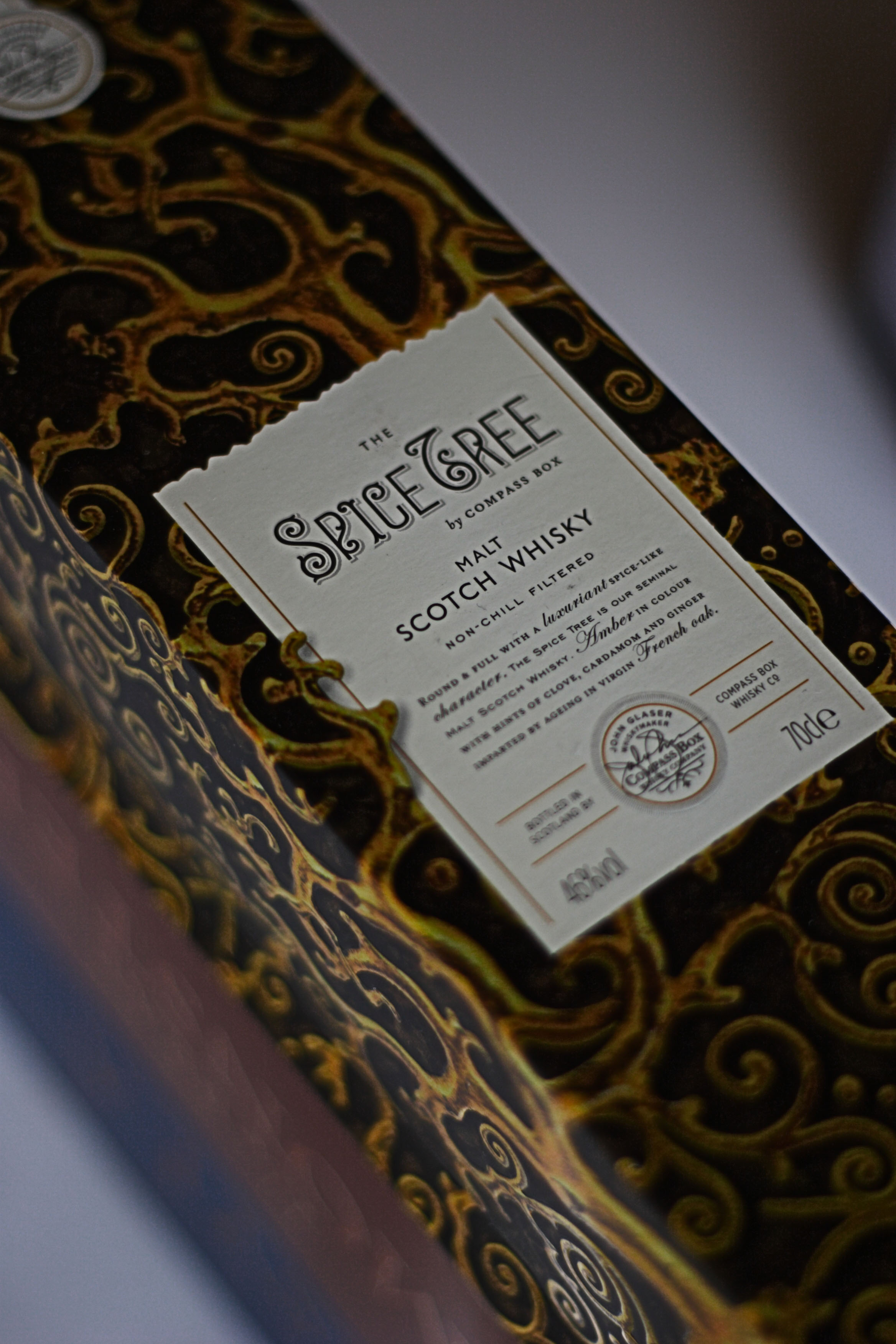
The Spice Tree – 46%

Nose:  Wham!  This is brilliant!  Clove.  Spiced cranberry.  Caramel.  Warm and worn-in leather.  Bold and creamy and nearly perfect.

Palate:  Hint of malted barley.  Fruit skins and toffee.  Cinnamon spiced apples.

Finish:  Apple skin and sucking on a cinnamon stick.

Assessment:  Best of the Compass Box line-up.  Primarily from Clynelish, they say.  This has more in common with Brora than contemporary expressions of Clynelish.  Sexy…sexy…sexy!


Photo courtesy of Pat


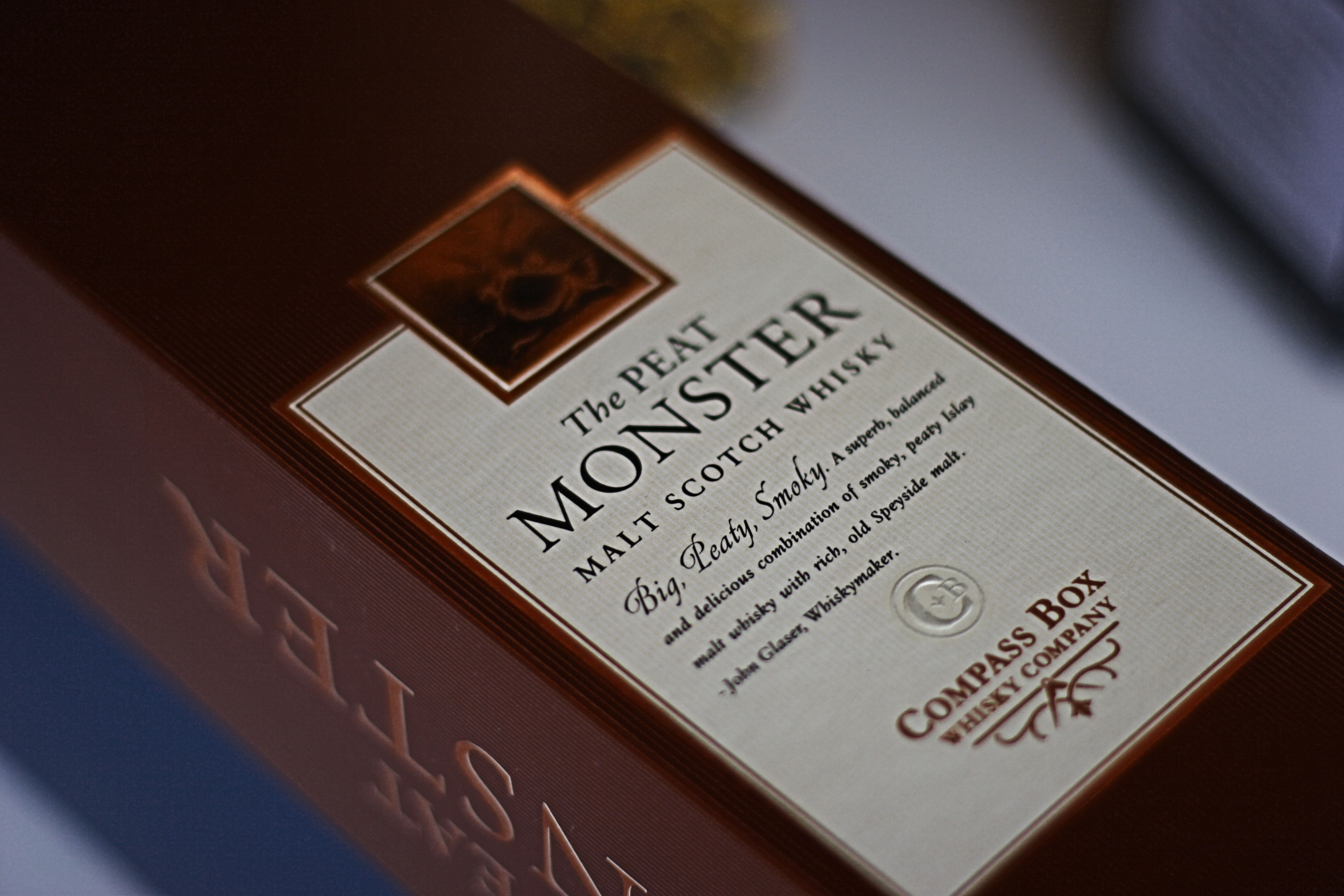
The Peat Monster – 46%

Nose:  Sharp tangy Islay bog.  Deep salty smoke and peat.  Iodine and seawater.  Malty.  Lime and kiwi freshness.  Young mashtun notes.  Touch of vanilla snaking through.  Like smoldering vegetation.

Palate:  Smoke, iodine and fruit skins.  Rich and oily.

Finish:  Lingering smoke, tartness and…yeah…smoke.

Assessment:  Seems feisty and young, though apparently all malts within are 10-16 years.  A little sharp.  Not quite my idea of perfect balance, but great nevertheless and very well-made.  An improvement on the Peat Monster of old.


Photo courtesy of Pat


Flaming Heart – 48.9%

Nose:  Pungent peat (but not Islay peat at the heart…most certainly from the Ardmore).  Tangy.  Floral and vegetal.  Slight peppery bite.  Hint of pear.  Coastal and tarry (Caol Ila, anyone?).  Slightly bread-like and yeasty.  Grains and malt.

Palate:  Malty.  Smoky.  Nutty.  Peaty.  Delivers briny oakiness.

Finish:  Vanilla and dry wood dominate the finish.  Yes…with fading smoke.

Assessment:  Good, but…I hoped for a wee bit more.  Thankfully…I still have a fresh bottle set aside for rainy days.


Hedonism Maximus – 46%

Nose:  Rich in sweet toffee grain.  Almost rye-like.  Sweet bourbon.  Fresh orange intensity.  Lightly buttered baking.  Creamy.  Mild nutmeg and cinnamon.  Strata of vanilla.

Palate:  Bourbon-like delivery.  Buttered caramel and oak.  Sweet and chewy like crunching down on freshly picked grain.

Finish:  Drying and fruity.  Subtly…manipulatively…charms its way into staying for a while.

Assessment:  Lovely.  Nose is exceptional.  Palate…quite good.  Would have loved to try this side-by-side with the other Hedonism.  This is aged grain as it is meant to be presented.  Brilliant.


Photo courtesy of Pat


– All notes:  Curt

Bruichladdich – Legacy

BRUICHLADDICH TASTING

LEGACY SERIES – ONE TO SIX / DNA 1&2 / 40 YEAR OLD


What does LEGACY mean as its applies to this series of whiskies tasted?  We, the gang of four (almost the gang of three, after a heated debate over scoring) set out to answer this question.  Tempers were stemmed after one of the gang of four reminded us that burying a body in the ground might prove to be difficult after one’s been drinking.

The Legacy here is in the stock of whisky laid down prior to the distillery being mothballed in 1994.  And in the stillmen who worked there before the production went silent.  Stillmen like Neil MacTaggart, who started at Bruichladdich in 1970; Duncan McGillivray in 1974 (sorry for breaking your sod cutter/lifter back in 2008); and Duncan MacFadyen in 1989, who came back in 2001 to continue production.  The Legacy is also in the rich history, starting with the brothers William, John and Robert Harvey who built the distillery in 1881, up on the bank near the shores of Loch Indaal and named it as such.

I believe that the distillery workers and the owners of Bruichladdich, past and present, collectively set out to make the FINEST SPIRIT that could be made, as they draw great pride (also daily drams) from their jobs.  This legacy quote from Woodrow Wilson summarizes how I feel about whisky making:  “You are not here merely to make a living.  You are here to enable the world to live more amply, with greater vision, and with a FINER SPIRIT of hope and achievement.  You are here to enrich the world.  You impoverish yourself if you forget this errand”.

What is the future of Bruichladdich and the continued  legacy of this great establishment?  It is no secret that Andrew Grey is no longer working for the distillery, rumors of a sale persist, an unwelcome recession has hurt cash flow, along with delaying plans to start up a second distillery at Port Charlotte and criticism still abounds over the amount of expressions on the market.  But people come and go, every distillery sells sooner or later, the economy will rebound and having a greater choice in your whisky section is always a good thing.  If the current ownership were to sell (PLEASE, JUST NOT TO DIAGEO!!!) the legacy left behind by Andrew Grey, Jim McEwan (please never stick your finger in my whisky glass again), Mark Reynier, Simon Coughlin and the other thirty plus owners and employees, would be tasted for years to come and all the innovation and hard work would be realized by both the future owners and by us, the whisky drudges and judges.


LEGACY #1   –   36 YEAR OLD  40.6% ABV BOTTLED 2002 BOTTLE #896

NOSE:  Honey, butter, floral, fruity.

TASTE:  Cinnamon, raspberry/strawberry.  Very sweet.

FINISH:  Medium to long.  Tad briny.

ASSESSMENT:  Nice and pleasant to drink.

RATED:  #5 of the six Legacy series and #8 overall


LEGACY #2   –  37 YEAR OLD 41.8% ABV BOTTLED 2003 BOTTLE #972 OF 1500

NOSE:  Punchy peach.  Grassy.

TASTE:  Sweet, nutty.

FINISH:  Medium, little dry.

ASSESSMENT:  Worn down by age.  I think I can taste Jim McEwan’s finger in this one.

RATED:  #6 of the Legacy series and #9 overall.


LEGACY #3  –   35 YEAR OLD 40.7% ABV BOTTLED 2004 BOTTLE #206 OF 1572

NOSE:  Butterscotch, very creamy.  Fruity.

TASTE:  Almost tropical.  Chewy.

FINISH:  Great long smooth finish.

ASSESSMENT:  Reminds me of eating fresh strawberries with clotted cream at Wimbledon.

RATED:  #1 of the Legacy series and #3 overall.


LEGACY #4  –    32 YEAR OLD 47.5% ABV BOTTLED 2005 BOTTLE #129 OF 820

NOSE:  Apples & raisins.  Spices.

TASTE:  Honey. Botanicals.  The sweet honey coats your tongue.

FINISH:  Long and warming.

ASSESSMENT:  Like drinking liquid gold.  Similar to the 1970.

RATED:  #4 of the legacy series and #6 overall.


LEGACY #5   –   33 YEAR OLD 40.9% ABV BOTTLED 2006 BOTTLE # 993 OF 1690

NOSE:  Oaky.  Caramel and almonds .  Apricots.

TASTE:  Very demure.  Sweet.  Licorice.

FINISH:  Creamy.  Medium.

ASSESSMENT:  Not a bad expression of an older Bruichladdich.

RATED:  #3 of the legacy series and  #5 overall.


LEGACY #6   –   34 YEAR OLD 41.0% ABV BOTTLED 2007 BOTTLE #170 OF 1704

NOSE:  Light and dark fruits.  Honey and mint.

TASTE:  Cream.  Cherries and cinnamon.

FINISH:  Medium and very light.

ASSESSMENT:  Completely lip-smacking.

RATED:  #2 of the legacy series and #4 overall.


DNA #1   –   36 YEAR OLD 41.0% ABV BOTTLE #673 BOURBON & SHERRY CASKS  FROM SIXTIES & SEVENTIES FINISHED IN CHATEAU LE PIN WINE CASKS

NOSE:  Candied cherries.  Floral and some honey.

TASTE:  Vanilla, milk chocolate.  Raisins.

FINISH:  Long.  Little dry.  Fades gently at the end.

ASSESSMENT:  What a great drink.  Could drink this all day long.

RATED:  #1 of the DNA series and #2 overall.


DNA #2  –   32 YEAR OLD 47.4% ABV DISTILLED 1977 BOTTLED 2009 BOTTLE # 385 OF 844

NOSE:  Musty.  Spearmint.  Butterscotch.

TASTE:  Licorice.  Chocolate.  Nutty.

FINISH:  Crisp and long.

ASSESSMENT:  Nice drink to savor.

RATED:  #2 of the DNA series and #7 overall.


40 YEAR OLD  43.1% ABV  DISTILLED OCTOBER 24 , 1964 BOTTLED 2004  BOTTLE #230 OF 550

NOSE:  Minty fresh bourbon.  Farmy.  Ripe melons.

TASTE:  Tropical and much more.  Creamy.

FINISH:  Long and enjoyable.  Bit briny at the end.

ASSESSMENT:  Number one favorite of the night.  Best expression of Bruichladdich I have ever tasted.

RATED:  #1 overall.


*Please, Bruichladdich, buy back as many privately owned casks as you can find, to bottle more of the 40 year!

It seems that whenever  it comes to Bruichladdich, for every action there is an equal and opposite criticism, more so than any other Distillery.


– Maltmonster

Maker’s Mark – The Charm of a Southern Belle

The Charm of a Southern Belle

Deep in the heart of Kentucky, on the banks of Hardin’s Creek, there rests a tiny little burg called Loretto.  Aside from downhome charm and quaint Southern beauty, this Marion County ‘city’ offers the world something equally full of heart and character.

That something is Maker’s Mark bourbon.

At once steeped in tradition and forging new paths, the Maker’s distillery is a veritable treasure in the American whiskey scene.  The distillery has been producing in its current incarnation since 1954, though under other guises production on site began as early as 1805.

The bourbon we know today is one of premium prestige and affordable approachability.

Maker’s characteristic sweetness, heft (45%) and spice have made it a household name globally, while the bourbon’s unique mashbill (70% corn, 16% red winter wheat and 14% malted barley) allows us a drink that sparkles like a gem in the formidable gold setting that comprises the Kentucky Bourbon Trail.

The classy addition of the red wax dipped neck makes this a bourbon sans compare.

One final personal bias I have to add…any bourbon known as a ‘whisky’ and not a ‘whiskey’, for some inexplicable reason, also scores an extra point or two from this guy.


Maker’s Mark – New Make Spirit

Details:  Clear as a virgin’s conscience.  ABV unknown.  AKA ‘white dog’ as American new-make spirit.

Nose:  Big raw grains and orchard fruit.  Mild waxy notes.  Somewhat plastic.  Foot-like and alcoholic.  Lacks the rich fruity dessert notes of mature Maker’s, but the shadow is there.

Palate:  Cherry lip balm and grain liquor.  Raw and footy.  Definitely needs wood influence.  The potential is barely recognizable (again…just hints).  Finish is primarily corn.

Verdict:  A little aggressive.  Not in terms of alcoholic bite or anything, but in a somewhat cloying foot odor that is hard to get around.  The spice, vanilla and fruit that so characterizes Maker’s Mark is obviously not here yet due to the lack of wood influence.  There is something almost plastic-like in this ‘just off the still’ juice.  Not for the faint-hearted.


Maker's Mark Original Red Seal


Maker’s Mark – Original Red Seal

Details:  Aged between 6 and 7 ½ years.  Rich honeyed-amber color.

Nose:  Honeyed fruit.  Corn and oak.  Rich cherry spice and creamy dessert notes.  Hint of toffee and vanilla.  Mild Cacao.  Wax (think lip balm).  Just a hint, fleeting, of something sharp and green.

Palate:  Oak carries vanilla and spices.  Hint of mint.  Honeyed grains and cherry.  Finish is corn/grain and oaked cherry.

Verdict:  Biggest fruity notes of all.  Deep and mysterious.  Charming as hell.  The fruit marries oh so well with the spice and wood and the vanilla tempers everything beautifully.  A must have in any whisky cabinet, methinks.


Maker's Mark 46


Maker’s Mark – 46

Details:  Starts off as standard mature Maker’s Mark aged 6 to 7 ½ years.  Seared oak staves are inserted into the cask to add a caramelized sugar depth before the cask is resealed to mature for a few months longer.  The ‘46’ refers to the batch experiment that finally ‘made the cut’ so to speak.

Nose:  Wax (lypsyl).  More caramel and vanilla than standard Maker’s, and a touch less fruit.  Healthy hint of maple.  Fruity, but less cherry than I would expect from this distillery.  Dusty corn.  Vanilla and a mild nutmeg.

Palate:  Spiced corn and youthful fruit.  Fades into throbbing popcorn and fruit-tinged finish.  Oak holds on a little too.

Verdict:  Beautiful variant on the Maker’s Mark standard.  Better?  In terms of composition…perhaps a touch.  In terms of enjoyment…hmmm…tough call.  More mature and mellow anyway.  Even a few more months in wood in the Kentucky clime allows for a more mature spirit.


Southern Beauty


– Notes:  Curt

          – Photos:  Pat (www.standstillphotography.ca)

1972 Glendronach

TASTING OF TWO  1972 GLENDRONACH
CANADA & SWEDEN


In order to try a repair the rift that exists between Canada and Sweden over the 1994 Olympic games, after  Sweden took the gold medal in hockey from us in an overtime shootout and then went on to make a postage stamp with the winning goal on it, I thought it would be appropriate, as sign of good faith, to do tasting notes in both official languages.  Please excuse my heartfelt
attempt to translate these notes properly, as some of the meaning might be lost in the translation.


1972 CASK # 718   38 YEAR OLD 51.5% ABV  BOTTLE # 313 OF 396
MARCH 2 1972 – JUNE 2010.  OLOROSO SHERRY BUTT.

NOSE: Oranges.  Varnish.  Coffee bean and lavender.  Raspberry.  Burnt butter.

“Potatis, köttbullar, sill.”

TASTE: Dark chocolate.  Bitter tannins.  Black pepper and mint.

“Färgade smaksatt vodka.”

FINISH: Long and warming

“Längre än Tiger Woods marrigae löfte.”

ASSESSMENT: Good expression of Glendronach, but it’s hard to get past that one off note of varnish on the nose.

“Detta är bättre än Dolph Lundgren är en skådespelare och mindre störande än att sätta ihop Ikea-möbler.”


1972 CASK # 711 39 YEAR OLD  ABV – CASK STRENGTH,  ADVANCE SAMPLE FOR KENSGINGTON WINE MARKET.  OLOROSO SHERRY BUTT.

NOSE: Fruit explosion.  Pineapple, bananas, mango, melons, cherries and oranges.  Cocoa and mint.

“Kål renar, inlagd sill.”

TASTE: Melons and prunes.  Tannins from the sherry.  Raisins, coffee and cinnamon.

“Färgade smaksatt vodka.”

FINISH: Long and fantastic.  Begins creamy & spicy, then warms up and fades gently.  Little briny at the back end.

“Ungefär lika länge som en Abba-musikalen.”

ASSESSMENT: Complex and balanced older sherry fruit bomb.  What a nose!  Would put this whisky right between the Black Bowmore and the Glenfarclas 40 year old.

“Detta är whisky att Sedin tvillingarna skulle ha firat med om de hade visat upp och spelade i sista matchen i Stanley Cup-finalen.”


– Sincerely, Maltmonster

ODE TO BLACK BOWMORE

ODE TO………………BLACK BOWMORE


Once upon a midnight dreary, while I pondered, weak and weary,

Over many a quaint and curious whiskies of forgotten lore,

While I nodded, nearly napping, suddenly there came a tapping,

As of someone gently rapping, rapping at my liquor cabinet door.

“‘Tis some visitor,” I muttered, “tapping at my liquor cabinet door

Only this, the famous Black Bowmore.”


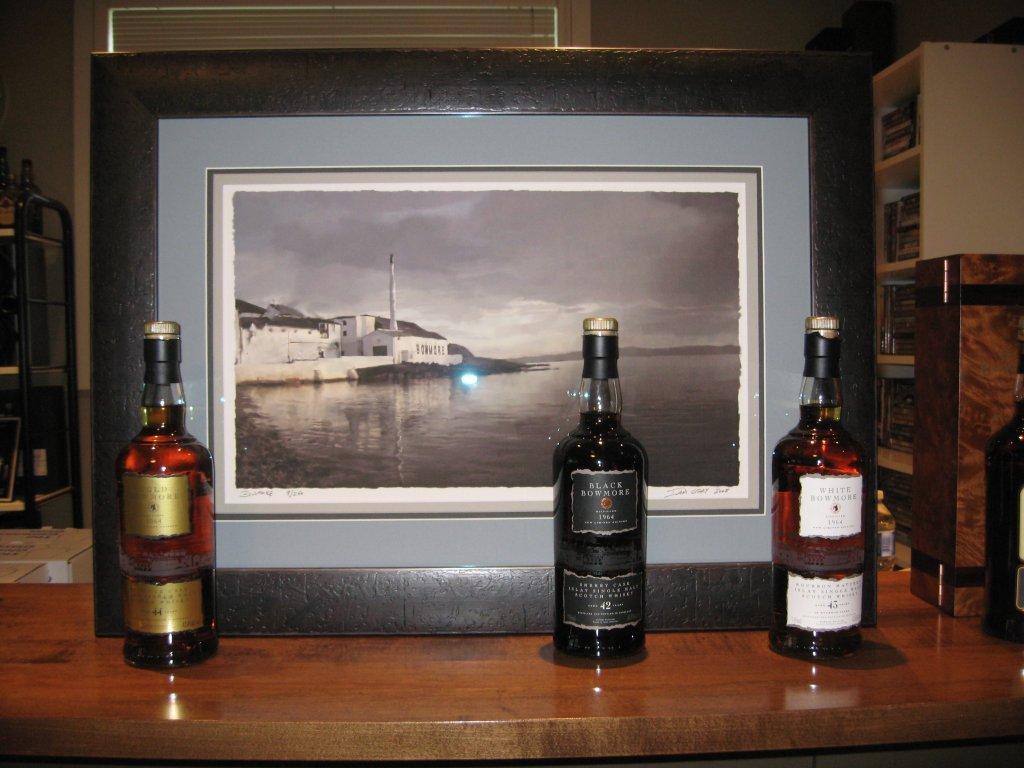
To honor the famous Black Bowmore we gathered together again, the infamous gang of four, to taste this thing of lore.

Some of us have tried the Black Bowmore, along with the White Bowmore and the Gold Bowmore, but never have any of us tried all three together in a vertical tasting.  We also had a chance, due to one generous sole in our infamous gang of four, to try some older, and equally as good, Bowmore.

So on a wet and dreary night in June we banded together to taste and ponder a few Bowmore and nothing more…


15 YEAR OLD  MARINER SCREENPRINT LABLE  43% ABV  BOTTLED
APPROXIMATELY 1994  2ND  RELEASE  OF THE 15 YEAR OLD

NOSE: Oranges and burnt toast.  Marzipan.  Fudge.

TASTE: Peat.  Little fruit.  Briny and creamy.

FINISH: Medium to long.

ASSESSMENT: Great expression of a younger Bowmore that was outstanding.  Only wish the younger Bowmore of today could be as good.


21 YEAR OLD 43 % ABV   PHASED OUT  FOR THE 25 YEAR OLD

NOSE: Big old fat juicy peach.  Strawberries and Cherries.  Honey.

TASTE: Peach & cream in harmony.  Buttery.  Little mint.

FINISH: Medium.  Wee bit a salt at the very end.

ASSESSMENT: Little peat or brine at this age.


25 YEAR OLD 43% ABV  BLUE MOONLIGHT OVER BOWMORE  & SEA
GULLS CERAMIC BOTTLE

NOSE: Light tropical fruit.  Coffee and dark chocolate.  Bit floral.

TASTE: Toffee.  Licorice.  Infused dark fruits.  Pomegranates.

FINISH: Medium to long.  Fades away nicely.

ASSESSMENT: Rich and complex drink.


30 YEAR OLD 43% ABV BLACK SEA DRAGON CERAMIC BOTTLE

NOSE: Tropical fruit, but less than the 25.  Oranges, cherries, melons and apples.  Oaky and maybe a bit of charcoal.

TASTE: Cherries and sherry cask imparted spice.  Marzipan.  Mint and dark chocolate.

FINISH: Medium to long.  Brine arrives at the end.

ASSESSMENT: What a great bottle and great expression of a fruity Bowmore.  I remember they had a hard time selling these for less than $200 in Calgary back in 2002, If I had only bought more.


34 YEAR OLD 1971 51% ABV  BOTTLE # 761 OF 960

NOSE: Earthy.  Coffee beans.  Tobacco and dark chocolate.

TASTE: Nutmeg.  Spicy sherry notes.

FINISH: Medium to long.

ASSESSMENT: Probably mixed one bad cask with a good one or two to hide it.


37 YEAR OLD  1968 43.3% ABV  BOTTLE # 683 OF 708

NOSE: Tropical fruit explosion!  Grapefruit & orange.  Minty sweet Bourbon.

TASTE: Again you get pleasantly assaulted by the tropical fruit.  Bananas.  Little spice and Briny.

FINISH: Long.  Absolutely no peat.  Fades nicely with a little salt at the end.

ASSESSMENT: Nose is in the Black Bowmore range.  Incredible whisky, was not prepared for how good this was.


42 YEAR OLD 1964 40.5% ABV  BOTTLE # 668 OF 827 BLACK BOWMORE
BOTTLED 2007,  4TH AND FINAL RELEASE , VATTED FROM ONLY OLOROSO CASKS

NOSE: Fruit bomb!  If you can think of the fruit, you can find it in this five alive fruit cocktail.  Milk chocolate.  Coffee bean.
Minty and little vanilla.

TASTE: Oranges & cherries.  Dark chocolate.  Licorice.

FINISH: Long and fades nicely with the memory of the nose.

ASSESSMENT: They state it was a vatting of Oloroso casks from 1964, but methinks that there is a possibility that maybe a bourbon cask was dumped into the sherry cask, as there is some sweet hints of vanilla.  The wow factor maybe in order here. What a nose.  This whisky could bring any rum child to instant conversion into a whisky man or woman.


43 YEAR OLD 1964 42.8% ABV  BOTTLE # 673 OF 732 WHITE BOWMORE, BOTTLED 2008 , VATTING OF SIX BOURBON CASKS

NOSE: Tropical fruits, but much more subtle.  Floral.  Winey notes.  Little oaky.

TASTE: Overwhelming amount of fruits.  Vanilla.  Oaky and dry.

FINISH: Long.  Very smooth and enjoyable.

ASSESSMENT: Past its prime.  Would have been better to bottle this a few years earlier.


44 YEAR OLD 1964 42.4% ABV BOTTLE # 156 OF 701 GOLD BOWMORE ,
BOTTLED 2009 , VATTING OF BOURBON AND ONE OLOROSO CASK

NOSE: Melons, cherries and oranges.  Vanilla.  Touch of smoke.

TASTE: Complex.  Nutmeg and sharp ginger.

FINISH: Medium to long.  Brine shows up at the very end.

ASSESSMENT: Rich full nose.  The most balanced of the three (Black, White and Gold) releases.


The number one rated whisky of the night was the Black Bowmore, the second (was also the first choice of some of the gang) was the 37 year old from 1968, followed by the Gold, then the White and 30 year old.

I know the Black Bowmore was meant to be drank, but I can’t help feeling sad, that once the cork is open you are obligated to finish the bottle within a reasonable period of time, and after this bottle is drained of its contents, the Black Bowmore shall be Nevermore …………….. (Good thing we have a spare bottle)


– Nothing More, Maltmonster

Glenrothes: A Tasting Through The Seventies

GLENROTHES

 A TASTING THROUGH THE SEVENTIES

Two from 1972, 1973, 1974, 1975, 1978, Three from 1979 and John Ramsay (73-87)


1969 saw the zenith of man’s achievements in Apollo 11, Whisky and Woodstock.  Enter the seventies.  Whisky is booming and single malts are starting to become popular, but great rock stars like Janis Joplin, Jim Morrison and Jimi Hendrix are removed from the collective genius that is rock.  Whisky and Rock are still at the top but ,like a foreign species invasion, disco and rum are emerging in the void created by the passing of rock superstars and the break up of so many great rock bands.

An Irish political philosopher, Edmund Burke, said it best with this variant quote “All that is necessary for the triumph of evil rum is that good whisky makers do nothing”.  Fortunately distilleries like Glenrothes continued to produce fantastic whiskies throughout the seventies.  This foresight by Glenrothes to continue the production of great whiskies allowed rock music to once again flourish into the eighties and undo the devolution which was the stain of the late seventies caused by the intoxicated rum driven disco craze.

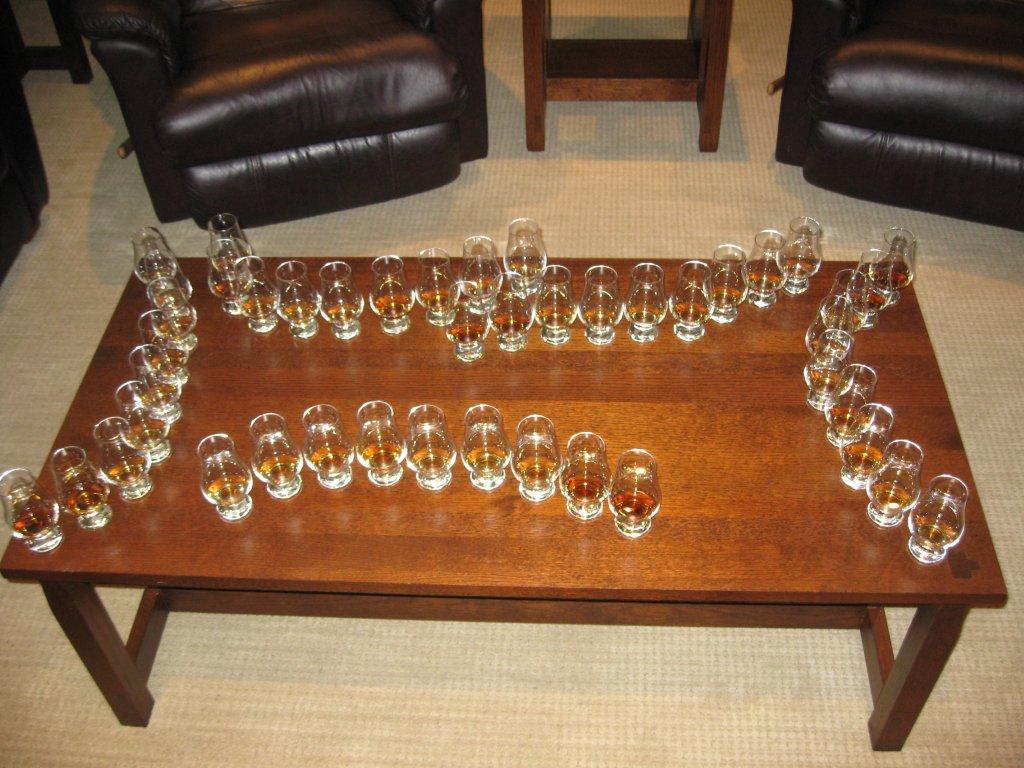
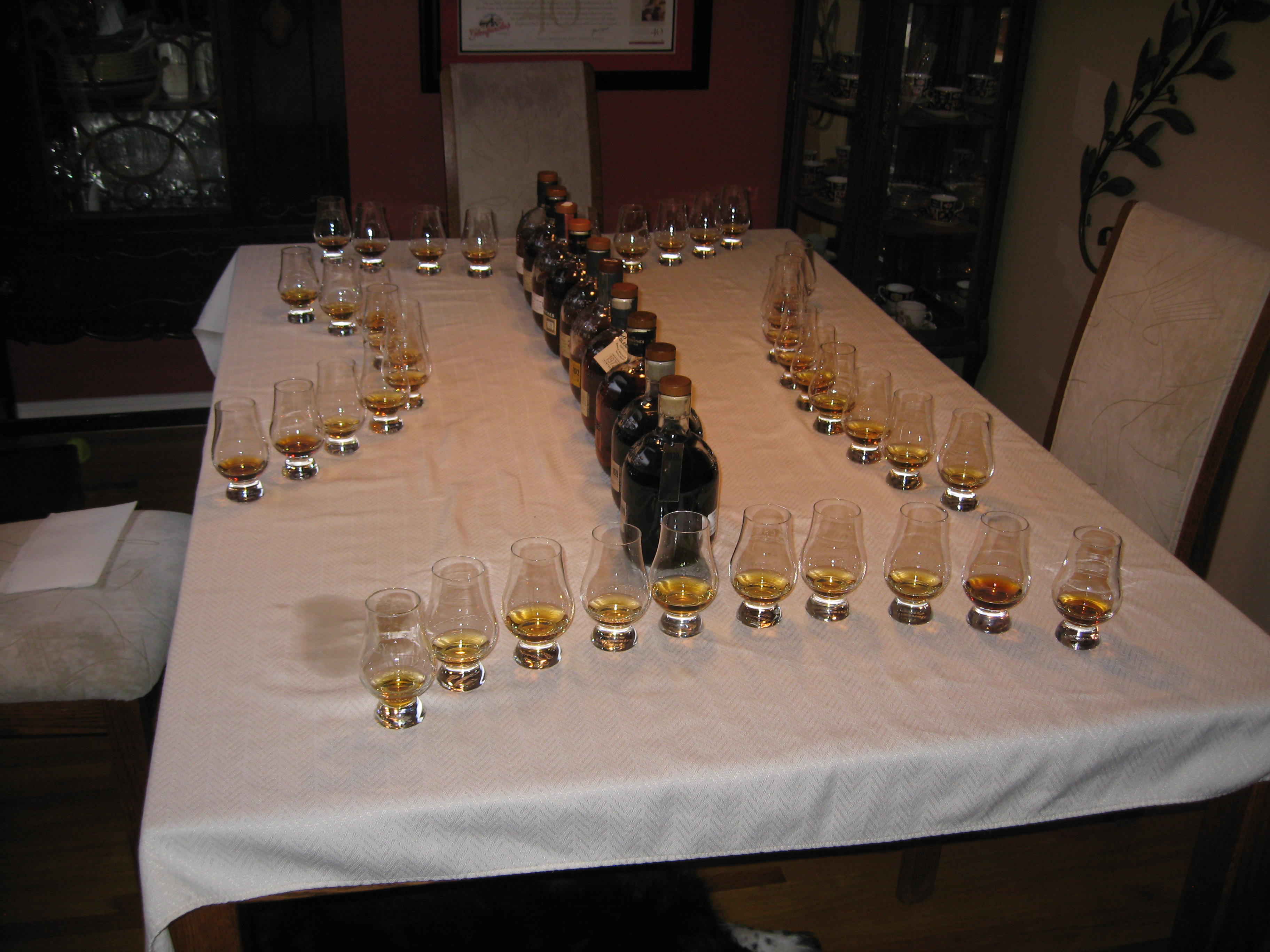
To honor Glenrothes for their contribution towards the demise of disco the ‘gang of four’, named after a failed attempt to take control of Diageo a few years ago, sat down to a tasting of ten seventies Glenrothes malts.  Eight of which were elegant and floral and two sherry bombs.  We found all the malts enjoyable and very similar (excluding the two sherry bombs), but only noted our top four.

1972 Restricted Release November 2, 1972 – March 26, 1996 43% ABV 

NOSE:  Tropical fruit, honey and spice.

TASTE:  Chewy, dark chocolate, hazel nuts.

FINISH:  Medium – long.

ASSESSMENT:  I need you, by me, beside me, because when you’re bad, you’re so so good.  Run away favorite and number one of the night.  Rumor mill – this was removed from Canada because of the levels of carcinogens in the malt. Observation -why is it that every time I like something it’s bad for me?!

1972 Limited Release December 5, 1972 – March 29, 2004 43% ABV Bottle # 05091

NOSE:  Eucalyptus, apples, herbal.

TASTE:  Pears, vanilla and dark chocolate.

FINISH:  Short to Medium.  Bit oily.

ASSESSMENT:  Now it’s all right, it’s ok, just not a good as the other 1972.

1973   March 16, 1973 – July 5, 2000 ABV 43%

NOSE:  Ripe oranges, pears and honey.

TASTE:  Raisins, toffee.  Bit oaky.

FINISH:  Medium.  Very dry.

ASSESSMENT:  Won’t you take me to funky town.  Not in the top four, but has some nice qualities.

30 Year Old Limited Release August 15, 1974 – November 8, 2004 50.2 ABV # 967 of 1134 Bottles

NOSE:  Oranges, cherries and honey.

TASTE:  Citrus, vanilla and almonds.  Malty.

FINISH:  Medium.  Uber elegant

ASSESSMENT:  Oh, that’s the way; uh-huh uh-huh I like it, uh-huh uh- huh.  It really is a wonderful malt and finished in the top four.


1975 Vintage Release August 1975 – April 25, 2006 43 % ABV Bottle # 1581 of 3708 Bottles

NOSE:  Toffee, cherries, honey.

TASTE:  Coffee bean, nutty.

FINISH:  Medium. Very soft.

ASSESSMENT:  Looking for some hot stuff baby this evening.  Just finished out of the top four.

1978 Vintage Release November 3, 1978 – July 1, 2008 43% ABV 

NOSE:  Floral, jammy, cherries and vanilla.

TASTE:  Spicy, apples and marzipan.

FINISH:  Medium.  Soft for the nose and very drinkable.

ASSESSMENT:  There’s a party going on right here.  Finished in the top four.  Could sip this malt all night long.

1979 General Release November 24, 1979 – February 13, 2002 43 % ABV 

NOSE:  Grapefruit, oranges and floral.

TASTE:  Apples, sweet, red liquorice.

FINISH:  Medium to long. Warming and bit dry.

ASSESSMENT:  I love to love you baby.  Used to be one of my favorites when it was released, but fails to make the top four in this range taste.

John Ramsay  Legacy  46.7% ABV   # 1228 of 1400 Bottles Bottled 2009 .Vatted from 2nd fill American oak sherry casks from 1973, 1978 , 1979 , 1982 , 1985 , 1986 , 1987

NOSE:  Floral, ripe sweet oranges, vanilla and a trace of mint.

TASTE:  Grapefruit, nuts, malty.

FINISH:  Medium to long.  Demure and understated.

ASSESSMENT:  If I can’t have you, I don’t want no other baby. This is good stuff, hats off to the mad vatter. Finished second behind the restricted release 1972

1979 Single Cask # 13458 1979 – June 7, 2000 57 % ABV Bottle # 35 of 519 Bottles

NOSE:  Oranges, raisins, mellow spice, cinnamon and little sulfur.

TASTE:  Chewy, cappuccino.  Sticky sweet port.

FINISH:  Long and intense.

ASSESSMENT:  First I was afraid, I was petrified, kept thinking of the sulfur that Jim Murray had testified.  This, in my not so humble opinion, is not a wrecked cask.  Has less sulphur than cask #13459.

1979 Single Cask # 13459 1979 – May 4, 2006 56.6 % ABV # 96 of 492 Bottles

NOSE:  Sharp spice, sulphur, raisins, dark chocolate and bananas.

TASTE:  Robust and chewy.  Liquorice, raspberry jam.

FINISH:  Long.  Warming and very intense.

ASSESSMENT:  Burn baby burn.  Satisfaction came in a chain reaction of chewy spice and all things nice.

– Maltmonster

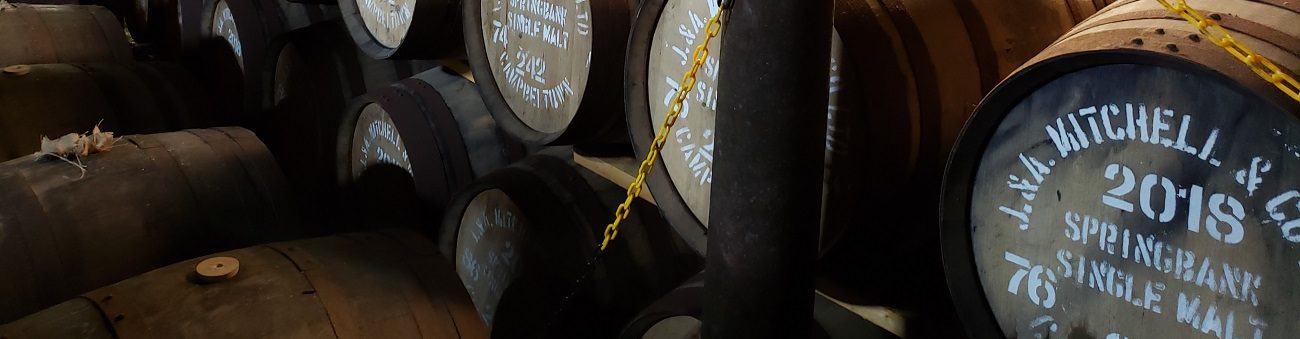
Springbank In Springbank

“SPRINGBANK   IN   SPRINGBANK”

1911 – 2011

IN MEMORY OF WILLY HARDY

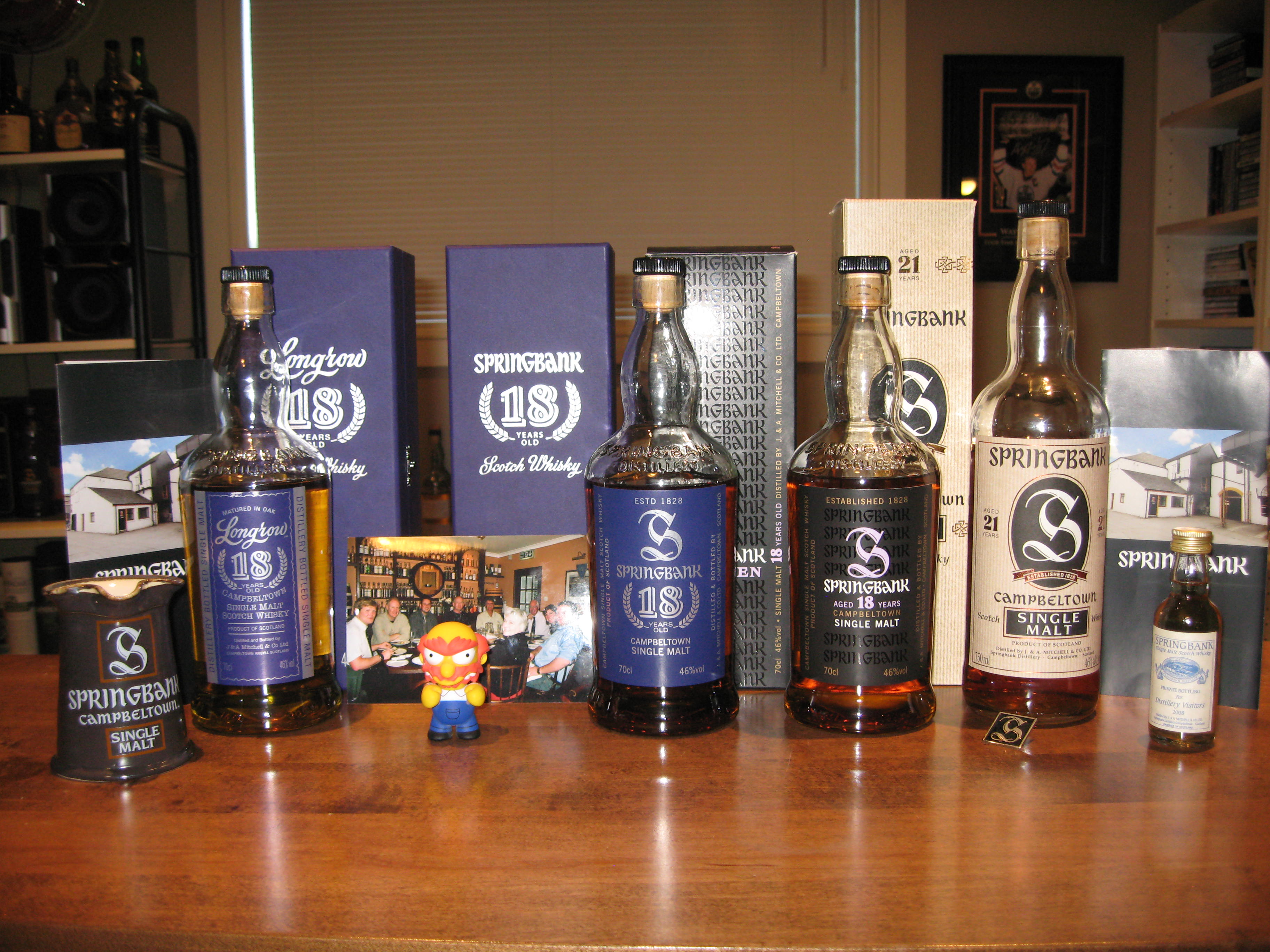
A TASTING OF SEVEN SPRINGBANK MALTS

SPRINGBANK –18 (2009), 18 (2010), 21, 25, 32, 40 SIGNATORY

LONGROW – 18

Legend has it that a Scotsman from Cambeltown, named Willy Hardy, a tarry-fingered lad wanting to escape persecution from the law, after a misunderstanding involving whisky ownership, is responsible for the community name of Springbank in Alberta, Canada.  Rumors told of Willy having a severe case of Kleptomania, and when it got bad he would be forced to take something for it.  Eluding the Scottish law, Willy immigrated to Canada in 1911.  After learning to speak English he settled aboot the foothills of the Rocky Mountains, between Banff and Calgary.  Lonely for his hometown, he decided to name his homestead in Canada ‘Springbank’ after the distillery that gave him so much pleasure and the motivation to move here.

Springbank has flourished since that time and is now a thriving community in which I call home.  To honor the legend of Willy we decided to have a range tasting of Springbank whiskies and celebrate this most important of anniversaries.

SPRINGBANK  18 YEAR OLD    OB    46% ABV.    Release 2009

NOSE: Cotton candy, fruit, cream and mild smoke.

TASTE: Candied apples, cream.

FINISH: Medium to long.

ASSESSMENT: This has been a much anticipated malt, which is to lead us back to the 21year old.  Please Springbank never run out of 21 ever again…or least in my life time.  Rated # 6 of six tasted

SPRINGBANK    18 YEAR OLD    OB    46% ABV.    Release 2010

NOSE: Citrus lemon & lime.  More floral than the first but not as much smoke.

TASTE: Bubblegum, spice and some liquorice.

FINISH: Medium. This finish seems to fade quite quickly.

ASSESSMENT: Not as good as the 2009 release (Don’t make us beat up Peter Currie when next he is in town).  Need to kick it up for the road back to the 21 year old. Rated # 5 of six tasted.

SPRINGBANK    21 YEAR OLD    OB    46% ABV.  Limited to 2,400 Bottles.

NOSE: Brown sugar, all fruits, cinnamon, milk chocolate.  Tender smoke.

TASTE: Citrus, mangos, cloves and other spices.

FINISH: Rich and warming, long, lip smacking.

ASSESSMENT: The royal flush of single malts.  Very complex and balanced.  This is the reason I drink single malts and not that cane juice.  Rated #1 of six tasted.

SPRINGBANK    25 YEAR OLD    OB    46% ABV.

NOSE: Citrus fruits, vanilla and more than a little oaky.

TASTE: Nutmeg and raisins.

FINISH: Medium to long and fades nicely.

ASSESSMENT: Bit of a let down after the 21, not as complex but is still a great malt. Rated # 4 of six tasted.

SPRINGBANK    32 YEAR OLD    OB    46% ABV.

NOSE: Very sharp varnish note dominates the nose.  After working this one we find coconut, lavender.

TASTE: Sweet, whip cream, fruits and little oily.

FINISH: Medium to long, lightly warming.

ASSESSMENT: The taste in this case is better than the nose but is still a very exceptional malt.  Rated #3 of six tasted.

SPRINGBANK (Signatory) 40 YEAR OLD     54.4% ABV.    1969 – 2009,

Single Sherry butt, cask # 263    356 Bottles.

NOSE: Exotic fruits, coconut, spice and all things nice.

TASTE: Burnt sugar, fruit explosion.

FINISH: Rich and warm.  Long and lingering.

ASSESSMENT: You really can find all the fruits in this malt.  Age has mellowed and enriched this whisky nicely.  Rating #2 of six tasted.

SPRINGBANK – LONGROW   18 YEAR OLD    OB    46% ABV.    2008 Release    Limited to 2,280 Bottles

NOSE: Infused smoke, apples and pears, caramel.

TASTE: Pepper, raisins, cigar humidor, liquorice.

FINISH: Long and zesty.

ASSESSMENT: Not rating this one with the other Springbanks as this needs to be rated against other Longrow or other peated malts.  Is another great product from the stills of Springbank.  Great to drink now, can’t wait until this hits 21 years as well.

– Maltmonster


“All of life is a dispute over taste and tasting” (Nietzsche)

Feature Interview – Mark Reynier of Bruichladdich

It is quite possible that Bruichladdich is my favorite distillery.  Though not the force behind my absolute favorite malts, they are responsible for many – and I mean many – that I absolutely adore.   The diversity of spirit produced and expansive cask selection allows for a palette (not to be confused with palate) of broad and stunning spectrum.  Armed with an arsenal of tools (great stills, brilliant wood and exceptionally clean spirit) and an unmatched artistic flare, Bruichladdich has managed to carve out an impressive niche and done so in the purest of fashions.  The distillery drives the local economy and community in way that puts the industry giants to shame (a topic I intentionally steered clear of in this chat).  They bottle at 46% or higher, never chill-filter and continually push the boundaries in searching for the next creative outlet.  And all of this has all been accomplished in a fiercely independent and uniquely Islay manner.

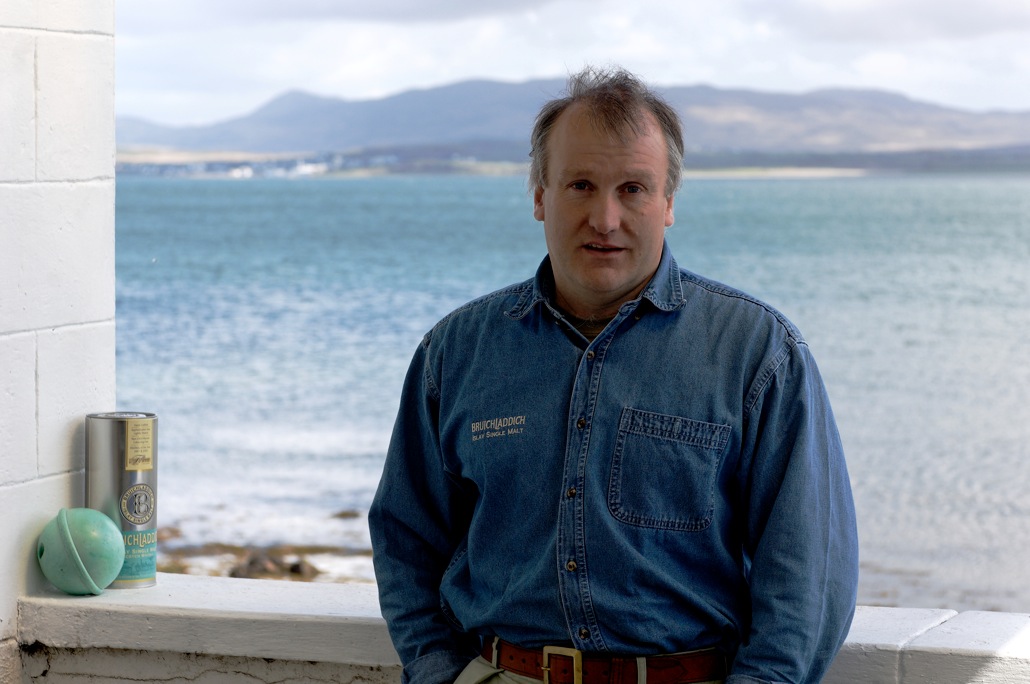
Several months back I spent an hour or so with Mark Reynier, managing director, in his office at the distillery.  We spoke of his path to ownership of the distillery, life on Islay, expressions en route (at the time Mark was writing up the latest Organic notes), reporting in the industry and much, much more.  Since that time Mark and I have shared a few email chats and his opinions and thoughts have always been something I look forward to. 

Undoubtedly one of my favorite industry personalities,

Mark Reynier:

Bruichladdich's Mark Reynier

ATW:  Your trials leading to the purchase Bruichladdich are not secret, but do have more of an impact coming from the source.  Can you share some of the history that led you to Bruichladdich?

MR:  Check out this film made by Crowsnest Films which I think captures it all pretty well: http://www.vimeo.com/15662396


ATW:  You take exception to the currently accepted translation of ‘Bruichladdich’.  When last we spoke you gave a much more romantic translation and spoke to how it reflects more closely the character of the distillery and whisky.  What is your take on the true meaning of ‘Bruichladdich’?

MR:  Bruichladdich is listed as one of the fifty most unpronounceable names in Scotland (Scottish Miscellany).

Most Hebridean names derived from either the Gaelic, Norse or Anglicised equivalents denoting a precise geographical location.  Bruichladdich is derived from two Gaelic words brudhach and chladdich.  Brudhach a Chladdaich.  It is usually translated as meaning ‘brae by the shore’.

‘Brae’ is a Lowland Scots word derived from the Old Norse, breiðr, meaning a broad hillside, or ‘a gentle slope to the sea’.  Since names were originally given as specific location markers for navigation, neither meaning is pertinent to this location.

There is a steep bank at Bruichladdich, a raised beach of post-glacial marine deposits; trouble is that it runs for 8 miles along the north side of Lochindaal and so is not terribly precise as a locator, like saying ‘1st Avenue and 1st to 60th street’.

The confusion perhaps comes from Brudhach or bruthach.  According to Dwelly’s 1901 dictionary, is a rather general term in steepness from an ascent, hill-side, brae, to a steep acclivity, and precipice.  Chladach or cladach means a shore, beach, coast, or more specifically, a stony beach.  Interestingly, though obsolete by 1901, it also means a lee shore, a dangerous coast for sailing ships in a prevailing wind.

This specific part of Lochindaal in front of the distillery, is shallow and peppered with exposed rocks up to 50 metres offshore rather than ubiquitous sand of the loch.  With only a metre of tide to cover it, this is a deceptive and dangerous piece of the loch in the prevailing wind to ships either landing or at anchor – even today.  In the days of sail, a lee shore with sharp rocks waiting for an unsuspecting ship would indeed be worthy of specifying it’s location.

We can be  fairly sure that  Brudhach refers to the the raised beach, but specifically ‘a Chladdaich’, at the place of the dangerous rocky shore: Steep Bank at the Rocky Lee Shore would seem a more useful and accurate, if not so romantic, translation.

Brudhach, pronounced ‘brew-ac(h)k’ – with the ‘ack’ heavily aspirated and  Chladdich, here on Islay, is a softer ‘kladd-ie’.  So we get ‘brew-ahk-ah-kladd-ie’, which with the ending of the first word and the beginning of the second, eliding over time became ‘brew-ah-kladdie’, or ‘brook-laddie’ as it became in the nineteenth century.

A view of the distillery from the shores of the loch.


ATW:  Your history in the wine spheres have given you a profoundly unique approach to whisky maturation and finishing.  What do you feel has been the most successful marriage of Bruichladdich whisky and wine cask to date?

MR:  The 125 bottling.  1970 vintage in “selection de grains nobles” casks from Olivier Zind Humbrecht, the famous biodynamic wine grower from Alsace.  They had contained Pinot gris grapes from the Clos Jebsal vineyard, late-picked for über sweetness.  The “magic casks”, as Olivier calls them, were made by Dominic Laurent in Burgundy.  The quality of the oak casks was simply exceptional.  Combined with the richness of the wine and the vanilla of the spirit it was sensational.  It is a profound bottling, a landmark I would go so far as to say, though some people just did not get it: the whisky either scored 99% or 70% – there was nothing in between.  We have learnt an enormous amount.  Jim is a cooper by trade, from the age of 15, and I was a wine merchant trawling the cellars and vineyards of France from the age of 18.  Together that makes a powerful combination.  I have been able to introduce types of oak that Jim had only dreamed about.  His unparralleled, hands-on knowledge of whisky and wood means that we have been able to achieve some extraordinary results.  You wait till you see the follow on to Octomore Orpheus, the Ocotmore 4:2, released this autumn… Boy – a real mindXXXX!  Of course the loudest critics at the outset, industry players, have to a man made miraculous Damascene conversions.  But for us this work that takes place on a daily basis is no marketing wheeze, dreamt up by some PR department in London, Paris, Tokyo or New York; it is inquisitiveness.  Besides, we reckon a mix of oaks is more interesting but that’s for another time.


ATW:  I can only assume with your experimental nature that the Renegade rum line, and the forthcoming gin (which is exceptional!), are your ideas.  What triggered the decision for an Islay whisky distillery to branch out in these directions, and can we expect more innovations beyond whisky?

MR:  There are many similarities between the rum and Scotch whisky industries.  They are, after all, pretty much owned by the same players.  In my view, the rum industry is in an even more parlous state than the Scotch whisky was when I started to get involved.

Unlike rhum agricole, British rum has always been a by-product of sugar manufacture; it was generally blended away with other rums.  Its success was consequently inextricably linked to the that of sugar and commerce. But most of the Caribbean single estate distilleries, many created in the seventeenth century, have now disappeared leaving a small number of mega-plants.  This situation was created, more or less, by fatal cocktail of post-colonial independence, capitalist amalgamation, and socialist nationalisation.

The odd barrel of these defunct distilleries’ rums still exist, bottling them naturally like our single malts – single estate rum – wasn’t therefore exactly rocket science.  We wanted to demonstrate the individuality rather than conformity.  As well as honouring these estates, we were curious.  There is a dearth of knowledge out there apart from the mega brands.

The same big guys dominate the rum industry as they do whisky: volume is king – the rum equivalent of blended whisky.  I fear the reality is, sadly, that what we have is a last-gasp, end of an era thing. There are, though, one or two small estates doing well, but when you see the old derelict distilleries lying there in ivy-covered ruins it is a damming, desolate sight.  And remember, the single malt category, a tiresome, fiddly sector for those big players, very nearly did not happen at all.  It may be just too late for authentic, single estate rum.  We’ll see.

Botanist gin came about because we are curious about distilling.  For us it is not a question of merely pushing buttons, we like to test our distilling skills, we are intrigued.  With Trestaraig and X4 we have explored triple and quadruple distillation, so with a Lomond still that we had liberated from Inverleven in 2003, we were wondering how to use it. It was an experimental still, the first of its kind and now the last.  

'Ugly Betty', the old Lomond still Reynier speaks of, used to produce Bruichladdich gin.


ATW:  Bruichladdich has released a couple of organic expressions to date.  Do you believe the Organic was a success in terms of both flavor profile and as a viable product to move forward with? 

MR:  Yes.  The first was a very limited, flag-in-the-sand bottling at high strength from the 2003 vintage.  The second, perhaps more representative, is a full scale bottling at 46%.  It has extraordinary definition and intensity which some will get, others won’t.  Scottish organic barley now represents almost 50% of our requirements (depending on harvest) with the other 50% + coming from Islay itself.  It is a definitive, unparalleled, tangible proof of our desire to rediscover traceability, authenticity and provenance all of which, we feel, have been surrendered for conformity.  We are going to distil some 100 tons of biodynamically grown barley, as far as we are aware this über organic barley has never been used for whisky.


ATW:  At some point in the future to you intend to malt at least a portion of your barley (be it organic or otherwise) on site?

MR:  Possibly, but it is not a priority as it is unlikely to add quality.  Malting is a very precise art which in my view is best left to the experts – and we have a very good relationship with Bairds who bend over backwards to help us with the 26 different farms’s barley that we use, keeping each separate from field to fermentation.

Malting is fine to play about with on a small scale – and we do – but with 2,200 tons (almost 50% organic) it is different. Sure, some play at it for the tourists, but I am unaware of anyone that malts that volume themselves on site for their own use.  We have looked at it, done a little ourselves, and it is certainly something that we could consider in the future; but it would be an economic consideration primarily – all or nothing – not an emotive one.


ATW:  Bruichladdich’s flood of expressions is one of the things that has made collectors and connoisseurs both groan and drool.  On the one hand, there are countless new expressions to try.  On the other, there are countless new expressions to buy.  How do you respond to criticism regarding claims there are simply too many expressions?

MR:  No one is forcing anyone to buy them.


ATW:  I guess the follow-up question would logically be about a core range.  Though your independent, small batch style doesn’t necessarily lend itself well to the idea of a consistent core line-up, are there thoughts of establishing a more traditional ‘age statement’ type structure at some point or is the goal to get people bought in to the “spirit” of BL as opposed to specific standardized products?

MR:  The distillery was shut between 1994 and 2001 – apart from a period in 1998 – and the older stocks erratic in both ages and volumes.  And with a cost price of December 2000. This influenced our sales strategy which was based, basically, on the independent bottler format – small volume, limited editions.  As we approach our 10 years, our own stocks are coming on line, and we have been able to evolve that strategy which we have been doing over the last three or four years. Our portfolio is now based around 10 specific Bruichladdich subsets from work that we have been doing over this period, each with its own intrinsic raison d’être:

Rocks, Classic, 10, Organic, Islay Grown (out in 2011), 18, Black Art, Infinity, PC, Octomore

As well as the first team line-up there will be one or two special, limited editions like PC 9 &10, Octomore 4, and 4:2, DNA, Micro Provenanace, and of course the odd intriguing vintage or two…

There are, for example, a brace of web and shop-only bottlings we are finalising to celebrate our 10 years of opening the distillery which coincides with our exciting new web site on 31st March.


ATW:  The Bruichladdich approach has resulted in an interesting and eclectic collection of whiskies…I have to assume that with this level of experimentation there has been many surprises along the way.  Any huge surprises (or humorous mishaps) you’d care to share with the readers?

MR:  The 125 bottling – grab it if you can find one – sort of encapsulated what we have been doing; for some whisky producers on the Ford production programme, the ‘any colour you like as long as it is black’ brigade, it is abhorrent to have any more than one single distillery bottling; that was how it was when we started – now even the most staid of distilleries has three or four bottlings on the go.  What is wrong with variety?  Choice?

We are not navel gazing, we want to attract new consumers to single malt rather than the died-in-the-wool ‘traditionalist’ (shall we politely say) that complain we have too many syllables let alone bottlings. Our bottlings are unashamedly aimed at sophisticated consumers, wine drinkers, the unblinkered, the inquisitive of mind, those prepared to try real things, to learn, enjoy to savour the flavour.  They want to to know the Scotch was made with Scottish barley, that Islay single malt was made – from barley to barrel to bottle – from Islay barley.  Bruichladdich consumers want integrity, provenance, authenticity.

Humorous mishap? An enormously fat woman falling through the first floor of a warehouse – between the joists no less – almost on top of a freaked-out warehouse worker beneath; unfortunately she was a health and safety officer on holiday.


ATW:  Can you speak to the working relationship you and Jim McEwan have?  Obviously you are both individuals with well-developed noses / palates, and I would assume strong opinions.  

MR:  Culturally, and age, you could not get two more different people if you tried: one a metropolitan, small company, privately-educated, wine trade, English upbringing, pragmatic, Catholic, rugby fan; the other an islander, large company, protestant, whisky industry, Rangers supporting, superstitious Celt.  I first met Jim in 1989 outside Bowmore and remember being amazed at the enthusiasm of the man who I recall being even more enthusiastic about his love of whisky than I am about wine.  The next time we met face to face was a decade later in a solicitor’s office in Glasgow on the even of the purchase of the distillery.  I would not deny that it has been challenging at times – that tension would not be there if one didn’t care – and after all, we have absolutely nothing in common.  Nothing, that is, except passion, pride, enthusiasm, eagerness, daring, tasting ability, determination, imagination, inquisitiveness, vision… It took time to understand each other but thanks to my mother being half Scottish (my heart probably rather than my head) and the French and Viking blood of my father it helps.


ATW:  Is there any talk of restarting the Bruichladdich Academy again?

MR:  No.  Too much hassle.  We wanted to do it properly, give people the true experience rather than some dumbed-down, vacuous PR exercise.  It was fun do do but the simple reality was that it was too draining, too invasive on everyone – and we have enough on our plate as it is.


ATW:  Can you update us on the status of the New Port Charlotte Distillery?

MR:  We have the planning permission but were held up by the environmental permissions.  But since we finally received those, a year of monitoring river levels and flow rates etc… the economy has fallen out of bed and with that uncertainty we feel it would be unwise to proceed with this project, at this time, and compromise what we already have.  


ATW:  …and finally (from a couple of us)…

If a distillery owner was turning 50, say next year, would they not want to vat a special malt for that occasion, and if so would they not want loyal fans in Calgary to share a bottle?

MR:  I do not know to whom you refer.


Thanks, Mark.  Your time and effort are appreciated.

Watch ATW in the near future for a review of Willow Park’s (Calgary) exclusive Bruichladdich manzanilla 12 year old and a feature on Bruichladdich’s distillery manager, Allan Logan.

Also ‘Laddie on ATW:

An interview with Jim McEwan, Bruichladdich’s master distiller.

The Port Charlotte lineup in a vertical tasting (PC5-PC8).

…and several reviews under ‘Reviews’ on the right side of the page.
Dust On The Bottle

From Alberta Venture:


by Meribeth Deen | Photography by Darrell Lecorre


WHISKY A GO GO: Habit and Cascade Room bar co-owner Nick Devine promotes Alberta rye to his clientele

Vancouver’s Habit Lounge might be the last place you’d ever expect to find a bottle of Alberta Whisky.

Located just north of the intersection of Main Street and Broadway, which marks both the city’s geographic centre and its cultural heart and soul, the bar (and its next door neighbour, the Cascade Room) is a popular destination for the scores of mustachioed, plaid-clad men and vintage-dress-wearing women who populate the area. While the Royal Canadian Legion hall across the street might seem like a more appropriate venue for a glass of Alberta’s finest, it’s at Habit where the whisky, along with other Canadian whiskies, gets top billing.

Habit’s cocktail menu includes a section dedicated exclusively to Canadian whisky, featuring 21 of the country’s best. At the top of that list is Alberta Premium, which Nick Devine, a bartender and co-owner of both Habit and the Cascade Room, describes as “a good little whisky.” Devine says scotch snobs won’t touch a Canadian whisky, and when customers do ask for one, it’ll be a Canadian Club or, on occasion, a Forty Creek. But if a customer asks for a rye and ginger or a manhattan, she will get a taste of Alberta Premium, the house whisky.

Devine is English and says he didn’t know much at all about Canadian whisky before deciding to make them a focus at his bars. “In the U.K., Canadian whisky is considered smooth, light and entry-level. That’s the stigma. Alberta Premium’s a bit different,” he says. That difference sets it apart from most other Canadian whiskies, which are rye whiskies in name but, in fact, have only a touch of rye blended in for flavour toward the end of the distilling process.

Alberta Premium is made from 100 per cent rye grain. “The rye makes it bolder, gives it more bite,” Devine says. “It’s not everyone’s cup of tea.”

It’s also a stark departure from the traditional Canadian approach to making whisky. When the Loyalists came north, they brought with them the American tradition of using rye to make whisky. A century or so later, that tradition took a turn. Canada’s most successful distillers of whisky – Hiram Walker and Samuel Bronfman – started blending their products with corn and barley to mellow the flavour. Canadian Club and Crown Royal found widespread appeal through this mellowing, but lost the respect of serious drinkers of scotch and whisky.

Alberta Premium’s “bite” is slowly bringing renewed credibility to Canadian whisky.The bargain-priced product, which retails in Alberta liquor stores for just over $20 for a 750-millilitre bottle, was declared the “Best Canadian Whisky” by Jim Murray’s Whisky Bible for four years running, between 2006 and 2009. Murray, a renowned British whisky writer and three-time winner of the Glenfiddich Whisky Writer of the Year award, tastes and evaluates some 3,000 whiskies from around the world every year, ranking each on its nose, palate, finish and balance. Despite the fact that Alberta Premium lost its first-place status in 2010, Murray is quick to recall why it won four years in a row. “It stands out for its vividness, a precise degree of sweetness against the rye. It has an unbelievable intensity. It’s one of the most charming whiskies around.”

Murray is an exuberant supporter of Canadian whisky and is highly critical of Canadians – and Albertans – for not drinking it. He’s also critical of the Canadian industry for doing such a bad job of promoting its product. “The Canadian whisky industry has so much potential; distillers just have to believe in themselves a little,” he says. “And Alberta Premium is the perfect example – 25-year-old bottles were sold for $25! It should have been priced at $125 a bottle – it’s a world-class whisky. By pricing it so low, the distillery is sending people the wrong message.”

The director of operations for Alberta Distillers, Rob Tuer, says there are two reasons why Alberta Premium is priced so inexpensively. The first is that it’s cheap to produce.

“We use rye grown in the Prairie provinces,” he says. “Rye is cheaper than corn, and because it’s local, we don’t have to pay for transportation.” But there’s also a branding strategy of sorts at play. Alberta Distillers has been producing Alberta Premium whisky for more than 50 years, and as a rye whisky at a low price, it held a certain appeal for Alberta’s hard-working cowboy culture of old. Albert Premium continues to chase the so-called “cowboy market” by sponsoring rodeos in small communities in Alberta, British Columbia, Manitoba, Saskatchewan and Ontario. “We want to focus on support from the grassroots,” says James Monaghan, assistant brand manager for Alberta Premium. “And our pricing is geared towards maintaining loyalty in that market.”

The distillery where Alberta Premium is made is the oldest of its kind in Western Canada and is still situated on its original 40-acre property in central Calgary. It was founded by George Conrad Reifel, who came from a family of determined German braumeisters. The family established numerous breweries with varying degrees of success in Vancouver and on Vancouver Island between arriving in 1896 and 1917, when the Prohibition Act banned the sale and consumption of alcohol in Canada. After closing down their Canadian businesses, Reifel and his father moved to Japan, where they learned to make malt from rice and established the Anglo-Japanese Brewing Company.

The Japanese venture was successful, and George Reifel returned to Vancouver. The circumstances that led to his partnership with Alberta oil tycoon Frank McMahon and the establishment of Alberta Distillers in 1946 are unclear. The Reifel family sold the business to National Distillers sometime around 1970. A decade later, National Distillers sold the company to Jim Beam, now Beam Global Spirits & Wine Inc., owned by Fortune Brands. Alberta Distillers, which also produces Alberta Springs, Canadian Gold, Canadian Spirit and Tangle Ridge ryes, sells approximately 600,000 cases of spirits each year. But it barely registers as part of a company representing many bigger and far more recognizable products, including spirits like Jim Beam and Canadian Club and big names in golf like Titleist, Foot Joy and Pinnacle.

In contrast, High River’s Highwood Distillers might just be the “grassroots” product that Alberta Premium aspires to be. Started as a public company in 1974, the distillery was privatized in 2002 and doubled in size after purchasing Potter’s Distiller in British Columbia in 2005. Highwood wants to keep growing, though, and has attempted to win over vodka drinkers by producing a clear whisky called White Owl. Priced between $35 and $45 a bottle, White Owl illustrates Highwood’s desire to break into the market in Quebec and Ontario, where liquor stores and the customers that populate them tend to favour more expensive products.

The strategy behind Highwood’s White Owl Whisky reflects the direction the Canadian whisky market as whole is heading. It may not be expanding – total sales for Canadian whisky have dropped from 3.7 million cases in 2006 to 3.4 million in 2010 – but it is diversifying, with new boutique distilleries popping up across the country. Like

Alberta Premium’s claim as the only 100 per cent rye whisky and White Owl’s distinction as the only clear whisky, there are a host of competitors with claims of their own. Forty Creek, which emerged out of the Kittling Ridge Winery in Grimsby, Ontario, and first entered the market with a 10-year-old whisky in 2002, can claim to be the only whisky that uses Canadian wood casks in the distilling process.

Even Wiser’s, the venerable producer of familiar products like Wiser’s Deluxe and Wiser’s Special Blend, is trying to set itself apart from the crowd. In celebration of its 150th anniversary, the Ontario distiller created Red Letter in 2007, a one-time bottling that is the only non-chill-filtered whisky made in Canada. The one-off creation, priced at $150 per
750 millilitre bottle, even managed to steal Jim Murray’s designation of best Canadian whisky from Alberta Premium in 2010.

It may have missed out on a fifth straight award but Alberta Premium continues to trundle along all the same. In 2010 Alberta Distillers sold 205,518 cases of Alberta Premium, which placed it sixth among Canadian whiskies. Meanwhile, it ranked a respectable seventh out of 22 brands of Canadian whisky sold in Ontario’s government-run liquor stores. At Calgary’s Kensington Wine Market, scotch expert Andrew Ferguson describes Alberta Premium as a “good seller.” However, he doesn’t attribute those sales to any particular brand identity or strategy on the part of the company that makes it. “It’s like an orphan,” he says, and adds, “Whoever makes Alberta Premium didn’t seem to do anything when they were winning accolades from Jim Murray. They probably didn’t know what to do with that.”

Ferguson may be right. It’s also possible that Beam Wine and Spirits isn’t interested in pushing a product that pushes itself without any help from money spent on advertising. As a domestic product, Beam doesn’t need to worry about Alberta Premium competing with the other whisky brand they own and in which they’ve invested effective advertising dollars: Canadian Club. Canadian Club also has Don Draper on its side; consistent exposure on the hit TV series Mad Men will ensure the brand comes to mind for drinkers who might not know much else about whisky. And Canadian Club, unlike Alberta Premium, is distributed internationally.

Jim Murray says he’s sure that Alberta Premium will be at the top of his list of Canadian whiskies again – and it will probably happen soon. “Its sharpness has just waned a bit,” he says. “That happens sometimes. It could be due to strength of sun on the rye on a particular summer or a slight change in the wood casks.” In the meantime, Murray will continue to take bottles of Alberta Premium back to the U.K. from his visits to Canada, and he’ll continue to serve it to guests in his home. With Jim Murray’s endorsement, and the support of Fortune Brands, Alberta Premium is not going anywhere. In the end, though, that might be its biggest problem of all.

Original page here.