Category Archives: Whisky Reviews & Tasting Notes

Nikka Taketsuru Pure Malt Review

Nikka Taketsuru Pure Malt156

43% abv

Score:  88/100


A Japanese blended malt from Nikka.  Non age-stated, but let’s assume a middling youth.  Asian malts mature a little bit differently from their Scottish brethren in most cases, so using the same metrics is misleading.  What I can say, though, is that this one is neither underdeveloped, nor is it gracefully waltzing up into its golden years (that apex of maturity we ache for in the whisky world).

Initial rumblings on this one pegged it as a wonder malt of sorts.  Something that was unparalleled in its price bracket in terms of relative quality and depth of pseudo-tropicalia.  I kinda see it, yeah.  Word of mouth from a few trusted sources was enough to get our local club – The Dram Initiative – to spring blindly for a couple bottles to shelve for a future Japanese whisky night.  It now seems that was a solid investment.  The bottle you see in the photo above was purchased on behalf of another l’il club here in town, called Liquorature for an event held a few months back.  The seven or eight gents that gathered over good reads and good malts that night spanked the hell out of it, I should note.  Fortunately there were a few drops left over for a couple of revisits and some tasting notes.

Again…we decry the lack of vintage on the label – in this day and age there is no excuse for clandestine policies regarding age – but concede a well-executed drink.  Oh, and a hell of a price for a Japanese whisky in this era of unrestrained price gouging.

Nose:  Pear, orange and a touch of that syrupy fruit cocktail mix from the can.  Vaguely floral too.   Like a good young Speysider with a more exotic spice bouquet.  White chocolate and vanilla cake.  Kinda reminds of ice cream…or custard.  Not a complex malt, but very well-composed and infinitely drinkable.

Palate:  Nice arrival that immediately shifts gears into darker vanilla and tannic notes.  Plum skins.  Is that peat?  Really?  The fruits that ebb and flow here do border on tropical (but the whisky is just too young for it to truly plunge into tropical territory), with those semi-bitter, but also incredibly sweet, colorful explosions (too esoteric?).  Think of a very muted tropical juice blend poured over angel food cake.  Leaves smoked peaches and oak on the back end.  Neat.

Thoughts:  An incredibly well made dram, and for a ridiculously fair price considering the mark-up on Japanese whisky nowadays.  $60 give or take.  One final note…the nose does somewhat outshine the palate.


 – Images & Words:  Curt

Chu Yeh Ching Chiew Review

Chu Yeh Ching Chiew181

45% abv

Score:  47/100


Jesus Christ.  I’m sorry.  I wish I could find a respectful way to say this, but I simply can’t.  My taste buds are in revolt.  As is my tact.  There’ll be no pulling punches here, as this is – quite frankly – ruddy foul stuff.  Like overtly offensive, if I’m being totally up front.

So…is this actually whisky?  I honestly don’t know.  I bought it in a section labeled ‘whisky’.  The tag beneath it said ‘whisky’.  But nowhere can I find reliable information as to whether or not anyone actually considers this a whisky.  It is, however, a distilled beverage made from barley (and other stuff), so let’s proceed anyway, if for nothing other than shits and giggles (and an occasional foray into masochism).

An ingredients list that features sorghum, barley, peas, sugar and bamboo leaves should be your first clue that things may be a little squiffy here.  However, that sort of mixture should logically give a rather organic and earthy profile, shouldn’t it?  Not a chance here.  This one is an ‘x-file’ of a drink.  It’s a soupy-smelling, meaty anomaly and should actually be left on the shelf…or maybe used for cooking.

Chu Yeh Ching Chiew is served up in a 500 ml bottle.  That’s about 480 ml too much considering I probably needed only about 20 ml for this write-up.  Now ‘scuse me while I go scour my tongue with an S.O.S. pad.

If anyone out there knows more about this one please feel free to share.

Nose:  Nose:  Beef ramen flavour packet.  BBQ Beef Hula Hoops (for those of you with access to UK snack fare).  Miso.  Very savoury and spicy.  Dried meats and tea leaves.  Maybe sweet peas (but that could be nothing more than the power of suggestion).  Polish, citrus zest and a fleeting aroma of chocolate.  But really all that other stuff is buried behind the big beefy Oxo/Bovril/Beef ramen scent.  This is the meatiest drink I’ve ever nosed, and that includes the time I tried ‘bone-luging’ Lagavulin 16 down a freshly de-marrowed beef bone.

Palate:  Gah!  Less meaty now.  More on over-the-top sugar sweetness and vegetable soup.  Tomato.  Kale.  Lemongrass.  A bit of meatiness now.  Plain egg noodles.  Fuck, is this ever weird.  No more.  I’m done.

Thoughts:  <shudder>


 – Images & Words:  Curt


Ardbeg Rollercoaster Committee Release Review

Ardbeg Rollercoaster Committee Release097

57.3% abv

Score:  90.5/100


Oh, man.  If only this were a legitimate road to travel.  Back in 2010 Ardbeg released what would become – for me, anyway – the poster child for what NAS whisky could be (if it has to exist at all, that is) without the interference of the SWA and the British government enforcers.

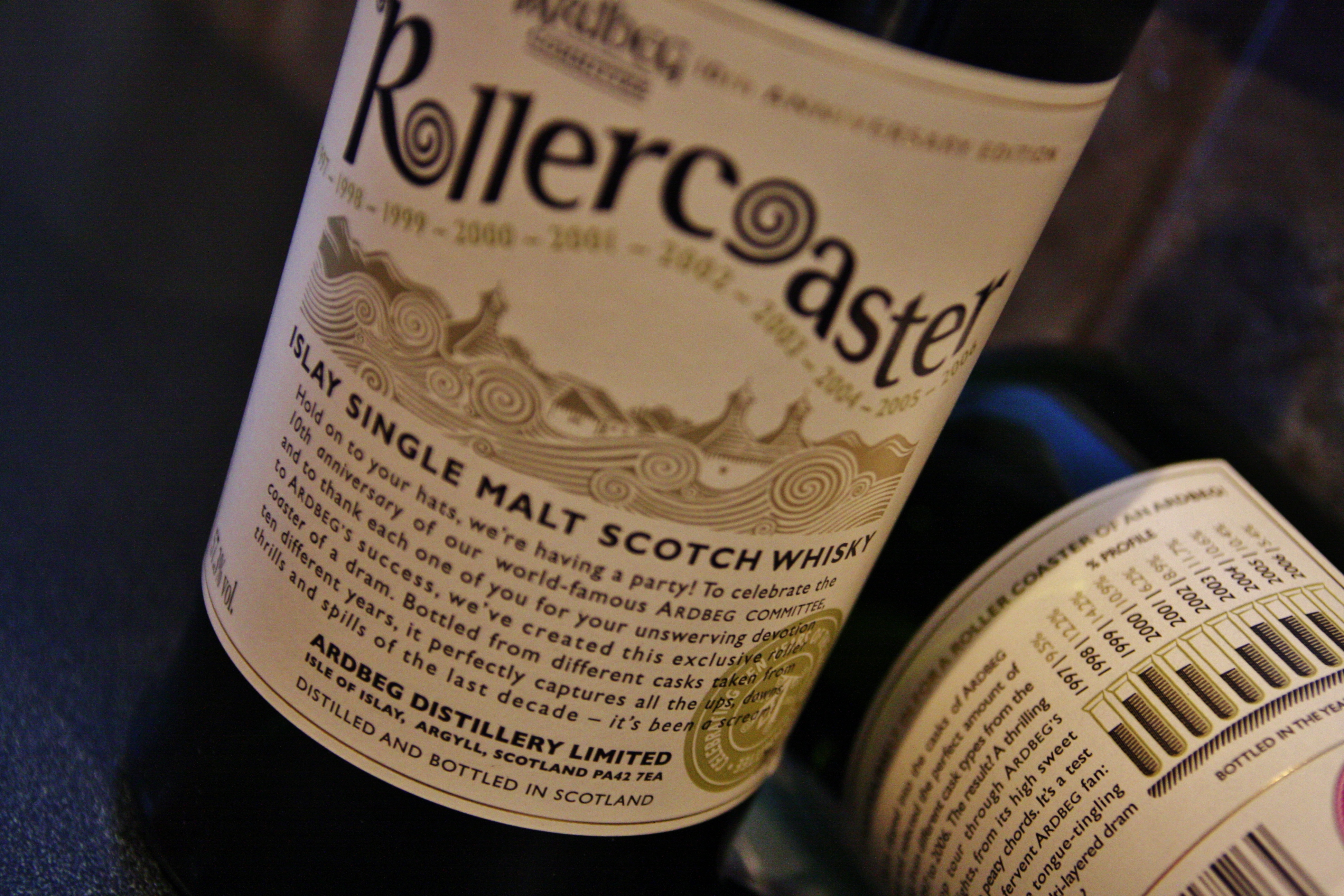
Ok, so the bottle doesn’t say 10 or 12 year old, as you can see, but it does have a curious band of dates dancing across the front label and an even curiouser little bar graph on the back label.  Hmmm.  What have we here?  Long and short of it is that before the folks at Ardbeg got their knuckles rapped for disclosure (well…not exactly), they printed up these labels and 15,000 bottles of Rollercoaster hit the open market.  And those aforementioned dates and graph?  A breakdown of the vintages that went into creating this careening gem of a malt, as well as the percentage of each that made it into the final vatting.  These component casks range from 3 to 12 years of age.  Now…if Ardbeg had played by the rules this one would have had to have been labeled a 3 year old.  Would that sell?  Maybe.  Probably, actually, but you’ll never convince Big Business of that.  Too much of a gamble.

Anyway, Ardbeg gave us the details, were subsequently given the ‘shame on you’ treatment’ and that was the last we saw of what is – in my mind – a brilliant way of selling a marriage of young and old.  Of course, the proof is in the puddin’, as they say, and fortunately this is a hell of a sexy malt, proving that there’s nothing wrong with bridging malt gaps; only with the concept of doing it without being held accountable to the consumer (read: the dreaded NAS).

For those of you interested in the actual barrel breakdown…voila!

1997 Cask: 2nd fill – 9.5%
1998 Cask: Refill Hogshead – 12.2%
1999 Cask: 1st Fill Barrel – 14.2%
2000 Cask: 1st Fill Barrel – 10.9%
2001 Cask: Refill Barrel – 6.2%
2002 Cask: Refill Barrel – 8.9%
2003 Cask: 1st Fill Barrel – 11.7%
2004 Cask: 1st Fill Barrel – 10.6%
2005 Cask: 2nd Fill Sherry Butt – 10.4%
2006 Cask: Refill Hogshead – 5.4%

Great whisky that is now a part of malt lore.  Much as Balvenie’s Tun series (early days anyway) and Glaser’s recent online info share will be for future generations.

There’s much more we could say about this one, but only so long I expect to be able to hold your interest, so how ’bout some tasting notes now?

Before we do, though, a big cheers to my mate Voytek for allowing the opportunity to try this one.  That was an unforgettable night!

Nose:  Ashy and redolent of beachside bonfire.  Very juicy and sweet, fruit-rich nose.  Ardbeggian through and through. Smoke and black licorice.  Chocolate.  Charred scallops and seared meat.  Warm rubber.  A sweet and savoury collision.  A slight leathery note in the background.  Iodine and apples.  Tangy…like a good BBQ sauce.

Palate:  Yes!  Yes!  Yes!  What an arrival!  If only the stocks existed to make this recipe a staple in the core releases.  Big tart, green notes.  Black licorice meets blackberry jam.  A mouthful of strong, strong medicine.  Loads of syrupy dark fruits.  Loads of smoke.  Lime zest, bittersweet chocolate and a hint of coffee.

Thoughts:  I expected a bumpier ride, to be honest, but this is a freaking great build.


– Images & Words:  Curt

Laphroaig Cairdeas 200th Anniversary 2015 Review

Laphroaig Cairdeas 200th Anniversary 2015120

51.5% abv

Score:  92/100


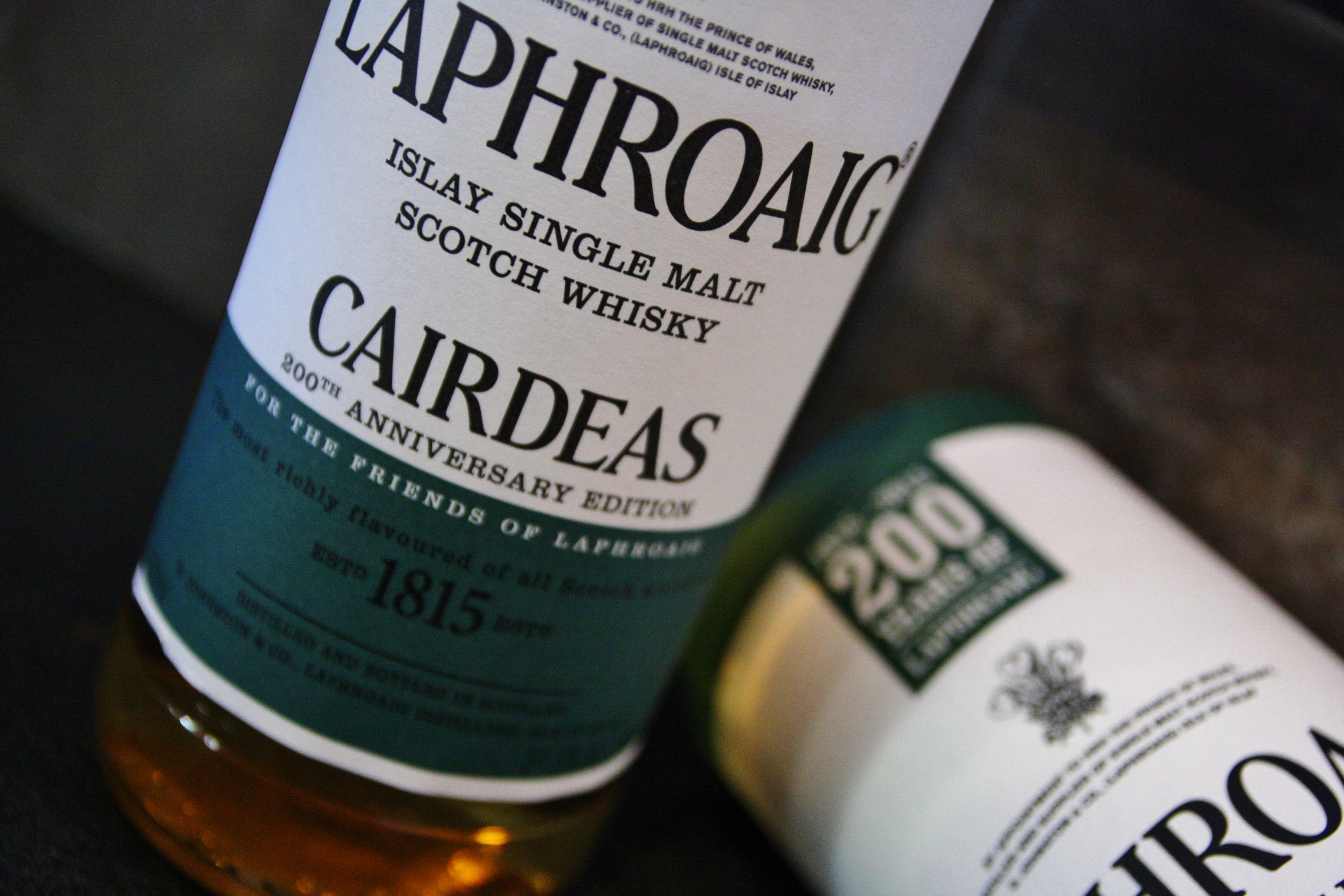
I love what Laphroaig has done with the 2015 edition of the popular Cairdeas expression.  This bog beast is built entirely of barley floor-malted at the distillery (as opposed to most Laphroaig releases which feature predominantly malted barley procured from the Port Ellen Maltings), distilled in the squat l’il stills and then matured in the Number 1 Warehouse (yes, that is a different place than Bowmore’s legendary Number 1 Vaults) near the briny influence of the Atlantic (if you believe that makes a difference).  Whereas we can usually expect Laphroaig’s phenols to hover around 40-45 ppm pre-distillation, who knows what we have here?  The peat level isn’t really the main talking point however.  The fact that this is an entirely old school malt with a crystalline purity and stunning balance is.  Wow, what a dram.  Best Laphroaig in a long time, and that is saying something.

The elephant in the room is that this is – for all intents and purposes – an NAS expression.  The reality is though that John Campbell, distillery manager and the architect of this dram, has been rather forthright about this one; explaining that it was laid down in 2003 and bottled in 2015.  Effectively an unofficial 11 year old, I suppose, as his comments referred to it being ‘nearly twelve years old’.  This Cairdeas wears its youth like a badge here, shining bright and conspicuous.

I first tasted this one in a range that included three different Leapfrog 25 year olds, and still this Cairdeas held its own (and then some).  Well worth tracking down and spending your shekels on.  Oh, and having said that…this one was released in 2015 for the distillery’s bicentennial.  It is limited, but to just how many bottles I’m not certain.  20,000 litres in total, I believe.  Grab before it’s gone.

Nose:  Key lime pie.  Peaty, earthy and smoky.  Ash and mineral notes.  Eucalyptus, in a Mint Leaves candy kinda way.  Green Jolly Ranchers.  I know this is built on 11 year old malt, but it noses older.  Very much a fruity candy treat.  With a medicinal edge, of course.  Soft sugared dough.  Dust, blood orange and tangerine.  Latex and ‘old whisky aroma’  (what we’ll call ‘OWA’ from here on out).

Palate:  A licorice, smoke and medicinal arrival.  Again…wow.  How does an 11 year old taste this mature?!  Soft fruit meets sugar cookies.  Lime zest, rubber.  Slightly, slightly bitter.  Ashy and oily as hell.  Faint cardamom in soft chocolate.

Thoughts:  The best Laphroaig I’ve had since the 25, I think.  This one works for me on so many levels.


– Images & Words:  Curt

Ardbeg Supernova 2014 Review

Ardbeg Supernova 2014137

55% abv

Score:  91/100


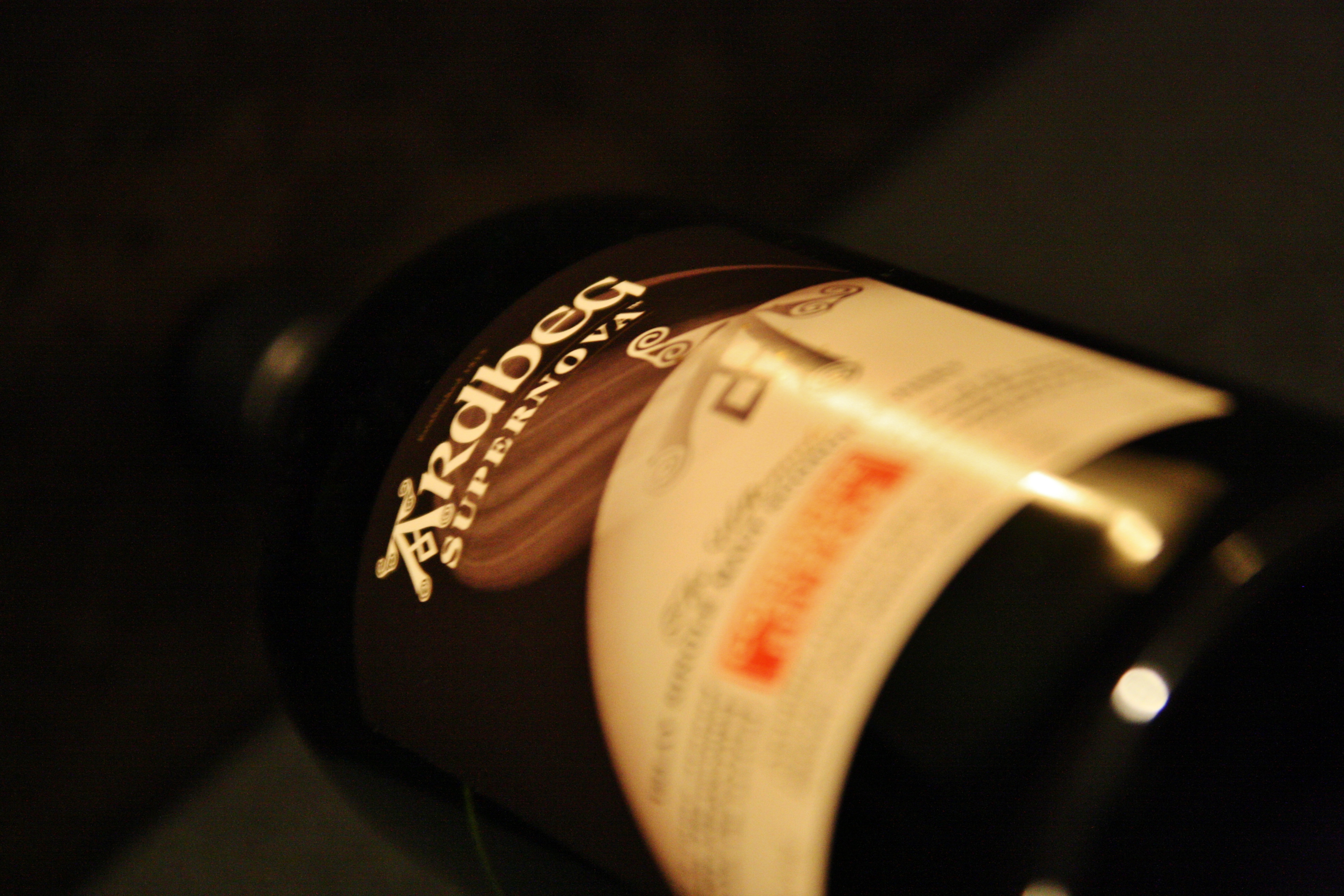
Yes, I realize I’m gonna get lambasted by the righteous for this review, but I really don’t give a shit.  So be it.  Those that want me to negate any positivity toward all whiskies that are NAS will be chomping at the bit to have their say here, so let’s get it out of the way early, before I explain my reasonings (no, not justifications):  yes, I really like this whisky, and no, I do not support the philosophy or pricing behind it.

At one point Ardbeg was unquestionably my favorite distillery.  In terms of consistently producing solid releases they’re definitely still at the top of the heap, but unfortunately it is becoming increasingly difficult to reconcile a love like this with my own moral standings regarding whisky.  Yes, I have such things as moral standings.  I do still love Ardbeg.  I love the island it is from (my home away from home); I love the people at the distillery (truly beautiful souls); I love the smells and tastes (celestial, in my humble opinion); and I do love the aesthetics and intangibles associated.  Sometimes the ones we love most, though, have the power to hurt us deepest.  Why Ardbeg insists on this path of non age-stated malts is beyond me.

But Supernova 2014 now…is it good?  Yes, it’s actually very good.  It was bound to be, wasn’t it?  A few dissenters’ opininons aside, Ardbeg seems to be one of the few distilleries that actually seems to unite malt lovers, despite what would seemingly be a polarizing profile.  It’s not hard to recognize the inherent quality in each subsequent release, irrespective of whether or not it’s to one’s personal tastes.  Sometimes quality is objective.  The fracture point comes between those who will swallow anything and everything Ardbeg markets (literally) irrespective of price, and those who recognize that the combined might of good malt + strong marketing and aesthetics = blank check pricing policies, and are turned off by that.  Reflect back now.  Can you recall a new Ardbeg release in the last 5 or 6 years that has hit the shelves at anything less than $120 or so?  Not around here anyway.  And that is with a fairly readily-acknowledged admission to ages of really not more than ±10 years.  So, I guess the real question with Supernova 2014 is not whether or not it is good, but whether or not it is $200 good?  And sadly, no.  No, it’s not.  Around $90 will get you a cask strength 15 year old Bowmore Laimrig, and that is a stunner in its own right.  The math speaks for itself.

Ultimately Ardbeg sells, though.  The market dictates prices.  And Ardbeg will not be getting cheaper anytime soon.  C’est la vie.

Nose:  Extreme iodine.  Lots of saltwater.  Smoke and pepper.  Green mint leaf candies.  A little bit of cinnamon coming through.  Ash and licorice.  Evergreen.  Coke and lime.  This is huge stuff.  The sherry influence makes this a lot mustier and damper than the razor sharp SN2010.

Palate:  Wood smoke.  A lot of salt licorice.  Smoke…and more smoke.  Citric tartness.  Granny smith apple skins and clean oak shavings.  Quite drying as it fades out.  There’s more, but you don’t need more.  Tangy, smoky, licorice-y.  Awesome, really.

Thoughts:  To be concise: a very good, very overpriced malt.


– Reviewed by:  Curt

– Photo:  Curt

Té Bheag Review

Té BheagTe Bheag

40% abv

Score:  81.5/100


Infamous in these circles as ‘Tea Bag’. For those who think hooked-on-phonics is the way to go…well…perhaps not with Gaelic. This whisky is pronounced ‘chay veck’, which means ‘the little lady’ or ‘a wee dram’ in Gaelic.

Té Bheag is being marketed as a ‘blended Gaelic whisky’ by its producers at Pràban na Linne.  Their goal, apparently, to provide ‘authentic whisky for the Gaelic speaking islands of Scotland’.  Sources vary, but I’ve heard this is a blend of 8-11 year old whiskies from Islay, Skye and Speyside.  I would assume that 8-11 would be subject to change from vatting to vatting; the inherent issue with NAS whiskies.  As this is a blend, though, we’ll cut a little more slack.  At the same time, we’ll also give credit where credit is due: this non-chill-filtered whisky is comprised of 40% single malt.  If you know your blends, you’ll recognize this as a rather impressive ratio of malt to grain. Generally the composition of a blend will rely a bit more heavily on the grains to hold it up, with the malts being more like the diamonds in the setting.  Seems Pràban na Linne is putting an emphasis on quality and character over simple economic considerations.  I should also note that it is exceptionally rare to find a 40%er that is non-chill-filtered.  Well done, folks.

Pràban na Linne makes its home on the Isle of Skye, home of the Talisker distillery.  As Té Bheag has been confirmed to contain Skye malt in the end product, we do at least know that there is Talisker in the mix.  As for the remaining components in the recipe?  Who knows.  We could assume Caol Ila from Islay (though I detect nothing of that profile), and as for Speyside, well…your guess is as good as mine.

While this blend is quite regularly available locally, it has crept from somewhere around the $30 mark to upwards of $40 in even the most affordable of shops (i.e. Superstore).  In others it goes for even more.  $40 may be a little bit of a stretch here, but it is a decent dram in all fairness.  Any more than that though?  Nah.  Likely a pass.  There are simply too many great and colorful single malts out there.  Malt snobbery shining through, I suppose.

Nose:  Rich in heavy toffee, caramel, butterscotch and any other ooey gooey stuff you can think of.  Notes of honey and a touch of ginger.  Apples.  Slight hints of pepper (just a wee bite) and peat, which again hearkens back to Talisker. I would guess a bit of sherry-matured malt in here too.  Not sure on that though.  Fruit and nut.

Palate:  That heavy, rich creamy caramel carries over to the palate as well.  A slight earthy, tobacco, peatiness.  Caramel apple.  Cinnamon cookies.  Vaguely fruity, but kinda like stewed fruits that have been doused in dulce de leche.

Thoughts:  All in all…a fairly distinct blend.  Smooth drinking, singular, but maybe lacking enough of an edge to make it truly stand out.


– Reviewed by:  Curt

– Photo:  Curt

Macallan Fine Oak 17 y.o. Review

Macallan Fine Oak 17 y.o.066 (2)

43% abv

Score:  87/100


Hmmm…tough one.  While much of the world mourns the loss of age stated expressions in the Macallan range, it’s somewhat tougher to get too weepy over the current scarcity of most of the Fine Oak releases.

For those who are maybe not so up to speed, the FO line-up is built around the idea of vatting together bourbon and sherry-matured barrels.  If I’ve heard correctly over the years, this is something Macallan has always engaged in, but for this series the ratios are skewed heavily in favour of using drastically more affordable bourbon casks in the mix than sherry butts.  Financially sound, of course, but not so sound in terms of preservation of reputation.  Let’s face it…Macallan built it’s monolithic name throughout the years by way of the deep and rich complexities of their heavily-sherried malts,  Unfortunately, with few exceptions, the Fine Oak range which hit the shelves in the mid-2000s never quite delivered to the standards set by its ‘redder’ brethren.

This isn’t to say we judge our whiskies based on colour, name or any other such triviality, but the reality is that those sherry bruisers from olden days were magical in a way that Macallan simply hasn’t been able to replicate with their current stocks and contemporary expressions.

While this may seem like merely a bias against the FO series, it should be noted that there are tasting notes here on ATW for more than 25 different Macallan expressions (as of now).  Additionally I have tried many, many more which I’ve not written up.  At this point I can unequivocally state that Macallan’s forte was never the FO expressions.  Mind you, neither is it the current 1824 series.  Sad to see the decline of an empire.

But let’s not veer too far from the point.  Fine Oak 17.  This one is actually one of the better FO releases I’ve tried.  The price point was higher than most were comfortable with, but that’s the reality of both single malt and Macallan.  So be it.  Either way, a decent dram, if not quite exceptional.

Nose:  Green apples and grape skins.  A bit of citrus and maybe orange.  Ginger and vanilla.  Caramelized sugars and a faint whiff of smoke.  Hay, and herbal notes.  Soft spices spice.  Slightly overly woody.

Palate:  A little thin, as we’d expect at 43%, but not a bad arrival.  Fruit-led and slightly tannic as it folds over the tongue.  Poached apple or pear with cinnamon.  More citrus and notes of sugar cookies.  Vanilla fudge.  Still a touch of smoke here (surprisingly).  The finish is a little disappointing; leaving not much more than a slightly eucalyptus note and the wood.

Thoughts:  This lighter style Macallan doesn’t sit quite right with me.  Not as a whisky, I mean, but as a Macallan.  I’m reminded of hearing George Grant speak of Glenfarclas; remarking that they would never release bourbon-matured Glenfarclas, as that is not what the name Glenfarclas is all about.  Macallan should lean a little more heavily on the big sherries, I think.


– Reviewed by:  Curt

– Photo:  Curt

BenRiach 1999 Cask #57669 Dram Initiative Exclusive Review

BenRiach 1999 Cask #57669 Dram Initiative Exclusive127

57.6% abv

Score:  90/100


This one has ‘bias’ written all over it.  And stubbornly I refuse to back down from the score I’m giving it.

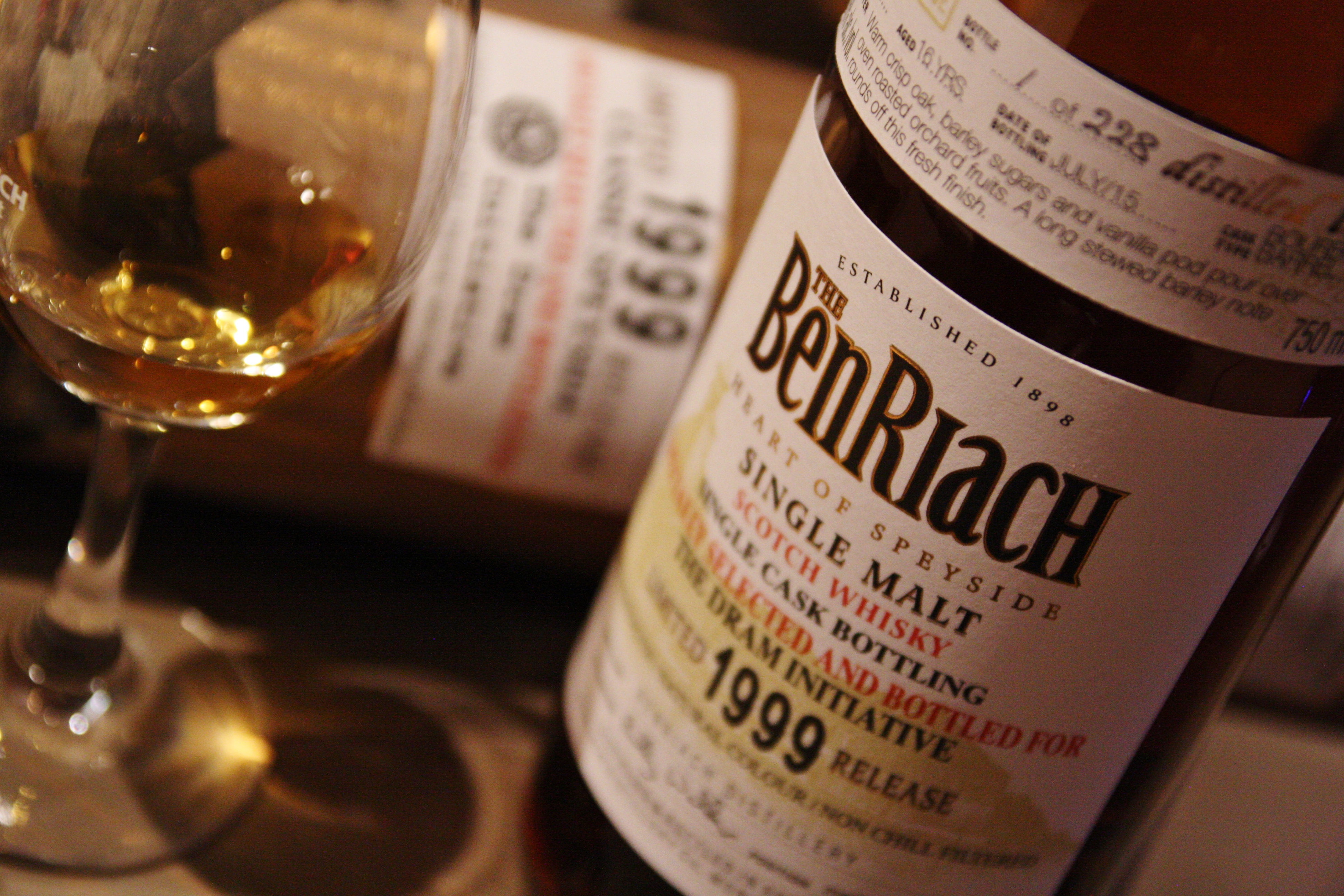
Full disclosure: I (along with a couple other gents, including the nefarious MaltMonster) picked this cask to bottle for our local whisky club, The Dram Initiative.  After going through a couple runs of cask samples, this 16 y.o. bourbon barrel jumped out as a stellar example of what happens when a distillery’s best cut goes into a flawless cask for a few seasons.  What we ended up with is the epitome of ‘universal appeal’.  Quite simply, this is a beautiful, creamy fruitbomb of a malt, with just the right dashes and sprinkles of spice.

For those not local or ‘in the know’ regarding The Dram Initiative, this is a 100 member strong club we launched more than two and half years back.  We do things big – with sprawling ranges and high end malts – and try to combine the sublime with the ridiculous.  There are always great drams, lots of laughs and a flair for individuality.  An endeavour like bottling our own barrel seemed like a brilliant unifying factor for members.  And indeed it has been.  This BenRiach cask will certainly be the first of many DI-exclusive bottlings.

Anyway…when I say ‘bias’ let’s not forget that we, of course, had nothing to do with actually making this whisky or anything; It’s more for transparency and an acknowledgment of the fantastic work the team at BenRiach has done.  Mashmen, Stillmen, Warehousemen, all the way up the ladder.  To end up with a malt this clean is a true testament to craft and passion.  And I guess maybe we did have some say in what this whisky ultimately ended up being.  Our role in the end product came about by way of saying ‘stop the maturation, and bottle it’ when we recognized the intrinsic quality of the malt.

This is a great whisky.  Proud to have been a part of seeing it come to fruition.

Nose:  Sweet and syrupy.  Almost jammy in some ways.  Oh, man, this is like the ultimate dessert.  Caramel apples.  Soft vanilla.  Toasted coconut and grilled pineapple.  Roman nougat.  Some tart and tangy moist dried fruits (maybe fruit leather).  All rich in sweet heavy cream.  Such a great mix of rich fruit and softer vanilla-heavy baking notes.  Harmonious and universally appealing.  LOVE it.

Palate:  Oh yeah!  What an arrival!  Lots of vibrant fruits with a creamy sweet undernote to balance it out.  Delivers what the nose promises, by way of those borderline tropical coconut/pineapple notes.  Viscous and mouthwatering.  Great, but subtle spices from the bourbon influence.  This malt had a beautiful 16 year long nap in a gorgeous comfy, cozy bourbon barrel.  It’s awake again now and infinitely charming in all its subtle complexities.

Thoughts:  Not sure what more to say.  Love this whisky.


 – Images & Words:  Curt

Head To Head – Bruichladdich Scottish Barley vs The Laddie Ten

Head To Head – Bruichladdich Scottish Barley vs The Laddie Ten


I think I promised this one a long while back.  With the moratorium on NAS reviews I had to shelve the concept, but we’ve yanked the gag now and are moving forward unimpeded, right?  So…let’s have a go at two Laddies that absolutely merit comparison.  For obvious reasons.

Here’s the thing…some distilleries historically have had a more sound rationale than others for avoiding age statements at certain points in time.  This is by no means an endorsement of the concept, but merely an acknowledgment that I see why it was done when it was.  However…this was all prior to the current spate of endless NAS expressions driving consumer trust into the ground.

Gaps in production and new start-ups are the most obvious reasons for wanting to use NAS as a Band-Aid solution, whereby a mix of old and young stock may have been necessary, or because there simply wasn’t any older stock in existence.  I am a little more forgiving of this in retrospect for distilleries such as Ardbeg, Bruichladdich, Glenglassaugh, etc.  Nowadays, however, I don’t think we need to be quite so lenient.

Could these brands now give us expressions with a label that reads something like ‘aged 7 years’?  Sure.  And for some of them it would be a maverick sort of move that would play right into their buck-the-trends rebellious mystique.  Bruichladdich would be a prime candidate.  I like to think it’s a more mature market out there now.  People are willing to accept young whisky, so long as the price is fair.

By now we’re probably all familiar with the story of the grand launch of the Laddie Ten, Sixteen and Twenty Two a couple years back.  These were to be the bright, bold (turquoise!) future of the brand.  Unfortunately it was only a blink of an eye before demand outstripped supply and these malts were pulled from general release and replaced with an NAS offering under the banner of ‘Scottish Barley’.  The alcohol by volume was tweaked upwards a tick (from 46% to 50%, which we appreciated), but the profile took a rather drastic change.  In some ways this was a lateral move, but in others it was definitely a step backwards.

The point of this post is not to say AS or NAS is better (because, of course, that argument has never been about quality), it’s merely to stack up an age-stated expression against its NAS replacement, as we discussed doing long ago.  The conclusion you draw from there is up to you.

I reviewed these both individually a while back, but stacking them side-by-side helps shine a light on some highs and lows in both.  Additionally, this is almost certainly a more contemporary batch of the Scottish Barley than that I reviewed back then.  Tellingly, perhaps, the scores are slightly different than when originally posted.  Here ya go…

120
Bruichladdich The Laddie Ten

46% abv

Score:  88/100

Nose:  Some farmy notes and some big familiar buttery Laddie-ness.  Definitely some peat in there in spite of the label stating ‘unpeated’.  And an earthiness.  Mild hints of Springbank, to be honest.  A touch of leather.  Creamy and rich.  Hay fields and far off prairie fire.  Creme brulee.

Palate:  Still farmy here.  Some polished wood.  Citric and salty.  Savoury pastry.  Leaves some over-toasted marshmallow notes and an almost winey tang.  Or maybe that’s tea.  Lemon and orange attack.

Thoughts:  Much more complex than the Scottish Barley.  And the old school charm has won me over much more with this visit than I recall in previous tastings (and there were a LOT of them).


Bruichladdich Scottish Barley

50% abv

Score:  85.5/100

Nose:  Less on the familiar Laddie, with louder grains and a more biting edge.  I think I’d guess Arran blindly.  Maybe that’s just ’cause I’m tasting it alongside the heftier Laddie Ten.  Fruitier than the that malt, incidentally, but faux fruits…like candy or something.  Lemon and orange.  A slightly sharp, underdeveloped edge.  Raw pastry dough.  A little bit floral and a little herbaceousness too.

Palate:  Same pastry notes here.  Definitely a more biting (read: youthful) attack here than the Laddie Ten.  Scones with fruit jam.  Lemon and freshly milled grain (or maybe just flour).  Grassy and apple-y.  Not bad, but…well…youngish.  Not too young, mind.  We like young malts when they’re this well composed.

Thoughts:  This IS a downgrade from the Laddie Ten, no two ways about it.  Not a bad whisky, but how ’bout just a ‘here’s a younger version (sans sherry this time, I think) for ya since we don’t have enough ten year old stock’.  I’d buy that.  Especially for the honesty.

 – Images & Words:  Curt

Crown Royal Northern Harvest Rye Review

Crown Royal Northern Harvest Rye125

45% abv

Score:  83.5/100


Let’s be timely for once.  I feel dirty just stooping to this, but we’ll do it anyway.  Lots of you out there are wondering about this one, so here goes…

A few days back some now largely irrelevant and virtually obsolete ‘prophet’ announced this whisky as his ‘world whisky of the year’.  If you were grabbing a few beer in a local pub and overheard some young ‘Crown and ginger’ types at an adjacent table make a comment like this you’d think ‘hyperbole’; a non-whisky geek who is simply enamoured with a new flavour.  No harm, no foul.  But let’s put this in context a little more.  This self-proclaimed expert – with nearly unlimited access to ridiculous numbers of old and rare, sexy and special malts – has bypassed all of the heirs apparent and coronated this generic Canadian expression above all others.  Really?  Really?  We’re to believe there weren’t dozens – or even hundreds – of better single malts…unique single casks…fabulous expression from the ’50s, ’60s and ’70s…tropical fruit-rich bourbon barrel matured malts…stunning old sherry bombs…atrociously huge peat monsters…that crossed those lecherous old lips this year?  No repeat winners from past logic-defying selections?  What happened to the rise of Japanese whisky?  Where’s the Ardbeg or Pulteney love?  How ’bout taking the piss with another Ballantine’s award?  But Crown Royal?  Please.  Now you’re just insulting us.

In the event you’re wondering if I shouldn’t just be pleased to see a dram from my home and native land scoring accolades and bringing attention to the Canadian whisky industry the simplest answer is: no.  Ridiculous is ridiculous, irrespective of provenance.  This is an ‘ok’ whisky.  But unfortunately the reality is that Canadian whisky as a category is so far behind the world whisky movement that even the best examples are sort of like being the smartest idiot.  Crown Royal is simply not on par with the best of Scotland, Japan, the US, India or even Ireland.  This is like replacing the Stones with a local bar band and thinking people will still fill the stadium.

I hate to make this seem as though I’m ragging on Crown here.  That’s not really the point.  It’s a situational observation.  Unless, of course, as has been speculated, some Benjamins traded hands in order to ratchet this one up a few points, in which case we certainly will rag on all involved.  But we’ll assume not.  Benefit of the doubt.  It’s more likely the biblical blowhard simply needed a controversy to help propel sales of his book, which in recent times is about as relevant as VHS and cassette tapes.

At $35 (or thereabouts, if you can find it anymore) not a bad deal.  Having said that…I’ve tried it.  I can move on now.

Nose:  Very soft nose.  Rich in spices and smells like fresh-baked cinnamon buns.  A little ginger.  Much more refined than the standard Crown Royal.  Toffee.  Apple.  More cinnamon.  A touch of eucalyptus.  Creme brulee.  Wood is loud here.  Dark jams.  I like this nose quite a lot.  I really wanted to reject it at first sniff, but I’ve gotta be honest.  Fruitier and more down-home appeal than I expected.

Palate:  Yep…it’s Canadian whisky.  Huge letdown after the comfortable familiarity of the nose.  Thicken this up a bit into a syrup and it would be great over ice cream, where the cream would temper the sharper woody notes.  Too much wood spice (no, not just the typical rye spice, though there is that too).  Some apple.  Some orange oil.  Far too biting and zippy for something that smells this soft.  Thin and short on finish.  I do think, though, that with another ten years in a very dead barrel this could be a stunner…if at cask strength.

Thoughts:  So…what more should we say?  Hmmm.  Not bad, to be fair, but WWOTY?  You have got to be kidding me.  I think we’ll stop now.  We’re just feeding the troll.  He’s fat enough, I’d say.  At least his fedora-hatted head, anyway.


– Images & Words:  Curt