Author Archives: antihero7

Malt Messenger No. 45‏

Malt Messenger No. 45 – The Rum Issue

Dear Malt Messenger Subscribers,

I hope you are enjoying this authentically Canadian winter. I’ve done my best to take it in stride as I’m sure most of you have too. I’ve had a couple of great days of skiing and the heater in my truck is finally fixed, so I no longer need to bundle up for even short drives. I bundled up for the Winter Classic too, a couple of weekends back. That’s an experience I won’t soon forget, the game and its related excitement were great, but if it weren’t for the small flask of single malt I had on me I’m not sure how I would have survived the cold.

I was in Victoria for the Whisky Festival last month, which is without doubt the most impressive in Canada. And don’t just take my word for it, most of the Brand Ambassadors will tell you the same, many of them calling it one of the top 5 in the world. It’s an excellent show, drawing representatives from all over the world of whisky, who put on a slew of first rate Master Classes. One of the people I met up with in Victoria is Mark Gillespie of WhiskyCast. Mark produces a weekly podcast featuring news and interviews from the world of whisky. The podcast and his whisky reviews can be found on his website www.whiskycast.com or on his free app for the iPod and iPhone. Mark interviewed me in a segment that he included in podcast 302 a couple of weeks ago; you can hear that podcast by following this link: http://www.whiskycast.com/files/WhiskyCast_20110206.mp3..

While on the subject of interview I also made an appearance of CBC Radio back in January as part of the Calgary Eyeopener’s annual Robbie Burns Day celebrations. The interview can be heard at: http://www.cbc.ca/eyeopener/episode/2011/01/25/scotch-tasting-in-honour-of-robbie-burns/.. The 2011 Robbie Burns Dinner was a huge success, and the featured whiskies from the Isle of Arran Distillery very well received. The whiskies sampled included two casks which have been selected by and bottled for the Kensington Wine Market. Unable to choose between two exceptional casks, one bourbon and one sherry, we bottled both! I’ve provided a write-up on our Arran’s below, including tasting notes and how you can go about pre-ordering one of the bottlings, or both!

Finally, there are some great rums available in Alberta right now, and I thought it was about time to give them a little love on the Malt Messenger. I wouldn’t go so far as to call this Malt Messenger “the Rum Issue”, the bulk of my news still relates to single malts, but it’s the most attention that’s ever been paid to a topic other than single malts.

All this and much more in the 45th Malt Messenger, I hope you enjoy it.

Slainté!

Andrew Ferguson

PS-You can follow me on twitter at www.twitter.com/scotch_guy , and yes I am trying to make more regular contributions!


In This Issue


1.       KWM Arran Casks Coming Soon – Pre-order and Save 5-7%

2.       Makers Mark 46

3.       Spring Whisky Tours Update

4.       Victoria Whisky Festival In Perspective

5.       Special Rates for the Universal Whisky Experience in Las Vegas

6.       This Just In: 5 Limited Release BenRiachs

7.       Four New Glendronach Vintages Due Any Day

8.       Rum Roundup!

9.       Collector’s Pick for February – Royal Lochnagar Selected Reserve

10.   Tasting Notes On Two New Old Malt Cask Exclusives: Rosebank 20 and Port Ellen 27

11.   Whisky 101 Part II – What is a Single Malt Whisky?

12.   New Whiskies

13.   Coming Soon

14.   Tastings


KWM ARRAN SINGLE CASKS COMING SOON – Pre-order and Save 5-7%

Kensington Wine Market approached the Isle of Arran distillery to purchase a cask this fall, with the intention of launching it at our annual Burns Supper. KWM bottles a couple of casks of whisky every year, usually choosing the barrel from a selection of 6 samples with the assistance of some handpicked customers. The tasting usually ferrets out a clear favourite, but this time we found ourselves torn between an exceptional bourbon barrel and a superb sherry cask.

I wasn’t sure what to do, I had set out with the intention of bottling a Bourbon cask Arran which I feel generally best compliments the distillery’s raw spirit, but as good as the Bourbon Cask bottling was, and it was great, the sherry cask was excellent too! So we did what any rational person would do, we decided to bottle both, and I am ever glad we did. Our Kensington Arran bottlings will be coming in at around $85 a bottle; by far our most reasonably priced bottling yet!

The whiskies were officially launched at our Robbie Burns Supper on January 26th with special guest, Isle of Arran Brand Ambassador Andrew Hogan. In addition to sampling a range of whiskies from the Isle of Arran distillery, participants were the first to sample our bottled casks. Both casks were extremely well received and we had strong pre-orders for both whiskies. In that light I wanted to extend the offer to readership of the Malt Messenger. If you pre-order one of our Arran’s I will extend to you a 5% discount. If you order one or more of both I’ll give you a 7% discount!

Both whiskies are from single casks, bottled at their natural cask strengths without any artificial colouring. Each of the bottles will be individually numbered. My tasting notes for the two casks are as follows:

  1. Arran KWM Bourbon Barrel – Distilled July 9th, 1999 – Bottled January 19th 2011 – 11 Years – 57.4% – 199 individually numbered bottles – $84.99
  2. Arran KWM Sherry Hogshead – Distilled April 2nd 1998 – Bottled January 19th 2011 – 12 Years – 55.3% – 282 individually numbered bottles – $84.99


MAKER’S MARK 46 – $61.99

Maker’s Mark Bourbon has been made the same way since its introduction in 1958. Its creator, Bill Samuels, Sr., took a typical Bourbon mash, and used red winter wheat in place of rye. Pure clean iron free water comes from a natural spring located on the distilleries grounds. A mashbill composed of yellow corn, red winter wheat and a small amount of naturally malted barley combine to give Markers Mark a soft mellow character.

The Makers Mark 46  takes the regular recipe, which is typically aged 6-7 years and then takes it up a notch. Borrowing an idea from John Glasser of Compass Box, they have inserted new French oak staves into the casks to give the whisky an added kick of vanilla and spices. Here is how the company describes the process:

1)      Fully matured Maker’s Mark is removed from its barrel. Top hoops are removed from the barrel, and the barrel head is pulled.

2)      Ten wooden seared staves are then affixed to the inside of that barrel.

3)      Searing the staves caramelizes the sugars in the wood, adding a unique flavor that finishes on the front of the tongue.

4)      The fully matured Maker’s Mark is then put back in the barrel and aged several more months. When it tastes exactly right, Maker’s 46 is removed from the barrel, bottled, corked and dipped.

The result is a pretty interesting Bourbon. I had a chance to try it at the Victoria Whisky Festival, but then I sampled a number of things that weekend so I’ll leave it to John Hansel of Malt Advocate to fill you in on the details:

“This is original “red wax” Maker’s Mark that received additional aging in barrels containing internal “seared” French oak staves. The original Maker’s Mark, being a wheated bourbon (instead of rye, which is typically used), is rather mellow and easy-to-drink. The French oak staves in “46” add firm, complex dry spices (led by warming cinnamon, followed by nutmeg and clove), herb (a suggestion of Green Chartreuse, perhaps?), and some polished leather “grip”, which dovetails well with Maker’s trademark layered sweetness (caramel, vanilla, a hint of honey). I’m also picking up some dried fruit in the background. The seared oak stave influence is somewhat aggressive, but never to the point of being excessive.” – 90pts John Hansell, Malt Advocate

My Tasting Note: Nose: sweet corn and soft wheat oils, cognac-like notes, vanilla extract, citric fruit juices and notes of brown sugar and agave nectar which develop later; Palate: soft and smooth, loads of sweet-gentle-toasted oak; there is an initial prickle from the alcohol (which is 47%), but this disappears quickly in the first sip; Maker’s Mark’s signature soft winter wheat adds elegance to the palate, the spices are very delicate, coming from the French oak rather than the rye as in most bourbons, without the more common bitter and clove notes; there is a base of vanilla from the American oak, but is always second fiddle to the French oak influenced sweet-spice notes;  Finish: smooth and fresh with creamy bourbon, grassy wheat and faded spices; Comments: the step up from the good standard Maker’s Mark is definitely worth the extra 15 bucks!


SPRING WHISKY TOURS UPDATE

My May whisky tours are going ahead as planned. The second, Speyside and the Southern Highlands, is full. The first Islay and the Southwest Coast still has some room, but time is running out if you want to join in on the trip. The absolute latest I need to know if you would like to take part in the tour is the end of March. You can contact me by e-mail if you have any questions, scotchguy@kensingtonwinemarket.com , or you can visit my website: www.fergusonswhiskytours.com.. The trip cost will be about $2500.00, not including airfare. Here is an idea of what you might expect on the Islay tour:

Sunday May 8th – The group assembles and departs from Glasgow in the morning.

  • We visit the home of Robert Burns in Alloway.
  • We make our way to the Isle of Arran to tour the distillery and spend the night on the island.

Monday May 9th – We make our way to Campbeltown

  • VIP Tour and Tasting of Springbank and Glengyle Distilleries
  • Tour of Glen Scotia Distillery
  • Night is spent in Campbeltown.

Tuesday May 10th – We make our way to the island of Islay.

  • VIP Tour and Tastings at Ardbeg, Lagavulin and Laphroaig
  • We spend the next three nights in Bowmore.

Wednesday May 11th

  • VIP Tour Bruichladdich
  • Optional Golf Game

Thursday May 12th

  • Tour Isle of Jura Distillery
  • VIP Tour Bowmore Distillery

Friday May 13th

  • Tour Kilchoman
  • Tour Caol Ila
  • Return by Ferry to the Mainland

Saturday May 14th

  • Tour Auchentoshan Distillery
  • Scotch Malt Whisky Society Dinner in Edinburgh

*Exact details to be confirmed.


VICTORIA WHISKY FESTIVAL IN PERSPECTIVE

I had a wonderful time out in Victoria the weekend of the 21st, 22nd and 23rd of January at the 6th Annual Victoria Whisky Festival. The Festival is put on by a group of whisky enthusiast in Victoria BC, with all the proceeds going to local charities. The festival’s full time volunteer organiser is Lawrence Graham who is a key person in Victoria’s whisky circles. Lawrence presides over a couple of whisky clubs, produces a whisky blog www.whiskyintelligence.com (which publishes each and every Malt Messenger on its site) and is one of but a couple “Malt Maniacs” in Canada. The show is easily the best put on in Canada, not for its large festival tasting which lacks some of the selection of Alberta whisky festivals, but for the Master Classes put on by distilleries and personalities from the world of whisky. This year I attended both as a participant and a presenter.

On the Friday night I attended an excellent Master Class with John Glasser of Compass Box. Rather than just put on a tasting John gave all of those attending the opportunity to blend their own whisky. After tasting the Asyla, Spice Tree and Peat Monster to give us reference points we moved on to sample 5 blending components: 20 year old 1991 Cameronbridge grain whisky, Clynelish from a rejuvenated first fill bourbon barrel, a cask strength version of Compass Box’s Spice Tree, Ardmore (a heavily peated Speysider) and Caol Ila. After a bit of experimentation I set off to produce and bottle (100ml) my own blend consisting of 50% Caol Ila and 20% Ardmore to give it a peaty backbone. I was looking for something like the Compass Box Flaming Heart, but wanted to put my own twist on it. Adding  10% of the Spice Tree for character and 20% of the Cameronbridge for its silky sweet Bourbon notes did the trick! I haven’t had this much fun at a whisky tasting before, and hope to be able to bring an experience like this to Calgary.

Saturday was a busy day, I gave two Master Classes, the first of which was on the effects of aging, called “Better With Age?” I demonstrated how whiskies as young as three years can be very pleasant and that more time in oak didn’t always make for a better whisky. The tasting also showcased to whiskies aged more than 40 years, one of which had a depth and complexity not possible in younger whiskies and another which I felt was over the hill. The second Master Class was for Springbank distillery who were not able to attend the event. I poured whiskies in all three of Springbank’s styles: Hazelburn, Springbank and Longrow, as well as Kilkerran Work in Progress #1 from Glengyle distillery.

After the Springbank tasting I was invited to a Private Canadian Whisky tasting with Davin de Kergomeaux, a sommelier, a certified “Malt Maniac” and producer of the blog: www.canadianwhisky.org.. Davin brought along 3 rare Canadian whiskies from his own collection, including a bottling of Crown Royal from the 1960’s, a rare Rye called Lot 40 and a straight Canadian Rye bottled in the US in small batches called Whistle Pig. For me it was the corn which stood out in the Crown Royal bottling, with floral notes and buttered corn on the cob.  The Crown Royal of today is nothing like that of the 1960’s distilled at the Waterloo distillery. The Lot 40 was a revelation, and something I would love to have in my own collection. Made from both malted and un-malted rye it was very peppery and spicy with floral and honey notes. The Whistle Pig is a real interesting story, distilled in Canada it is bottled on a small farm in the US. Produced from 100% un-malted rye it was very sweet with juicy fruits and big spice notes. The tasting was a revelation about how good Canadian whisky is and how underappreciated and misunderstood it can be. There was a fourth very impressive whisky in the tasting, the Wiser’s Legacy which I will discuss in greater detail below. The festival tasting followed the Master Class on the Saturday night, and there were some memorable whiskies, but the weekends highlights and the biggest reasons to attend the Victoria Whisky Festival, are the Master Classes.

The weekend concluded with a small, by invite only whisky dinner at The Mark, a very small intimate dining room in the Hotel Grand Pacific. The evening’s guest of honour was Andrew Gray of Bruichladdich, and he lead us through a tasting of seven whiskies: Links Vancouver, 16 Year Old Cuvee A, 18 Year Old 1st Edition, Golder Still, 18 Year Old Kosher Wine Finish and DNA 2nd Edition 32 Year, and Black Arts II. The highlights were without doubt the DNA II and the Golder Still. The Black Arts II was far better than I had expected, and worth a try, but still nothing close to the Legendary Blacker Still. Speaking of the Blacker Still, we had a chance to enjoy that one too! A fellow Calgarian, and favourite customer of the Kensington Wine Market, Dr. Jane Cameron saw fit to donate a bottle of Blacker Still from her own collection to the night’s tasting. Revisiting this whisky was the perfect way to cap the dinner and the Victoria Whisky Festival weekend.

The Victoria Whisky Festival is truly is the finest whisky festival in Canada, and in the words of many of the presenters, among the best in the world.  This is a testament to the work done by Lawrence Graham and all the other volunteers.  I hope to be invited out again next year.

Tickets go on sale early in November, and sell out in a matter of hours. Nothing is up yet for 2012, but I’m sure it will be soon. Visit www.victoriawhiskyfestival.com for more details.


UNIVERSAL WHISKY EXPERIENCE Presents THE Nth 2011 SHOW

I am heading down to a really interesting looking whisky festival in Las Vegas this March. On the 18th and 19th of March the Wynn Encore resort will be playing host to the world’s first Super Premium whisky festival.  The show’s aim is to bring together producers, brand ambassadors, specialists, collectors and whisky aficionados to sample some of the rarest and most exclusive whiskies in the world. The show consists of a festival tasting on the Friday night, as well as some “events” included in the entry fee. These “special events” include everything from a Gordon & MacPhail tasting which promises the launch of “very old and very rare Single Malt Scotch Whisky”, a Whisky and Cigar pairing, Whisky and Chocolate and a Women and Whisky seminar. Saturday there are a slew of Master Classes from the likes of Dalmore, Bowmore, Glenfiddich, Macallan, Glenmorangie, Glendronach-BenRiach, Highland Park, Ardbeg and more, each with the opportunity to sample some very rare and precious whiskies. I am very excited about what looks like a very exclusive whisky tasting event.

As with most things in life, the Nth Whisky Show isn’t free, in fact it’s quite pricey, but there is also a lot on offer!  A ticket for the event will set you back $525, though this does include one Super-pour of a whisky valued at more than $300 a glass (see the web link below for more details). It also includes free cigar samples, a gourmet dinner and pre-reception, as well as free entry, subject to space, to Friday’s special events. The Saturday Master Classes run $55 a piece but look really appealing, with the opportunity to sample whisky like the Bowmore 40, Dalmore 40 and some unbelievable Glenfarclas bottlings. The shows organiser and visionary Mahesh Patel is offering a special %15 discount to readers of the Malt Messenger and customers of the Kensington Wine Market on the entry fee, as well as one free Master Class with each ticket. To take advantage of this special offer please contact me by e-mail for the access codes: scotchguy@kensingtonwinemarket.com. Also the Encore resort is offering special rates on its rooms to event registrants, but these rates won’t last long! For more info on the Nth Whisky Show 2011 visit: www.universalwhiskyexperience.com..


5 Limited Release BenRiachs

Five single cask BenRiach bottlings have just landed in Canada this year, all of them restricted to a single case of six bottles. All five cases have come to the Kensington Wine Market, and most of these bottles have in already sold out in but 2 days. Unfortunately it takes time to write the Malt Messenger…

I have had the pleasure of trying four of the five bottlings courtesy of a couple customers. I was able to write a tasting note on the 1977 and 1978 vintages thanks to Peter (last name withheld to protect the innocent). Bryan, the bar tender at Divino on 8th Avenue gave me a taste of the 1976 and 1984 before he took them to work. (Incidentally Divino’s whisky bar, while small, is one of the best in the city, with a range of really interesting whiskies.)  I hope we will continue to see more of these limited releases moving forward, here’s hoping. These whiskies are all limited to 1 bottle per customer. Here are the details on the five different vintages and their availability at the time of writing:

  1. BenRiach 1991 19 Year – Virgin Oak Finish – $135.99 – 54.9% – Distillery Tasting Note: Nose: Vanilla beans and butterscotch with oven baked toasted oat biscuits. Palate: Hot buttered toast with hazelnut butter, Incredible dried nut characteristics with a spicy kick. – 2 Bottles Left – $135.99
  2. BenRiach 1984 25 Year – Tawny Port Finish – $182.99 – 54.1% – My Tasting Note: oak cakes, soft-thick-earthy-peat, dark chocolate, toasted almonds and Oreo cookies; Palate: surprisingly malty after such a long time in the cask, juicy-peaty-malt so thick it feels like you have to chew it, the peaty-oils are gentle, and complimented by the chocolate and grape notes lent to the whisky by the port pipe; sweet vanilla notes shine through the avalanche of peated malt; Finish: bone dry with semi-sweet chocolate; Comments: this one took a full hour to open up in the glass, but boy was it worth the wait!  – 2 Bottles Left – $182.99
  3. BenRiach 1978 32 Year – Tokaji Finish – $271.99 – 50.4% – MY Tasting Note: loads of juicy ripe fruit and nut, very orangey with butter and marmalade on toast; burnt brown sugar and spicy toasted oak; Palate: round and fruity, big notes of white fruits from ripe to poached, candied orange peel, thick spice and dark chocolate, it is incredibly sweet and rich with brown sugar and Christmas spice; Finish: long, toasty and sweet with crisp oak and prickling spice. – SOLD OUT – $271.99
  4. BenRiach 1977 33 Year – Pedro Ximenez Finish – $290.99 – 52.2% – My Tasting Note: Nose: coffee bean, liquorice extract and anise, nutty sherry, the thickest caramel, ripe strawberries and chocolate; Palate: it hints at rich sweet notes, but the darker ones take over with notes of something smoky, with leather and tobacco notes developing late; Finish long and dark with espresso, brown sugar and burnt fruit. Comment: needs time to open! – SOLD OUT – $290.99
  5. BenRiach 1976 33 Year – Hogshead Cask – $290.99 – 53.2% – My Tasting Note: Nose: huge honey notes, honeycomb, peanut butter brittle, floral tones and vanilla ice cream; Palate: more honey notes, tropical fruit punch, graham wafers, marzipan, coconut shrimp and silky soft vanilla oils; Finish: long drying and very toasty with more sweet honey notes, and traces of floral notes and tropical fruits; Comments: I can see why they didn’t finish this one, thank God!  – 1 Bottle Left – $290.99


FOUR NEW GLENDRONACH VINTAGES DUE ANY DAY

Four different vintages of Glendronach are due over the next week or two and they are exclusive to the Kensington Wine Market in Canada. We are receiving just 6 to 12 bottles of each vintage: two different bottlings from 1990 and one each from 1991 and 1996. Out of fairness to our customers they will be strictly limited to 1 bottle of each vintage per person. The vintage releases of Glendronach are described below:

  1. Glendronach 1990 Cask 3068 – 20 Years – 52.6% – Pedro Ximenez Sherry Puncheon – Distillery Tasting Note: Nose: Ripe raisins and dates envolope the mouth and this integrates wonderfully with allspice and dense Pedro Ximinez notes. Palate: Creamy and smooth but with huge intense sherry characteristics. Dark chocolate sauce and sweet cinnamon and clove attributes. – $179.99 – ONLY 12 BOTTLES AVAILABLE!
  2. Glendronach 1990 Cask 3059 – 20 Years – 54.9% – Pedro Ximenez Sherry Puncheon – Distillery Tasting Note: Nose: Intense Pedro Ximinez aroma at the beginning followed up by ripe berry fruits with brambles and ripe plums. Palate: Fantastic ripe berry fruits and rich cocoa elements. The chocolate element intensifies with pronounced fresh sugar syrup on the mid palate. – $179.99 – ONLY 6 BOTTLES AVAILABLE!
  3. Glendronach 1991 Cask 2512 – 18 Years – 51.9% – Oloroso Sherry Butt – Distillery Tasting Note: Nose: Hazelnuts, walnuts and almonds create depth with a rich sweet Oloroso backbone. Palate: Bold sherry notes react in perfect harmony with chocolate fruit and nut torte. Toffee-apple elements impart a fresh fruity element to the mix. Delightful.  – $149.99 – ONLY 12 BOTTLES AVAILABLE!
  4. Glendronach 1996 Cask 202 –  14 Years – 58.3% – Oloroso Sherry Butt – Distillery Tasting Note: Nose: Super-ripe morrelo cherries and stewed plums combine with spiced raisins and allspice. Palate: Chewy and rich. Sweet plum pudding and chocolate coated raisins with an elegant sherry finish.  – $134.99 – ONLY 6 BOTTLES AVAILABLE!


KENSINGTON WINE MARKET RUM ROUNDUP

We’ve seen a distinct growth in the interest paid to premium rums over the last couple of years, and have done our best to satisfy the needs of Calgary rum connoisseurs. We can’t lay claim to having the largest selection of rum in town, currently we stock about 40 different varieties, but we can proudly lay claim to one of the best premium rum collections in the country. You won’t find the latest coconut, passion fruit or bargain (read cheaply produced) rums here, but you will find exceptional sipping rums from the Amrut Old Port to the Gordon & MacPhail Longpond 1941 58 year old.

There is neither the time nor the space to write a history of rum for this Malt Messenger, and similarly I do not have the ability to do justice to the topic of “how rum is made”. I hope you will settle for a description and tasting notes on 22 of the most interesting rums we stock:

1)      Amrut Old Port Rum – This little Indian rum is probably the best bargain in the store. It is produced by the same distillery that makes Amrut single malt. The price is so reasonable you wouldn’t hesitate to mix it, but the palate is so smooth and complex you don’t need to. – $26.46

2)      Appleton Estate Legacy – The Appleton Estate Legacy is crafted for rums of up to 30 years of age. Nose: toasted oak, spice and sugar cane with hints of citrus; Palate: very smooth with lots of oak, slightly sweet and oily; Finish: a slight spiciness and lots more oak. – $96.49

3)      Cadenhead Classic Green Label – This is an independently bottled rum from Scotland, but distilled in Guyana?, Jamaica? or Cuba? There seems to be a lot of disagreement on this issue. The bottle only indicates it is from the Caribbean, matured in oak and bottled at 50% without colouring or chill filtering. This rum always reminds me of Christmas with its strong notes of molasses, orange and spice so thick you could cut it with a knife. – $69.99

4)      Cadenhead 12 Year Demerara Laphroaig Cask – Surely the only peated rum in the world! This one came about by accident, with Demerara rum having been filled into barrels which had previously been used to mature Laphroaig single malt. Laphroaig has a very unique taste profile, even among Islay single malt whiskies, with a very salty-medicinal-smoky character. Caramelized and sweet on the one hand this rum is also peaty and medicinal. Islay whisky drinker’s rejoice, this smoky, peaty rum is right up your alley… – $83.99

5)      Cadenhead 8 Yr Panama Rum – I tried this little non-chill filtered rum well over a year ago, and remember it being quite chewy. The only tasting note I can now find is in German, so for all of you who sprechen sie duetche: Farbe: Leuchtendes Bernstein. Duft: Geben Sie diesem Rum etwas Zeit im Glas. Duft nach Karamell, Kokosnussmilch, etwas Lakritze. Geschmack: Komplexe cremige Süsse, sehr sanft, trocken. Nachklang: Unglaublich lange – sehr delikat.

6)      Clement VSOP – Martinique is a former French colony, officially designated an “overseas department”, meaning that it is still a part of France, but with roughly the same autonomy as the city of Paris. French colonial rums were typically made from cane juice or sugar cane extract, and are often more subtle and cognac like than the molasses driven rums of the English and Spanish Caribbean.  This rum has been matured 3 years in recharged Bourbon barrels, and one in ex-cognac casks. Rhum Clement is produced and bottled on the estate. Peppery, sweet and silky with cocoa & honey. – $51.99

7)      Clement XO – Is also referred to as the Top Vintage Cuvee. Rhum Clement is one of the few rums in the world to claim a terroir for its sugar cane, which is grown in a unique microclimate of volcanic soil on a single estate. Like the great wine producers of Bordeaux, Cognac or Champagne, Rhum Clement’s rums show the influence of weather, soil and geography. Rhum Clement is produced and bottled on the estate. The XO is superb I first tried it months ago, but lost my notes. Never the less its shows charcoal with maple and Demerara sugar and dried fruit on the palate. It is incredibly smooth, and very complex. – $124.49

8)      Cruzan Single Barrel 12 Year – We’ve carried a few of the Cruzan rums over the years, but this one caught our eye, being from a single barrel. The single barrel is made from a blend of rums aged up to 12 years of age. After blending the rum is re-casked and filled into new oak barrels to further matureand marry for at least six months, but up to a year. From this point on each barrel is bottled individually, meaning that there should be considerable variation from batch to batch. This rum typically shows notes of toffee, spice and dried fruit. – $40.49

9)      El Dorado 12 Year – El Dorado is the name given to a family of rums produced by Demerara Distillers of British Guyana. It was formed from merger of the last remaining rum producers in the country. Guyana has been producing rum for more than 350 years. By the 1800’s there were over 300 sugar estates, each with its own still(s). Port Mourant (Est. 1732) was the choice of the British Royal Navy in its early years, and when on to produce one of the most recognizable rum brands of the 1800’s OVD or Old Vatter Demerara. The El Dorado range is produced by blending rums produced at three unique stills: the unique wooden coffey still from the old Enmore sugar factory; the world’s last remaining wooden pot still for Port Mourant Estate; and the French savalle still from Uitvlught (pronounced “eye-flute”) Estate. All three stills are housed under one roof today on the Diamond Estate. The 12 Year is full of dark sugar and spice, lush toffee and citrus notes over powered towards the end by a big surge of caramel. The 12 year age refered to on the bottle is the age of the youngest rum in the blend. – $47.99

10)   El Dorado 15 Year – Tasting Note Adapted From www.liquorature.com : “You can taste the oak imparted by the barrels the components of the blend were aged in, but amazingly, they never overtake the whole blend…” “… You can separate out well balanced hints of caramel, molasses, burnt sugar, wound around with the faintest hint of cinnamon and vanilla, and the barest trace of orange peel.  There is just enough sweet for me to appreciate depth and body, and just little enough to pronounce its age.  In fairness, it’s a phenomenally well-balanced drink over all – it can go well neat, on ice or even as a mixer.” – Lance Surujbally – $57.49

11)   El Dorado 21 Year – Is a bit of an enigma when compare to the 15 and 25 year olds, both of which are considerably sweeter. The 21 year old is a considerable jump in price from the 15, but worth every penny, it is smooth, rich and complex. I once poured it blind for my whisky club, and not one of them could tell it was a rum, most of them thought it was a sherried Speyside whisky. To me this is a testament to the maturation, and the character derived from the unusual stills. Once again I will borrow from Lance Surujbally of http://www.liquorature.com: “Good stuff this. At 40% it is like caramel velvet going down…” “…Very very smooth, hardly any bite on the way down. And a long finish, where those sweet highlights come out and almost, but not quite, overpower all the other spices.” – $92.99

12)   El Dorado 25 Year – This is perhaps the rarest rum currently available in Alberta, next to the 58 year old Jamaican one (see G&M Longpond 1941 below). The rum was distilled in a single vintage, 1980, and has been bottled after maturing 25 years. Kensington Wine Market’s initial allocation was of only 6 bottles, of which we have 2 left. I have no word on whether we’ll get any more. My Tasting Note: Nose: initially it is very dusty/musty, like entering a earthen floor warehouse; it become more chocolatey with candied fruits and notes of Christmas cake, warmed brown sugar, vanilla extract and firm oak round out the nose; Palate: incredibly sweet, massively so… not since the Ron Zacapa 23 Year have I sampled such a sweet rum, and even then I’d have to try them side by side to say which is sweeter; aged Christmas cake, port wine, assorted chocolates and the softest caramelized fruits you can imagine; there is incredible depth to this rum, with notes of Pedro Ximenez, maple syrup and Beaver Tails; this is decadent, and a dessert in itself, it is as though concentrated Coca-Cola syrup  has already been added to the rum; Finish: drying and toasty with hints of the sweet complex layers that just surged over my palate like a storm surge! Comments: at close to $300 this rum isn’t for everyone, but it is infinitely better value and quality than the Santa Teresa Bicentenario which will set you back even more. $297.99

13)   El Dorado Single Barrel EHP (Enmore) – The label EHP was applied to rums distilled at the distillery attached to the Enmore Sugar factory which was founded by Edward Henry Porter nearly 200 years ago. This rum is produced by the only wooden Coffee still in the world. Of the three single barrels this one is sweetest and shows the most molasses. – $94.99

14)   El Dorado Single Barrel PM (Port Mourant) – PM is the marquee given to identify rums that originated from the Port Mourant Sugar Factory which, founded in 1732, was one of the oldest Estates in the world. Rums from Port Mourant were for a long time part of the British Royal Navy’s traditions. Demerara Distillers has preserved the last of Port Mourant wooden copper pot stills, which continues to be used to this day. This is the spiciest of the three single barrel El Dorados. – $94.99

15)   El Dorado Single Barrel ICBU (Uitvlught) – ICBU is the mark used to identify whisky which originated from the distillery attached to the Uitvlugt Sugar Factory which was founded on the West Bank of the Demerara River. Traditionally fermented and distilled in a French Savalle Still which has been relocated to the Diamond Estate where Demerara Distillers produces all its rums today. This is the most complex of the rums and if sales speak to anything it shows, the first case sold day 1! – $94.99

16)   English Harbour 1981 25 Year – Like the El Dorado this rum can stake a claim to being from a single vintage. This rum is from a batch of but 5712 bottles produced by the Antigua distillery, on the island of the same name. My Tasting Note: Nose: waves of ripe, stewed and candied fruits, treacle sauce abounds, as do notes of damp tobacco and moist cedar; Palate: I am struck immediately by how subtle and balanced the rum is, first being struck by orange peel, soft caramel and molasses which lead into some clean smoke; spices emerge more prominently on my second sip, as do traces of vanilla, crème brule and stewed fruits; Finish: long but soft, with more molasses, deft vanilla and fading stewed fruits. Comments: very well balanced and well structured; the lover of fine spirits will find much to admire here! $195.99

17)   G&M Longpond 1941 58 Year – This is surely the oldest bottled rum in the world, I am certainly not aware of any older! It was produced at the now closed Longpond distillery in Jamaica. The whisky is a curiosity because it was produced during the Second World War. Sometime afterwards it was transported to the UK where it came into the possession of Gordon & MacPhail (whisky merchants). This probably explains the advanced age of this rum, in the heat of the Caribbean it would have evaporated from the cask much more quickly than it did Scotland. My Tasting Note: Nose: I’m not sure there is a better word than unusual to sum up the nose; a bold combination of spearmint, linseed oil, marmalade and Nutella; the nose is thick, sweet and concentrated! After it begins to settle down it becomes more jammy and fruity with raspberries, and even some leafy smoke; Palate: first impressions is sweet, then oily, then floral, a touch bitter, then even sweeter with thick spearmint notes and soft thick vanilla, there are some leafy notes, hints of tobacco and even a hint of smoke; Finish: enormously drying, more spearmint and finally some trace of molasses with soar milk; Comments: after 58 years in oak it’s not surprising that this rum is unusual. What’s remarkable is that they have a rum of this age at all. I’ve never heard of a rum this age before, and as such my recommendation is that it is a must have for any serious rum connoisseur. If this was a Macallan it would be more $20,000.00 a bottle!

18)   Legendario Elixir – Legendario is a bit of an enigma, probably because it is produced in Havana, Cuba. There is very little information about it on the internet, and most of what is available is in Spanish. The elixir is a 7 year old Cuban rum, fortified by the addition of a small amount of grape extract. It is very sweet, and if you get on the bottle and thus your hands very sticky. This should probably be classified as a liqueur, but regulations are not that strict with rums. – $37.49

19)   Legendario 9 Year – This is rather new to the market, a 9 year old rum produced by Legendario in Cuba. My Tasting Note: Nose: rum raisin and fruit cake with orange marmalade; Palate: is soft and smooth with more orangey fruit, and a soft bed of not-too-sweet molasses; Finish: drying and salty with tangy molasses notes; Comments: this is a versatile rum which could go either way with respect to sipping or mixing!

20)   Santa Teresa Bicentenario – A very rare blend of rums up to 80 years of age which is married for 15 years before bottling. Only 1000 bottles of Bicentenario are released per year, and only 24 of them have come to Canada! My Tasting Note: Nose: elegant and restrained I find it a little eggy of the start, reminiscent of good home-made eggnog; honey, brown sugar and anise slowly develop for the patient enough to wait them out; Palate: the palate is light and sweet, with more egg-noggy notes, there are hints of the sweetness that would once have dominated this old rum, but it has mellowed over time into something which could easily be confused with a fine cognac; molasses and brown sugar lazily waltz around as if waiting for someone to pick them up; the oak doesn’t start to develop until 3-4 sips in; Finish: light drying and sweet. – $339.49

21)   St. Nicholas Abbey 10 Year – The owners of St. Nicholas are blending small batch rums until those produced by their distillery are of sufficient age to be bottled. This is a rum blended from a number of Barbadian rums. Only 150 bottles have come into Alberta! My Tasting Note: Nose: is honeyed and floral with molasses and nutty caramel notes; Palate: very soft and smooth, soft vanilla oils rain down on the palate, oak resin adds a layer of depth, to vanilla extract, old oak barrels, toffee apple and rum raisin; Finish: long, drying and oaky with sweet fading oils; Comment: a very soft, smooth rum with an elegant touch. – $145.99

22)   Zaya Gran Reserva – This used to be produced in Guatemala, but now says product of Trinidad on it. But why not said made or distilled in Trinidad? I’ve heard rumour it is still distilled in Guatemala but bottled in Trinidad. No matter it is still a very interesting rum. Aged 12 years in Bourbon and ex-whisky(?) barrels it is a very sweet rum with notes of coffee and chocolate, similar to the legendary Ron Zacapa. – $70.99


TASTING NOTES ON TWO NEW OLD MALT CASK EXCLUSIVES: ROSEBANK 20 AND PORT ELLEN 27

  1. OMC Rosebank 20 Year – 50% – Single Refill Hogshead – DL Reference 6396 – 232 Bottles – My Tasting Note: Nose: fresh, floral and creamy with white fruits; gentle vanilla cream, dew moistened flower petals, pan seared pear and apple crumble; Palate: creamy and soft with big notes of toasted oak and surging vanilla; poached and seared white fruits are augmented by light floral oils; there are grassy herbal tones too; Finish: drying and light with wore grassy herbal notes, firm toasted oak and traces of sweet vanilla. – $189.99 – Only 12 Bottles – Exclusive to KWM
  2. OMC Port Ellen 27 Year –  50% – Single Refill Hogshead – DL Reference 6588 – 225 Bottles – My Tasting Note: Nose: dry biscuity peat, lush backdrop of soft vanilla, bread dough, green grass and savoury herbs; there is salt and smoke too, but it has faded with time; Palate: creamier than I expected with an Ardbegian quality to it; the palate also has elements of chewy malt, vanilla custard, the same savoury herbs found on the nose and soft thick oily peat that reminds me of the Ardbeg malt bunds served at Glenmorangie House; Finish: long and savoury with clean smoke, gentle herbs and delicate peaty oils that leave a pleasant film on your palate; late lingering notes of cigar smoke finish it off; Comments: I haven’t come across a lot of Port Ellen’s that I don’t like, just some that are a lot better than others. This one is very drinkable, it is not the best Port Ellen I’ve ever had, but it is a pleasant drink which will please the palate of any Islay drinker. It is a fine example of a Port Ellen matured in American oak Bourbon barrels. – $349.99 – Only 12 Bottles – Exclusive to KWM


COLLECTOR’S PICK FOR FEBRUARY – Royal Lochnagar Selected Reserve – $358.99

Royal Lochnagar distillery is special for a couple of reasons. Firstly, it is one of only three distilleries to ever be given the prefix or suffix “Royal” (the others being Royal Brackla and Glenury Royal, the latter of which is now closed). Lochnagar was given a Royal Warrant after Queen Victoria’s visit in 1848. She could see the Lochnagar distillery from her window, and it remained her favourite whisky for the rest of her life. Secondly, the distillery is the smallest in Diageo’s portfolio of close to 30 distilleries.

The predecessor of Lochnagar distillery, Glen Feardan is founded on the north bank of the River Dee in 1823 by James Robertson. Three years later the distillery is burnt down by competitors. Robertson establishes a new distillery near the mountain, Lochnagar. In 1841 the distillery is again burnt down.  Four years later John Begg establishes a distillery on the south bank of the River Dee, it is called New Lochnagar. The distillery was built less than a mile from Balmoral Castle, the Queen’s official residence in Scotland.

The distillery only producesthree official bottlings, a 12 year old which is not sold in Canada, the Distillers Edition and the Selected Reserve. The Selected Reserve is usually a vatting of half European oak ex-sherry casks and half American oak ex-Bourbon casks. The bottling has no official age statement though it is believed to be composed of whiskies matured to between 18 and 20 years of age on average. The Selected Reserve is not bottled every year. This edition of the Royal Lochnagar Selected Reserve was bottled and released in 2008. It is limited to 4,700 bottles filled at 43%. The whisky has been in Alberta for a couple of years, but I resisted bringing it into the Kensington Wine Market until we could get it to a more reasonable price. We have been able to do so, and are now selling for fully $100 less than we would have had we brought it in on arrival.

87pts Malt Advocate Magazine: “So nice to see this whisky available here in the U.S. again. A more mature, more sherried expression of the standard Royal Lochnagar. Rich, silky, and sweet, with molasses, nutty toffee, old demerara pot still rum, caramelized fig, marmalade, and juicy oak. More subtle notes of honeyed ginger, coffee grounds, and tobacco leaf add complexity. A soothing post-prandial dram. “

My Tasting Note: Nose: soft and candied, Christmas spices, elegant sherry notes, like walking into a French bakery with fresh croissants, pain au chocolate and other rich assorted confectionary having just been removed from the oven; Palate: soft, rich and sweet with crisp spice; the palate is thick with caramel and molasses, there are notes of burnt fruit along with some dark sherry; the palate is sherry driven with only the faintest traces of American oak and vanilla, but all the while it is very soft; Finish: sweet, drying and spicy with smooth gentle oak; Comments: Royal Lochnagar is a relatively obscure single malt on this side of the Atlantic. I’ve only seen one independent bottling here in the 8 years I’ve been at the Kensigton Wine Market. This aged premium version by that criteria is rare indeed. It is a pleasant, complex, easy drinking whisky. My only criticism is that Diageo has yet to see the light and start bottling its whiskies at 46% or higher!


WHISKY 101 PART II – What is Single Malt Whisky?

If you’ll recall in the last instalment I outlined what exactly whisky is. In review, whisk(e)y is a spirit distilled spirit made from fermented grains (corn, wheat, rye or barley) which has matured 2-3 years (depending on the Country) in oak barrels with a strength of no less than 40%. But what is a single malt whisky?

Before we go any further it is worth noting that single malt and Scotch are not synonymous terms. “Scotch” refers to any whisky made in Scotland, but not all Scotch whiskies are single malts and not all single malts are Scotch. Single malt whiskies have been made in Scotland and Ireland for centuries. Japan got on board in the 1920’s and in the last couple of decades in the 20th and early 21st centuries single malt distilleries have been popping up the world over. From Cape Breton to Sweden, Spain to Thailand, India to Wales and the USA to Pakistan (yes even Pakistan) single malt whiskies are now being distilled the world-over, but you can’t call them Scotch!

The term single malt has two segments, the word “single” and the word “malt”. Single, when used in reference to a malt whisky indicates that the whisky was made at a single distillery. Malt is a reference to the style of whisky, one which has been made from malted barley. Barley is a particularly hearty grain, storing the energy it will employ to grow a future plant in the form of starch. The seed first must convert the starch to sugar before it can use that energy to grow a plant. Similarly, with respect to the production of whisky, the yeast needs enzymes in the barley to convert the starch to sugar before it can start producing alcohol. This process is called malting, and will be discussed in the next instalment of Whisky 101.


NEW WHISKIES

1)      OMC Port Ellen 27 Year – Exclusive to KWM. Only 12 bottles available. For more information on this whisky, see above. –  $349.99

2)      OMC Rosebank 20 Year – Exclusive to KWM. Only 12 bottles available. For more information on this whisky, see above. – $189.99

3)      OMC Mortlach 12 Year – 50% – Single Sherry Butt – 330 Total Bottles – Smooth and oaky with sweet spicy fruits, cherry coke, cinnamon, cardamom and clove. – Exclusive to KWM. Only 12 bottles available. DL Reference # 6074. $109.99

4)      Glenrothes 1988 – 43% – 20 Years – European and American Oak – “Rich candied orange peel  and fruit compote.” –  $99.99

5)      Hazelburn 12 Year 2nd Edition – 46% – Sherry Casks – “Malty, fruity and elegant. A very well balanced and rounded dram with hints of oak, figs and nuts. – $97.99

6)      Glenlivet Nadurra – 57.7% – American Oak – “Smooth and silky with the sweetness of soft fruits and honeyed flowers balanced by a dry, oak finish of considerable length with notes of ginger and hazelnuts.” – $77.99

7)      Royal Lochnagar Selected Reserve – 43% – European and American Oak – For more information and see above. – $358.99

8)      Bruichladdich Black Arts II – 49.7%21 Year –  As if Bruichladdich didn’t have enough of an identity problem to begin with, this just complicates things. Allegedly from a secret mix of casks known only to Jim Murray, with no doubt a high proportion of wine casks. I had chance to sample it in Victoria and will put my tasting note up on the website just as soon as I find it. – $140.99

9)      Bruichladdich Sherry Classic – 46% – Matured in Bourbon and Finished in Sherry – 91pts Jim Murray: “a barley-grape-see-saw which moves effortlessly, into a dry winey middle; the malt when apparent appears youthful and lithe”. –  $59.99

10)   Bruichladdich 16Year Cuvee F Pomerol – $46% – Bourbon Matured, Chateau Lafleur Finished – “Taste: barley tries to make a brief statement before the microphone is snatched away by bristling fruit; the mouthfeel is a bit like a dissolving sugar candy; Finish: some oak gets a word in, but can barely make itself heard against the barley.” – 135.99$73.49

11)   Ardmore Traditional – Peated Highland single malt whisky finished in Quarter casks. I will publish my own tasting note in the next issue. “Full, smooth.Peat smoke and earthy richness, tempered by subtle sweetness.” 88.5pts Jim Murray. – $43.99

12)   BenRiach 1991 – Exclusive to KWM. Only 6 bottles available. For more info see above. – $135.99

13)   BenRiach 1984 – Exclusive to KWM. Only 6 bottles available. For more info see above. –  $182.99

14)   BenRiach 1978 – Exclusive to KWM. Only 6 bottles available. For more info see above. –  $271.99

15)   BenRiach 1977 – Exclusive to KWM. Only 6 bottles available. For more info see above. –  $290.99

16)   BenRiach 1976 – Exclusive to KWM. Only 6 bottles available. For more info see above. –  $290.99

17)      Penderyn Peated – 46% – 1st Batch created when they accidentally matured Penderyn in peated casks. They received good reviews so they have recreated the mistake… My Tasting Note: Nose: reminds me of tequila, lush vanilla, sea breeze and steamed mussels, very green and vegetal; Palate: big creamy vanilla, white chocolate, kale, soft of clean smoke, and more vegetal grassy notes; Finish: grassy with clean smoke. –  $119.99


Coming Soon

1)      Arran 1999 KWM Bourbon Cask – Our own exclusive single cask of Bourbon matured Arran. Pre-order it and save 5%, pre-order both it and our Sherry cask and save 7%. For more info see above. – $84.99

2)      Arran 1998 KWM Sherry Cask – Our own exclusive single cask of Sherry matured Arran. Pre-order it and save 5%, pre-order it and the Bourbon cask and save 7%. For more info see above. – $84.99

3)      Arran Machrie Moor – The first release of peated Arran will soon be available. It is called Machrie Moor after the stone circles on the islands west coast. It has been getting good reviews and won’t last long. Only 90 bottles are coming into Alberta, and KWM is getting 60. – $77.99

4)      Glendronach 1990 Cask 3068 – For more info on the Glendronach single cask bottlings see above.

5)      Glendronach 1990 Cask 3059 – For more info on the Glendronach single cask bottlings see above.

6)      Glendronach 1991 Cask 2512 – For more info on the Glendronach single cask bottlings see above.

7)      Glendronach 1996 Cask 202 – For more info on the Glendronach single cask bottlings see above.

8)      Highland Park St. Magnus – The second bottling in a new series from Orkney’s most iconic distillery. – $TBA

9)      Glenmorangie Sonalta PX – 96.5pts Jim Murray – Pedro Ximenez finished Glenmorangie. This will be exclusive to KWM. – $TBA

10)   G&M Connoisseurs Choice Glen Keith 1968 – Exclusive to KWM. 40 year old Glen Keith, bottled at 46%! Only 30 bottles coming in to Canada. – $TBA


———————

If you have any whisky questions or comments concerning The Malt Messenger please contact me by e-mail, phone, or drop by the store. Feel free to forward me any whisky news you feel should be included in a future issue of The Malt Messenger; it might just get included.

All of the products mentioned in THE MALT MESSENGER can be purchased in store, over the phone or from our website at www.kensingtonwinemarket.com.. All prices quoted in the Malt Messenger are subject to change!


Thanks for reading the Malt Messenger!


Slainte!


Andrew Ferguson
KWM Scotchguy

403-283-8000
888-283-9004
1257 Kensington Rd. NW
Calgary, AB, Canada
T2N 3P8
scotchguy@kensingtonwinemarket.com

Feature Interview – Ralfy interviews…Ralfy!

One of the most fascinating pieces I have read in years is an interview with Tom Waits done by…Tom Waits!  The ever-charismatic Waits knocked one after another out of the park and had me both in awe and stitches through the whole article.  I think it is something unique in that the interviewee is finally able to say what they want to say and not be confined to call and response.  It opens up all sorts of doors that wouldn’t necessarily be opened.

 Most of us know Ralfy by now.  Being the affable chap that he is, Ralfy embraced this one head on and immediately agreed to share some insight.  And this is why we love him.

I won’t bother with a big lead in, as you either know him already, or will once you’ve read his piece.

Ralfy Interview with Ralfy

February 2011

For allthingswhisky.com


Ralfy:  Hello there, ralfy

Ralfy:  … Hello, malt-mate !


Ralfy:  What’s up?

Ralfy:  … Just checking over my latest recording, which happens to be WhiskyReview 183 – Caol Ila 30yo MacKillop’s Choice, an Independent bottling of thirty year old single malt at £90 ($143 Can:) … an affordable old malt for it’s age and worth the effort!

The emphasis with the Vlog (video-blog) is to advise anyone uncertain of what to expect from old whiskies, and how to get the best out of the smell and flavour.

I am also drinking a strong cup of coffee and will shortly smoke a lovely Nicaraguan cigar out in the garden potting shed so as not to upset my dear old mum with the smoke-smell … bliss!


Ralfy:  The Vlogs tend to be your speciality … why’s that ?

Ralfy:  … Well, I started two years ago with a conventional blog-format which I made ‘different’ by being flippant and humorous about the Whisky Industry marketing flannel and other stuff.  There are so many whisky related blogs that have appeared over the last few years so that to get noticed you have to provide something original and informative, or anything at all in the way of content which will potentially attract an audience.

I had the time to set things up then due to a shoulder injury keeping me off work for three months, and it was early on during this convalescence that my brother suggested I buy a video-cam and “do something”.

Having checked what was already on-line, It seemed to me that my completely irrational obsession with Scotch Whisky and the many years of non-methodical smelling and tasting had provided me with an approach to talking about whisky which was unorthodox and potentially entertaining.

A ‘Vlog’ was recorded in my back room (thereafter called the Artisan Studio) and after four (flustered) takes, I was reasonably happy with the results.

It was posted on YouTube and less than two years later and with thirty six hours of recordings now showing, over a million viewings have taken place. … Excellent !


Ralfy:  What’s the reason for the Vlogs success then ?

Ralfy:  … An informal, simple, unpretentious, irreverent, humorous, eccentric, disorganised chat which passes across my experience to encourage viewers in choosing, enjoying and thinking about whisky and other spirits.


Ralfy:  And what will we see over the next few years with your ‘stuff’ ?

Ralfy:  … More of the same, moderated, adjusted and enhanced by viewers feed-back and comments.  That’s one of the things about the internet format, it’s still new and fresh, anyone, and I do mean anybody at all … with originality and a knack for presenting their topic of choice can very quickly get noticed and gather an audience, all with a minimal outlay of cash and without the expense of publishing books, a professional reputation or T.V. contract.

With traditional media like radio, magazines and television, professional presentations are created at increasing expense which then go out to a large, but geographically restricted and potentially passive audience where people will generally experience the event once if they’re interested, … then it’s gone, either into archives or onto dentist waiting room tables.

The internet blogger can rattle off a short presentation in minutes with no editing, no expense, no script, no make-up, no ‘meetings’, no managers, no hassle … and soon after, can upload onto the internet for an interested, inquisitive, ‘waiting’ International audience who after reading or listening or watching (as many times as they want, whenever and wherever they want) then have an opportunity to comment, approve, criticise, add some content and generally interact.

The whole style of on-line commentary can be as unorthodox and unconventional as you want to make it and it does help to be as ‘different’ to traditional styles as possible, so I tend include all my bloopers, stumbles, mistakes and other mini-disasters whilst recording so long as the affable opinions and knowledge are passed across to the viewer who will hopefully be entertained as much as informed.

Hard at work in the Bothy


Ralfy:  Significant stuff ralfy … What do the Whisky Industry think of this situation then?

Ralfy:  … The older, traditional ‘executives’ (if they notice) are bemused and probably mildly irritated, but not too fussed so long as the standard Blended Scotch volume-sales grow in China and Russia … that’s where the main cash is.

The younger Industry professionals are generally more aware and comfortable with it because (luckily for the Industry) it is clear that the biggest majority of on-liners are sympathetic and enthusiastic, with no real Trolls (bad-guy internet’rs) spoiling things with a CrapWhiskyList Blog.com ( it will happen eventually! )

Recently, the Industry big-guns have extended hospitality and other sweeteners to successful whisky-bloggers in order to build relationships and this is a good thing, not just to acknowledge, but reward commentators who have spent time and effort on their Sites.  All the commentators are different in personality which adds a refreshing variety to the ‘mix’.

The hospitality is an option though, and any long-term commentator is wise to keep a certain distance from Industry Reps: as it is now clear that we are at the stage where readers and viewers are alert and sensitive to marketing-spin loaded blogging.


Ralfy:  A bit of conflict between producers and customers with the internet the field of action then?

Ralfy:  … Conventional marketing schemes have been focused recently towards Internet bloggers with attempts to offer bottles of whisky for ‘approval’, (I refuse the offers by the way! ) but significantly, the orthodox marketing message can very quickly get scrunched-up, re-jigged and lost completely due to the interpretative skills of internet’rs, both bloggers and audience.

I think at this stage everyone can see just how influential the Internet will continue to be as regards the successful promotion of any product and I am pleased to see that some producers are slowly responding to repeated and much discussed demands by whisky drinkers on-line for authentic craft-presented (no added colour, chill-filtering and 46%vol:) bottlings of Malts. (e.g. the Real Whisky Campaign which has still to find it’s big moment! )

Quite simply, a small number of reputable commentators (like Serge @ whiskyfun and John @ whatdoesjohnknow) will steer the attitudes and expectations of the far greater numbers of whisky-inquisitive customers Globally.

My own view is that the all drinks Industries should review their standards carefully.

We are after all willing to pay more money for true quality Spirits than mediocre standard blended whisky because we value the intrinsic smell and flavour and quality has value in economically tough times.

If the quality is not present, sales are lost, then reputation is diminished.

The internet has been the most important arena for whisky-fans to resist the dumbing down and ‘blanding’ of whiskies which the Industry have intermittently been accused of trying to achieve in the pursuit of greater profit margins.

– Just ask them about substantial investment in genetic modification of barley and even oak!

– Just ask about marketing consultants advising that creating a poorer quality product empowers the value of aggressive marketing messages!

– Just ask about “inactive cask” tolerance levels!

To some ‘Career Executives’ in the Industry, smell and flavour costs money, and costs must always be cut cut cut! for their bonus bonus bonus …. the deficit can be patched up later with enhanced marketing budgets!  People who actually know about production have their influence marginalised in decision making.

I think you can tell that this pisses me off!

That’s why I am a fan of the small Distillers though they to can have their shortcomings.


Ralfy:  Well, tell us why you’re increasingly a fan of the small Distillers (dispute some shortcomings)!

Ralfy:  … Small Distilleries the World over are the custodians of the traditional contemporary culture of production of alcoholic spirits, whether Whisky, Whiskey, Gin, Rum, Tequila … or whatever!

Large multi-national producers are by their very nature committed to huge volume and mass production as part of their survival and monopoly.

Nothing wrong with that you understand, but for me, something important gets lost …. Identity!

For example …the only part of Talisker which relates to Skye is it’s production as a raw spirit.

The only part of Springbank that relates to Campbeltown is … absolutely everything!

The small Distillers have by default a social commitment offering proportionally greater jobs per cost of production, community focus, tourism in remote areas, social interaction, uniqueness … and an enhanced personal product benefiting from local grain, hands-on production and a lack of over-rewarded top-heavy bureaucracy and ingrained politics which features in muti-nationals.

Importantly, the Big Distillers can buy the attention of on-liners with helicopter rides, large measures of old whisky. meals and other flattering stuff! … and in doing so comfortably keep themselves ‘in the frame’.

Small Distillers cannot afford this so easily and so I am increasingly featuring smaller and Independent Distillery whiskies in my Vlogs as a core feature of the ralfy-identity.

Viewers will notice that location Vlogs often feature small Distilleries and the characters who work in them and also other related services like Coopering and retail shops.

An important part of my personality as a commentator is an informal interaction with small Distilleries which works well because they are more than happy to open up the facilities which are great places to record many, if not all aspects of production.


Ralfy:  …And do they pay you like they do the professionals ?

Ralfy:  … No, I don’t even generally accept samples through the Post as this implies a commitment to review favourably despite providers’ assurances to the contrary.

In buying the bottles I review, I review the same whisky people buy and not a vetted small samples which the Distillers (for very legitimate reasons) ensure are the best version to promote their sales.

A perfectly understandable system which generally works for the Industry, but I avoid samples.

My costs (fuel, travel, food, buying bottles to review etc.) come from on-line linked advertising. I receive no payment from the Whisky Distillers. … it keeps things fresh that way! … and more fun too!


Ralfy:  So what do you see happening in the future ?

Ralfy:  … Chinese Whisky of good quality.  (Sooner rather than later)

Polish oak matured Vodka.

More World Whiskies from some very exotic places … hello Greenland!

Better quality matured and sipping Tequilas, Rums and even that Cinderella of Spirits, Cachaca.

Many Distilleries going into receivership and/or bought out.

Small Distilleries getting more noticed.

More internet sales of Spirits.

The internet increasingly influential in everything.

New hybrid Spirits.

Educational Drink Cruises as a holiday option.

Several new Spirit drinks never seen before like Rainforest Spirit and plant-Infused whiskies.

Marketing Departments going more ‘softly’ with messaging and more communities-interaction.

New grain-combo whiskies.

A Canadian Whisky renaissance.

Better Russian Vodka.

Scotland showing more self-respect to itself due to economic pressures, social unrest and unemployment problems.

The Isle of Man building it’s first proper Whisky Distillery.

… that’s enough predictions for now.


Ralfy:  Any advice for whisky-fans ?

Ralfy:  … Enjoy every drop from the bottles, but don’t drop the bottles.

Pick friends carefully, then share your Whisky generously.

Get your ‘system’ organised on the internet for working out where the best whiskies are and how much they cost !

Don’t suffer too much bullshit from anyone about anything.

Make time for silence in your life.

Smell and sip … slow, slow, slow !


Ralfy:  And finally ralfy, tell us about the Canadian Connection at ralfy.com.

Ralfy:  … There’s three !

… Firstly, it was the decision by the Scotch Whisky Association to spend a fortune in cash trying to prevent Glen Ora Distillery, Nova Scotia, Canada from using the word GLEN in its’ presentation of the Glen Breton Single Malt Canadian Whisky.

It was my personal sense of being deeply insulted and witnessing Scotland suffering offence with this ‘business’ decision that specifically instigated the first ever Vlog at ralfy.com WhiskyReviews (now review number 2)

Scottish culture, heritage and blood infuses Canada through generations and Scotland is very much a part of the fabric of this big Country.

… I cannot believe that any self-respecting Scotsman would have taken the litigious action of the Scotch Whisky Association.

… Another Canadian Connection has been the excellent hospitality of the organisers and people at the Victoria Whisky Festival in 2010 where I both recorded Vlogs and presented a masterclass ( a bit unorthodox, but it was popular! ) and despite offers from around the World, Victoria remains the only appearance of ralfy outside of Scotland at a Whisky Festival and this situation is likely to remain for quite a few years yet.

… The final Canadian Connection is (apart from having relatives in Canada) is my awareness that of all the Countries around the World, Canada has the best position in being able to re-invent it’s Whisky Industry with many exciting happenings going on including the use of Canadian oak for maturation, the refining of skills in multigrain distillation and the appearance of something genuinely new to the world of Spirits.  Check Davin’s excellent website canadianwhisky.org for Canadian-stuff !


Ralfy:  Thanks, Ralfy !

Ralfy:  You’re welcome.

Ralfy raises a glass

Y’see what I mean?  Thanks again, Ralfy.  Canada looks forward to having you back.

Slainte!

          – ATW

Port Charlotte – PC5, PC6, PC7 and PC8

Port Charlotte

“It was Jim’s idea,” says Mark Reynier, CEO of Bruichladdich.  Mark is referring to the initiative to resurrect the distillery in Port Charlotte.  With the closure of the Inverleven Distillery in 2003, Master Distiller Jim McEwan saw an opportunity to purchase the existing equipment before demolition.  A team led by Bruichladdich’s General Manager, Duncan McGillivray, ventured to Dumbarton and dismantled the distillation equipment, bolt-by-bolt, and shipped it by barge back to Islay.

Though plans to put Islay’s ninth distillery into production have unfortunately met with delay, for all intents and purposes, this project is still a ‘go’.

For those not in the know, Port Charlotte is destined to be Islay’s next destillery. Pieces are coming together, and it is only a matter of time until whisky flows from the stills in the village of Port Charlotte. From 1829 through 1929 the Lochindaal Distillery produced a peated malt whose resonance lingered long enough to lead to Bruichladdich’s plans of renaissance.  The buildings in Port Charlotte are still in tact from a time when the heavy hand of prohibition led to the Lochindaal Distillery being mothballed, however the last known bottling from this distillery was opened and drunk in 1963.

At the time of writing (2011) there is an indefinite hiatus in terms of rebuilding this highly anticipated addition to Islay’s stable of malt producing giants, however, irrespective of this, Bruichladdich has been producing a heavily-peated spirit under the Port Charlotte moniker for a nearly a decade now.  Eventually, plans are to shift this production to what will be Islay’s newest phoenix…Port Charlotte.

Though we’ll likely never know what the original malt tasted like, the new Port Charlotte is an instant classic.  It is a whisky that is simply unmistakeable.  The releases to date are all are young, biting, citric, and carry that hallmark Bruichladdich buttery character. They are all smoky and peaty, with a phenolic character that seems contrary to the declared 40ppm peating level.  The heft here makes me think this is a conservative number.  Each also delivers a wonderful anesthetic feeling after a couple sips of each (not surprising at this high of abv).

Forgive me for not being able to source a bottle of PCMV (the latest Port Charlotte multivintage vatting, and sadly not available in Canada as yet), but in the meantime…here are the ‘Big 4’:

Port Charlotte PC5, PC6, PC7 and PC8

Port Charlotte PC5 Evolution

Bourbon and sherry casks 63.5% 40PPM 5 y.o. 6,000 bottles

Nose:  Black licorice.  Peat and smoke.  Thistly and green with a touch of new make fruit.

Palate:  Prickly on arrival.  Caramel, sharp greens, tarry.  New make peaks through a little.

Finish:  Green apple and waves of smoke.

Balance:  Young and sharp, but surprisingly already showing strong suggestions of what it will become.

Impressions:  A little Caol Ila-ish, believe it or not.  Somewhat fruiter and a little drier than the others in the lineup.  Hasn’t quite mellowed with that caramely butteriness typical of the others.  Not nearly as balanced as the others, but extremely charming in that ‘dirty girl next door’ kinda way.

Port Charlotte PC6 Cuairt-Beatha

Bourbon and Madeira casks 61.6% 40PPM 6 y.o. 18,000 bottles

Nose:  Bucketloads of peat and smoke.  Butterscotch.  Hints of dust.  Sharp and salty.  Characteristic Bruichladdich butteriness.

Palate:  Swirling smoke.  Tar and anise.  Caramel.  Citrus zest

Finish:  Neverending.  Hints of oak here.

Balance:  Deep.  Sooooo deep.

Impressions:  My favorite of the bunch. The nose, especially, is in a league of its own. Bold, unique, sexy. I adore this whisky.

The Port Charlotte Lineup

Port Charlotte PC7 Sin An Doigh Ileach

American Oak Finish 61% 40PPM 7 y.o. 24,000 bottles

Nose:  Sharp smoldering peat and smoke.  Pungent woodiness.  Enormous caramel sweetness.  Freshly picked garden herbs.  Cola and citrus.

Palate:  Dense smoke.  Touch of dill.  Mouthcoating.

Finish:  Everlasting, but what would you expect? At this ABV and this heavily peated these flavors ain’t going anywhere.

Balance:  A little more ‘in-your-face’ than the other two. But I likes…I likes a lot. I concede you’ll likely get a better balance out of the PC6 and PC8.

Impressions:  Seems most aggressive of the bunch.  Not sure why.  Tried this on multiple occasions against the others, and even had concurrence from fellow tasters.  Utterly delicious though.

Port Charlotte PC8 Ar Duthchas

Bourbon and Madeira casks 60.5% 40PPM 8 y.o. 30,000 bottles

Nose:  What else? Peat and smoke.  Amplified clean cucumber and hints of dill.  Toffee.  Cola.  Citrus zest.  Hint of chocolate.

Palate:  Fruitier delivery.  Slightly (and I mean ‘slightly’) easier smoke.  Sweeter and more caramel.  Citrus.

Finish:  Ssssssssssmoky and woody.  Fruitier finish lingers.  Green apple.

Balance:  Most balanced so far, but I miss the jagged tors of the earlier releases.

Impressions:  A little more complex, but I prefer the more youthful bite. Saying this is my least favorite of the three is really not giving this its fair due, as it is still one hell of a dram.

Dissecting these gorgeous monsters is hard. You first have to disassociate the alcoholic burn and peat/smoke components. If you can do that, you’ll still be hard-pressed to find individual characteristics. This is essentially the same whisky at different ages, with different finishes. Logically, they would be fairly similar.  The obvious solution would be to add water, but as said before…as soon as we start adding water it becomes hard to know that you’re tasting the same strength as anyone else out there.  This sort of negates the review.

My personal opinion is that it’s more logical to simply weigh degrees of flavor and aroma balance and decide which one fits your palate best.

The wait for Port Charlotte’s rebirth is like the wait for ‘Chinese Democracy’, but we’ll be here with glasses raised to Bruichladdich when it becomes reality.

Two Sherried Calgary Exclusives From Springbank and Bruichladdich

Malmonster weighs in on two drams exclusive to the Calgary market (or as far as can be muled or shipped).  Great whisky at great shops.  I would recommend moving quickly if you hope to get your hands on these.


SMACKDOWN

 MANZANILLA   vs.   MANZANILLA

“THE RUMBLE IN THE ROCKIES”

Two exclusive Manzanilla Sherry cask 12 year old single malt Scotch whisky bottlings for * (CCCUFS) Calgary from Springbank & Bruichladdich.

A little background for the benefit of the great unwashed.  Sherry is a fortified wine made from white grapes in Spain. Fino is variety of Sherry that is very dry and pale as a Canadian after a long winter.  Manzanilla is a very light variety of the Fino Sherry.  Quality used Manzanilla Sherry casks are something that the accountants weep over because of the price.  Accounts are not well loved by most master distillers.

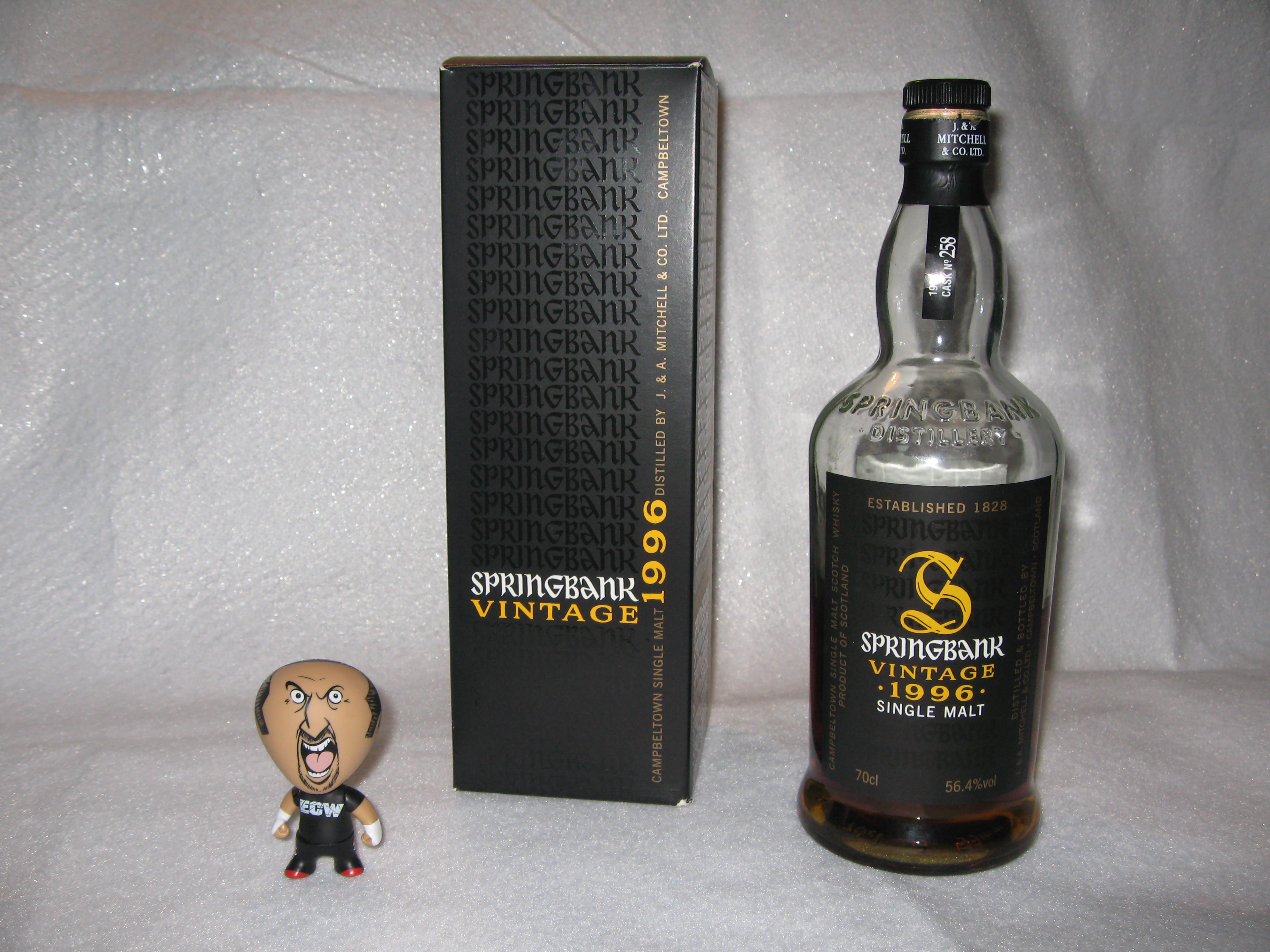
The contender Tommy Dreamer aka “Pretty Boy” for SPRINGBANK

Distilled 1996 – Bottled 2008 56.4% ABV Cask # 258 Manzanilla 12 Year old.  Limited to 594 bottles.  Bottled exclusively for Kensington Wine Market in Calgary.

NOSE:  Burnt sugar, spicy Partagas cigar, nutmeg.

TASTE:  Chewy vibrant spice, chocolate cake, almonds.

FINISH:  Long and warm, but very smooooooth.

ASSESSMENT:  Great stuff.  The people that helped choose this cask did a great job and should be consulted for any future cask selection.

Kensington's 1996 Springbank

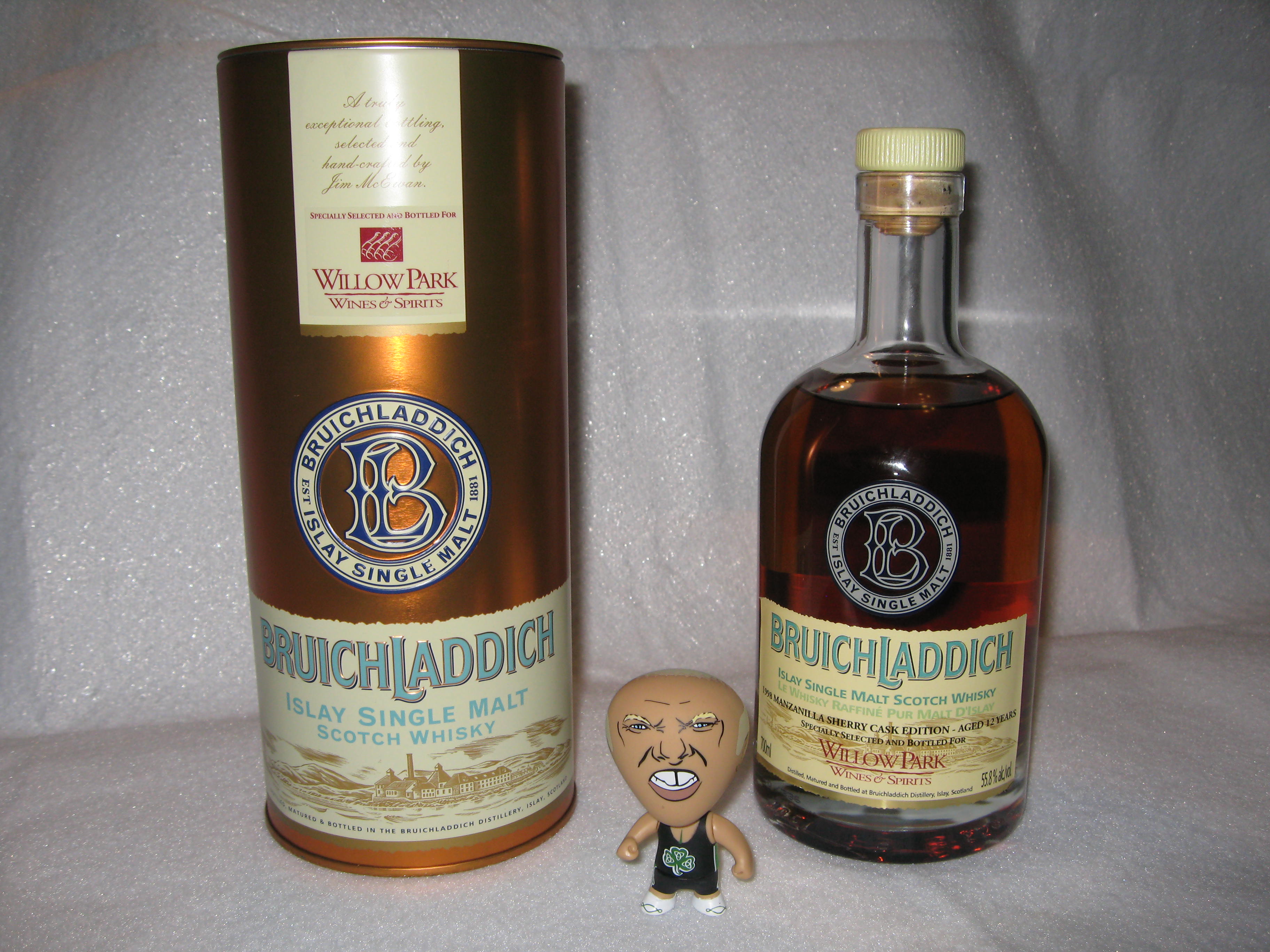
The upstart Fit Finlay aka “The Belfast Bruiser” for BRUICHLADDICH

Distilled 1998 – Bottled 2010 55.8% ABV Manzanilla cask.  Limited to 240 bottles.  Bottled exclusively for Willow Park Wines & Spirits Calgary

NOSE:  Banana custard, chocolate fudge, honey.  There is way more here than I have described, may need some help on this one.

TASTE:  Creamy cappuccino, marzipan, orange peel.

FINISH:  Long and sensuous.

ASSESSMENT:  This will set your heart a-bubblin, on the rocky road to Dublin.  One of the best and most interesting sherry casks I’ve tasted from Bruichladdich.

Willow Park's Bruichladdich

* CCUFS: Calgary Current Center of the Universe For Scotch

          – MM

Macallan Tasting – December 1st, 2010

Note:  This event took place on the 1st of December, 2010.

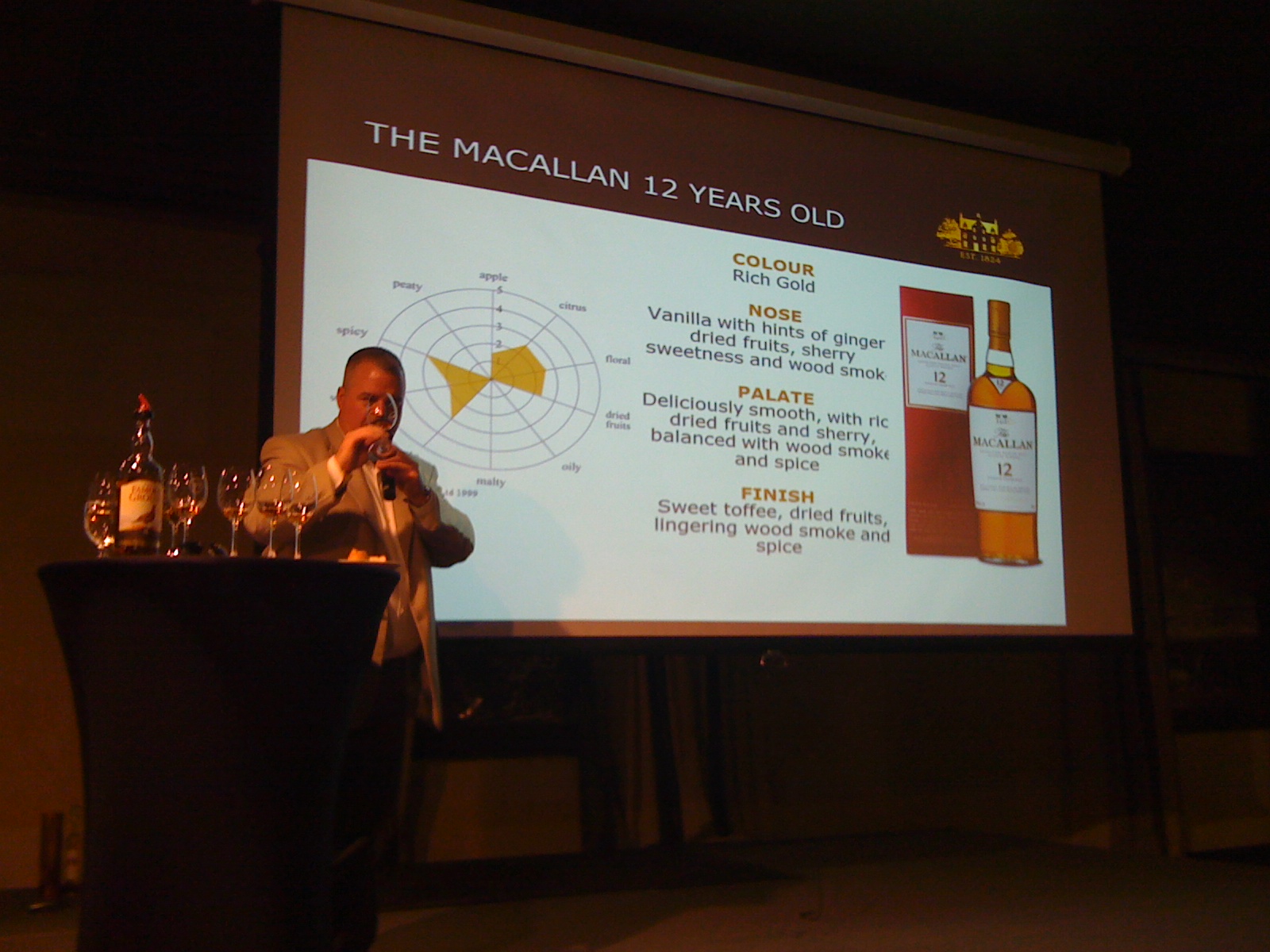
Laughs were easy tonight.  The audience, 102 strong, was there to have a good time and J. Wheelock’s casual demeanor helped to make a relatively formal event feel both comfortable and familiar.  A gift he has.  I mentioned similar thoughts regarding J’s approach in a review of a tasting he put on for Highland Park last year.  Edrington has an ace in the hole here with someone whose skill is matched only by the sincerity of his passions for what he presents.

J Wheelock at work

This particular event, much like the last, was a case where class won out.  The visuals, those of both Willow Park and Edrington, were warm, dark and cozy.  The ambience was set from the moment of arrival.  Everyone was greeted at the entrance with a glass of the Famous Grouse on ice and instructed to mix with bottles of ginger beer on the tables to create what they had deemed “the Ginger Grouse”.  Not bad.  Not particularly my thing though.  Regardless of preference and palate, it was a great welcome.

The presentation began with some history on the distillery, region and malts, and was peppered with humorous anecdotes and shared personal experience.  These are the pieces that come together to make these sorts of tastings worth attending (of couse, the whisky doesn’t hurt either, I suppose).  Many enthusiasts will never step foot on Scotland’s shores, let alone be allowed into the inner sanctum of some of the distilleries, so these insider insights are both entertaining and enlightening.  

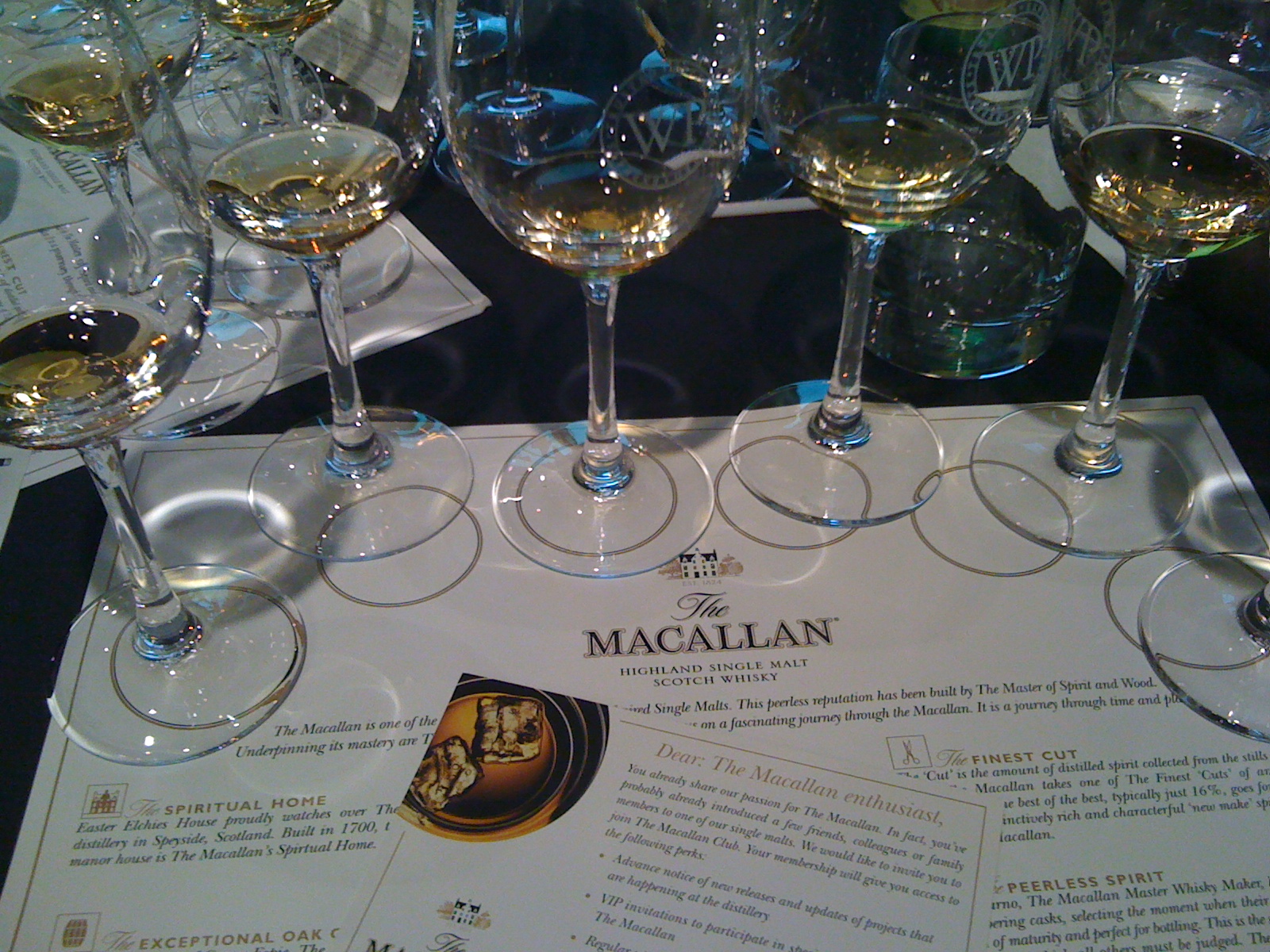
As the presentation unfolded we began to work our way through the lineup of malts that had been laid out for us.  Quite a range, really, and one that afforded a good look at the varied portfolio of the Macallan.  A few brief notes (several of these will be reviewed in the coming days) to give you an idea:

The evening's fare...a nice range of the Macallan


Macallan Sherry Oak 12 y.o. – Slightly oaky.  Sharp purple fruit and honey.  Sherry brings a touch of baking spice. Caramel apple.  Peppery grape/raisin on the palate.  Thin feel.

Macallan Fine Oak 15 y.o. – Typically Speyside-ish.  Tangy fruit, vanilla, fresh greens and smoked wood.  More floral and woody on the palate than the nose.  Somewhat weak in the delivery.

Macallan Sherry Oak 18 y.o. – Complex maturity.  Toffee with cinnamon and sherry.  Oak is an anchor.  Smoked apple skins.  Spices creep to the front on the palate.  Figs and cloves.  Best Macallan I have tasted to date.

Macallan Fine Oak 21 y.o. – Quite peppy and fruity.  Sweet caramel and vanilla.  Mixed tropical fruits.  Big citrus notes.  Nice arrival that builds to a head of creamy orange fruit and sugars.  It is the peppery woods that linger.  My wife referred to it as quite wintery fresh (my words, not hers).

Macallan Fine Oak 25 y.o. – Stunningly sweet toffee notes.  Mild and mature fruit.  Mildly floral with a hint of pepper.  Touch of peach and sugary biscuit.  Hint of smoke on the palate with a bit of an apple bite in the finish.  Almost bitter.  Much better nose than palate.  Great nose, in fact.

Macallan Fine Oak 30 y.o. – Mature and dignified.  Beautifully balanced fruit and caramel.  Again…dry apple finish.  While good…age does not win out here though.  The 18 year old is better.

Gotta be honest.  I have made no small secret of my uncertainty regarding Macallan.  It was never an issue of not liking the whiskies…more like being underwhelmed with what I had tried.  Did this tasting alleviate that?  Well…yes and no.  We tried some great whiskies, the 18 in particular being quite spectacular.  We also tried a couple that were beyond what most in attendance would pay for a bottle.  Both tasty and rewarding.

However…I have to stand behind the conviction that Macallan’s price point is simply too high.  The 12 year old is nearly $80 and the 18 year old hovers around $175.00.  At the end of the day I promise you can find better malts for less.  Does this make these bad whiskies?  Come on…of course not.  Quite the contrary.  I simply expect more for less, and can’t think of another brand out there that is pricey across the range as the Macallan.  I’ve said before though…value is subjective, and obviously many others out there see things in a vastly different light than I. 

Back to the evening…

To close out an already great night, J. asked everyone to take home the Macallan tumblers that had been placed in front of each setting.  A nice token and one which Edrington has done at both events I have attended. 

Nosing techniques and explaining the flavor map.

This tasting was nifty for me.  For the first (but hopefully not last) time my wife actually attended with me.  Can’t think of anything that could have made the night better. 

This will certainly not be the last event I attend put on by the Edrington group.  A great tasting.  Look forward to the next.

Feature Interview – John Glaser of Compass Box

John Glaser is the man behind Compass Box whiskies.   His unique and uncompromising approach to the craft is nearly unrivalled in terms of innovation and determination.  This fierce drive and desire to break the mold have led to more than a few hackles being raised, and conversely…not a few glowing accolades.  While finding ways to work within the narrow confines of SWA regulation John has still managed to carve his niche and blaze a trail of originality.  His battles to bring The Spice Tree to life are legend now. 

Along the journey, John has littered the path with gems the rest of us are fortunate enough to pick up.  Hedonism, Eleuthera, Flaming Heart and The Peat Monster are but a few.  I would strongly recommend any whisky enthusiasts find their way to one of John’s tastings, and if that proves an impossibility…well…hit up your local specialist and tell them you want Compass Box.

Now.

Without further ado…

John Glaser.

John Glaser

ATW:  How did Compass Box come about?  Your history in wines and working with Johnnie Walker have quite obviously given you a formidable bedrock from which to start, but was there a catalyst that made you say “okay…here’s what I’m going to do…”?

JG:  Starting Compass Box came out of a realisation that I was in a unique situation:  I am someone who likes making things, who enjoys the creative process, and I found myself living in the UK with an idea for doing Scotch whisky in a different way (that of the craft-scale blender), access to purchasing whisky direct from the producers, and an understanding (due to my work) of how to bring whisky brands to market internationally.  One day, on a holiday to the island of Eleuthera, I simply decided I was going to act on this and do it on my own.  There did not seem to be any option otherwise.  It just seemed to make perfect sense.


ATW:  Can you explain the significance of the name ‘Compass Box’ and why you
chose it?

JG:  See:  http://server7.sky-map.org/starview?object_type=5&object_id=69&locale=EN


ATW:  Compass Box whiskies are beautiful marriages of only a select few components.  Was this more of an early reflection on the quality of certain whiskies and your opinion of how they would compliment each other, or a reaction to the homogeneity that is too often a product of blending many whiskies?

JG:  It was both.  My approach to blending is that I WANT the characteristics of key whiskies to stand out.  I don’t want to use so many components that you achieve homogeneity.  It’s a different approach to blending than others take.  I start by using component whiskies with significant character and build around that, adding a few other whiskies to enhance complexity, to complement, to create balance.


ATW:  When you started up Compass Box were you aiming primarily at whisky enthusiasts?  Has this changed over time?

JG:  I have always aimed at people who seek out good stuff.  Whether whisky enthusiasts or not.  The core mission of our business is to share the joys of great whisky with more people.  In the beginning, this was mostly picked up by enthusiasts, but as we ‘ve grown, our reach has broadened.


ATW:  Do you single-handedly create all Compass Box expressions?

JG:  As our business has grown, and as the range of what we offer grows, I have been helped enormously by Gregg Glass, my assistant.  I still create the direction for new whiskies and lead the creation of these through prototype development.  Gregg helps me with this and helps manage our relationships with the distillers, coopers and our bottler.


ATW:  Where does the inspiration for your new lines come from? Do you start with a specific end in mind, or build on the-go as you come across interesting casks that will form the foundation of something new? Have you ever reached out to your customers for input on new blends?

JG:  Inspiration comes from all over.  There is no formula.  I believe if you work hard and if you keep your eyes open inspiration will come along.  You can’t plan for it.  You have to just keep working.


ATW:  What can you say about the Compass Box wood policy?  You are purchasing mature (or maturing) whiskies to use in your blends, of course, but the wood you choose for final maturation will obviously have an influence on your end product.

JG:  Our policy is to work with higher quality, more active wood.  By higher quality I am talking about two aspects:  one is how active the oak is, which is based on how many times it has been used.  The more a cask is used, the less it has to offer in terms of flavour materials and the less complexity you are able to achieve in the whisky. Most casks in Scotland are far too many times in my mind.  Which is why so many Scotch whiskies are boring.  Secondly, I am talking about the inherent quality of the oak for maturation purposes.  This is based on the tightness of the grain, the type of seasoning (air-dried, which we prefer, versus kiln-dried), the duration of the seasoning, (generally, longer air drying of the wood creates more complex and delicious flavours in the wood), and the type of toasting and/or charring the wood is exposed to (this transforms the flavours in the oak further and very significantly).


ATW:  What is the Compass Box expression you are most proud of to date?

JG:  You mean, which child am I most proud of?  Hmm.  Difficult… .


ATW:  Going on a decade now, can you reflect back on the peer reception Compass Box received upon inception, and the esteem it is held in now?

JG:  Perhaps a question better answered by others.


ATW:  What has been the single greatest hurdle Compass Box has had to overcome?

JG:  My tendency to try and do too much.


ATW:  Compass Box has been the recipient of many awards (over 60 at this point, I believe).  Can you speak to the award that meant the most to you?

JG:  Our first award for Innovation was given to me in our second year, and it was presented to me by the late Michael Jackson.  I look back on this fondly, for he was such a tremendous influence on the world of whisky (and beer, for that matter!).  He was a devoted individual who worked extremely hard, right up until he passed away.


ATW:  When you hold master classes or tasting events, what is the message you really want to get across to the audience?

JG:  Share and enjoy.


ATW:  There has been mention of Compass Box tastings that allow a ‘blend at your table’ deal for attendees.   Can you elaborate on this and the inspiration behind it?

JG:  I simply believe that one way to change peoples’ perceptions of something, of anything, you need to offer them rational explanation for why their current perceptions are inaccurate.  To change the perception in whisky that blending is somehow bad (and anything “single” is supposedly good), I let people blend for themselves, using our components.  They see that when you start with high quality components, and just a few (not 30 or 40), and if you blend with care and with a stylistic objective in mind, you can make lovely things.  When people experience this, it changes their minds about the possibilities with whisky blending.  For ever and for good.  This is our “blending school” program which we have been running for several years now.


ATW:  …and finally, a fun one…

I believe you were a literature major.  Can you recommend a few book and whisky pairings for the Compass Box expressions?

JG:  Alfred Jarry and The Peat Monster.  I’ll buy a drink for anyone who
makes the connection between the two!

Thanks, John.  Your time and effort are appreciated.

The gauntlet has been thrown.  I wiki’d Alfred Jarry and am now more than intrigued.  Readers out there…if you make this connection please do not post it here.  Keep it on the downlow until you meet Mr. Glaser.  Let’s keep this challange alive.

Slainte

Feature Tasting – Octomore vs Ardbeg Supernova

ATW’s good-hearted foot soldier and trained palate extraordinaire Maltmonster takes us on a head-to-head battle between the world’s peatiest drams…Bruichladdich’s Octomore and Ardbeg’s Supernova.  This particular collision is between the first release of Octomore (1.1) and Ardbeg’s latest incarnation of Supernova (SN2010).

At some point in the future I’ll put up my own notes for how these stack up.

Anyway…back to the here and now…


BOG PEOPLE – EXPOSED

TASTING OF TWO PEATED WHISKIES SUPERNOVA & OCTOMORE


Bog People also known as peat freaks, marsh mutants, peatophiles and phenol fanatics exist all around us. They hold normal jobs, eat normal food and they live just like normals, except they have a dirty dark secret.  They are addicted to layers of decaying vegetation called “peat”.  They roast their peat over barley, which they turn into alcohol in order to speed the delivery to their brains.  Most normals have no ideal as to the scope of the problem or the ability to recognize an infected person.

As a self acclaimed expert with months of experience I have no problem in identifying the people of the bog.  Four easy clues to identifying people who suck the bog juice are as follows;

1)  Language.  It’s a dead give away.  They use words like medicinal, tar, iodine, smoky, creosote, bonfire, diesel, reek. Learn these words and know the first warning signs.

2)  Visual.  Look around the house for bottles with  names like Authenticus, Ardbeg, Bowmore, Brora, Bruichladdich, Bunnahabhain, Caol Ila, Laphroaig, Port Ellen.  Be careful here, they are a tricky bunch and have been known to hide, or as they refer to it “stash”, their bottles.  Check the basement, attic and the garage.  They have also been known in extreme cases to hide their bottles at the neighbor’s.

3)  Leader.  Yes I said leader.  They follow and pay homage to the prophet named James Murray.  Again look around the house for books, and in particular look for a bible which bares the prophet’s name.  At the mere mention of the prophet’s name most bog people will stop whatever they are doing and immediately start chanting “Ardbeg whisky of the year, Ardbeg whisky of the year, Ardbeg whisky of the year”.  Know their leader and it could save your life.

4)  Promised land.  As strong as the need for some birds to head south for the winter, so is the desire for each Bog person to visit their promised land.  Their mystical home land is called “Islay”, which is an island off the coast of Scotland very close to Ireland.  They feel compelled to visit this island at least once in their lifetime.  Anytime the name of the mystical homeland is mentioned their eyes glaze over, drool falls from the mouth and they babble names of distilleries located on this mystical island.

Other warning signs of peat freaks in your midst may be breath smelling of a campfire, saved websites of distilleries on Islay, wills stating their bodies are to be interred on Islay.

Two commonly preferred whiskies drank by bog people are:

ARDBEG – SUPERNOVA (SN2010)

60.1 % ABV.      OVER 100 PPM

NOSE:  Strong smoke, farmy.  Lemon and pepper.

TASTE:  Salty, liquorice, some fruit.  Very chewy.

FINISH:  Long and warming.  Little dry.

ASSESSMENT:  Not as assertive as the Octomore and way more balanced with favor.

Ardbeg SN2010

BRUICHLADDICH – OCTOMORE  01.1   

63.5% ABV.   131 PPM

NOSE:  Creosote, Bolivar cigar, smoked oysters…hell maybe a smoked kitchen sink.

TASTE:  Intense smoke, salty and some young vanilla.

FINISH:  Powerful, robust and long.

ASSESSMENT:  Like the taste you get after breaking a bottle on the road and then spending the next hour licking it up.

Bruichladdich Octomore 1.1


Never, never use pepper spray on a peat head as they only enjoy this as additional favoring.  Also never use a stun gun on them as the many years of exposure to peat has left their senses so dull as to render the stun useless.  Never approach a large group of peat heads as they can be very dangerous.  I heard from a creditable Hollywood source that George Romero wrote Dawn Of The Dead after visiting some peat freaks on Islay.                         

If you find yourself trapped with a peat freak please remember the following:  Burn some smoky incense or light a fire which will serve to calm them; tell them you have to go to the store to pick some smoked oysters or smoked salmon to pair with their brew; Once outside phone the police, they are very adept in dealing with these deviants.

– MM

Bruichladdich – Redder Still / Blacker Still / Golder Still

STILL WATERS RUN DEEP

           Tasting of a series of three one off bottlings from Bruichladdich;  Blacker Still / Redder Still / Golder Still


Well in this case the opaque colored glass vessels might hint at the liquid contained inside, but the greater depth of this product is what’s hidden inside.  The radically different favors of each bottle share little in common with one another other than they all were born of the Bruichladdich stills.

BLACKER STILL

20 YEARS OLD   1986-2006   50.7% ABV.   Limited To 2840 Bottles, Matured in Sherry casks.

NOSE:  Burnt caramel, raisins and ham.  Light smoke

TASTE:  Both tart and sweet.  Spice, chocolate.  Chewy for sure

FINISH:  Intense at first then fades quickly.  Medium to long

COLOUR:  Deep mahogany

ASSESSMENT:  I’m a sucker for scary Sherry, but this Sherry is more aggressive than a Christian Bale Rant. Not the Black Bowmore as someone suggested to me, but is still very good.


REDDER STILL


22 YEARS OLD   1984-2007    50.4% ABV.  Limited to 4080 Bottles, Matured in first fill bourbon casks and finished in Chateau Lafleur Pomerol Bordeaux casks.

NOSE:  Refreshing fragrant, marshmallow and creamy honey

TASTE:  Vibrant oranges.  Mulled wine.  Tad chalky

FINISH:  Long and gets more intense and warming at the end

COLOUR:  Copper amber

ASSESSMENT:  This has more wine than what was heard from Paris Hilton in jail.  Almost needed to break out the cheese for this dram.  Was a favorite of one of my neighbors who doesn’t normally like whisky.  All in all this whisky is a great example of wine finishing.

GOLDER STILL

23 YEARS OLD   1984-2008   51.0% ABV.  Limited to 4866 Bottles, matured in unusual rare squat bourbon hogsheads casks allowing more contact between whisky and wood.

NOSE:  Rich malt.  Apples and raisins.  Whiff of smoke

TASTE:  Oaky at first giving way to gentle cream.  Soft fruits

FINISH:  Medium plus a little more

COLOUR:  Straw gold

ASSESSMENT:   This works as well as Tom Hanks in the movie ‘Joe Versus The Volcano’, defies description.  One for the book of “easier to ask for forgiveness”.

I still think the common denominator with the three releases is that Bruichladdich is still trying, and is still leading the industry with new still and old still made whisky products.  So as long they are still producing, they can still count on me to be still buying their product.  Still I ponder in the still of the night what Bruichladdich meant when they named these three releases something still other than they were made from a still by a still-person or maybe they meant that they were excited to still be in business with all the big money players still out there.

– Maltmonster

Malt Messenger No. 44‏


Malt Messenger No. 44

Dear Malt Messenger Subscribers,

A very Happy New Year to you all! I hope the holidays treated you well, and that you are rested, rejuvenated and brimming with optimism for the coming year.

I’m looking forward in 2011, to some great new whiskies, interesting tastings and some fun whisky tours. On the whisky front we have two new casks on the way from the Isle of Arran distillery. It was so difficult choosing between the two best cask samples—one bourbon and one sherry—that we simply decided to go with both! These whiskies will be formally launched at Scots Wha Hae, our Robbie Burns Supper, on January 26th , and will be available for purchase in late February or March. With a forecast price between $85-90 these will be our most reasonably priced private bottlings to date.

Speaking of our Burns Supper, we are back for our 6th straight year in 2011. For the third year in a row we will be back at Fort Calgary, which has been an excellent venue for us. The room is beautiful, the food excellent and the service first rate. “Scots Wha Hae” incorporates the traditional elements of the Burns Supper, poetry, song, highland dance, bagpipes and haggis, and blends into it a tasting of six whiskies from a feature distillery. This year our guest distillery is Arran and its brand ambassador Andrew Hogan our special guest. More information can be found on our Burns Supper below.

After a break in 2010, my whisky tours are back on the agenda beginning in May 2011. Speyside and the Southern Highlands (May 15th-21st) is already full, but the Islay and the Southwest Coast (May 8th– 14th) my most jam packed trip has plenty of room. I will be posting dates for my fall tours later in late February or early March. If you would like some more info on my whisky tours checkout: www.fergusonswhiskytours.com..

There are plenty of exciting new whiskies on the way this year, but before we can even start thinking about those, there are some whiskies which came in late in 2010 that we need to get caught up on first. There is Ballentine 17 Year Old (Jim Murray’s 2011 World Whisky of the Year), the Amrut Intermediate Sherry, some exciting new whiskies from Compass Box (Hedonism Maximus, Peat Monster Reserve, Flaming Heart and Double Single), Glenglassaugh Manager’s Legacy 1974 and 1986, Forty Creek Confederation Oak and  Signatory Dufftwon 1984 26 Year to name just a few!

Finally, I have a few New Year’s resolutions I’ve made that I hope will make the Malt Messenger more useful and more enjoyable. Firstly, I resolve to continue sending it out when I have something important to say or when I’ve been inspired by the whisky muse. The most rewarding compliments I have had about the Malt Messenger over the years have remarked on the genuine love and enthusiasm which comes across when I’m writing about whisky. Secondly, I resolve to not make the Malt Messenger more formulaic. Let’s face it, that just not my style. Anyone who’s ever seen my workspace can attest to that. The Malt Messenger will continue to vary in length and composition according to how much I have to write about, how inspired I am and what kind of time is available to write it. In short I resolve to continue giving you all, what so many of you have told me you’ve enjoyed over the past five years.

So curl up by the fire with your malt of choice and dig in. I hope you enjoy the first Malt Messenger of 2011!

Slainté!

Andrew Ferguson

PS-Don’t forget you can follow me on twitter at www.twitter.com/scotch_guy , I promise I will eventually getting around to sending out tweets again soon!

IN THIS ISSUE:

  1. Scots Wha Hae! – Our 6th Annual Robbie Burns Supper
  2. New Tastings Added
  3. A Tale of Two Dufftown’s
  4. Distillery in Focus – Glenglassaugh
  5. New Whiskies From Compass Box
  6. Collector’s Pick for December
  7. Collector’s Pick for January
  8. Kilkerran “Work in Progress” #1 vs. #2
  9. Forty Creek Confederation Oak
  10. Whisky 101 – Part I – What is Whisky?
  11. Ballantine’s 17 Year – World Whisky of the Year?


SCOTS WHA HAE! – Our 6th Annual Robbie Burns Supper at Fort Calgary – Wed Jan 26th 7PM – $99

Please note the deadline for registration is Tuesday January 25th at 3PM. With the first 80 tickets nearly sold we’ve just added another 40!

Our Robbie Burns Supper has grown from a humble event with just 20 participants—and one clueless host: yours truly—to one of the most respected in the city. We take a traditional Burns Supper and blend in a tasting of single malt Scotch whisky. Every year we feature one distillery, and invite their brand ambassador to attend as our special guest. This year we are pleased to present the Isle of Arran distillery, and its man, Andrew Hogan. Andrew’s a brave man, like Jamie Mackenzie of Bowmore distillery last year he has agreed to address the haggis, the evening’s most important ritual.

Isle of Arran is one of Scotland’s youngest distilleries, but in its 15 years of operation it has earned a strong reputation. The distillery produces soft, smooth whiskies with signature grassy-honey notes. We’ll sample 8 whiskies from Arran distillery including two barrels being bottled exclusively for Kensington Wine Market:

  1. Robert Burns Single Malt
  2. Arran 10 Year
  3. Arran 14 Year
  4. Arran Moscatel
  5. Arran Sauternes
  6. Arran Amarone
  7. Arran KWM Bourbon Cask
  8. Arran KWM Sherry Cask

In addition to the whiskies there will be a traditional three course meal prepared by Fort Calgary, highland dancing from the Springbank School of Highland Dance, poetry, piping courtesy of Mary Ann Houston who is with us for her 5th year, song and great camaraderie. And of course Terry Lauder, who’s been with us since the start, will be there again this year to delight and entertain. The evening is light-hearted and fun, whether in a group, as a couple, or single you’ll have a great time. If you’ve never been to a Kensington Wine Market Burns Supper, come see what you’ve been missing!

NEW TASTINGS ADDED

To meet demand, we have added an addition “Classic Malts” and “Rare Malts” tasting, the description and dates follow below:

  1. Classic Malts II – Monday February 28th – Back to basics, “Classic Malts” is our introduction to the world of Scottish single malt whisky: its regions, history and taste profiles. – $35.00
  2. Rare Malts II – Friday March 11th Only the oldest and rarest whiskies need apply! Taste whiskies that have been matured more than 20 years in oak, and are from closed distilleries or are exceptionally rare! – $75.00


A TALE OF TWO DUFFTOWN’S

We’ve had a very heavily sherried bottling of Dufftown in store for the last couple of months. It was a sherry monster with notes of burnt fruits and a trace of sulphur (full tasting note to follow below). I reordered it for Christmas, but instead of getting more of the same serendipity intervened. We received a different bottling of Dufftown from the same producer, distilled and filled into sherry casks on the same day, the only difference is that one of them is a first fill sherry cask, and the other a refill. I describe this as serendipitous because it was only by chance that we had two different bottles of whisky from the same distillery which we can compare with each other for the purposes of satisfying ones curiosity. Here we have a classic example of the difference between first fill and re-fill sherry!

Dufftown is one of Scotland’s more overlooked distilleries, not because it is in bad nick, but because it is an almost unknown quantity. There was until recently only one official bottling, and more than 97% of the distillery’s production continues to be used for blending, mainly in Bell’s. The distillery was until the launch of Roseisle a few years back the largest of Diageo’s 27 distilleries. Dufftown was the 7th distillery built in the town for which it was named. While other Dufftown single malts have gone on to great fame like Glenfiddich, Balvenie and Mortlach it continues to live in their shadows. But we have two interesting and very different bottlings of Dufftown which can help shed a little light on this little know distillery. Both of these Signatory bottlings are exclusive to KWM.

  1. Signatory Dufftown 1984 26 Year – Distilled: 09/01/1984 – Bottled: 12/04/2010 – Age 26 Years – Refill Sherry Butt – Cask #79 – 311 bottles – 55.0% – My Tasting Note: Nose: biscuity, fruit flan, graham wafers and honey, some rich sherry notes, buttery oak, malted milk candy bar and traces of sauternes; Palate: lovely soft sweet sherry notes, a dollop of sweet spices like cinnamon, ginger and cardamom and rich toasted oak which fades to soft leather and damp tobacco; there is sweet Christmas cake and some burnt fruits too; Finish: vanilla extract, more fruit flan, honey and soft sherry with some lingering tobacco; Comment: this is the more elegant and complex of the two. – $209.99
  2. Signatory Dufftown 1984 25 Year – Distilled: 09/01/1984 – Bottled: 14/09/2009 – Age 25 Years – First Fill Sherry Butt – Cask # 80 – 455 bottles – 57.5% – My Tasting Note: Nose: big, dark and chocolaty (dark), old saddle leather, a pleasing trace of burnt matches, and big, bold sherry notes; Palate: big and chewy, the sherry is lush and full throttle, some sweet and sour fruits with a bold layer of sulphur, firm earthy tannins and more leather; as the bottle develops the sulphur fades and spices and fruit come to the fore; Finish: sweet, spicy and fruity with fruit chocolate and earthy leather; Comment: this one is for the sherry bomb fan and is the more full bodied whisky of the two. $209.99


DISTILLERY IN FOCUS GLENGLASSAUGH

Glenglassaugh distillery was founded between 1873 and 1875 on the Morray Firth between the towns of Portsoy and Cullen. The distillery’s early history is a little like passages from Genesis in the Bible with so and so begetting so and so, distillery closures, reopening and the like. The real story begins in 1957-59 when the current distillery took its form. It reopened in 1960 and all the whisky we know of as Glenglassaugh was produced between this date and 1986 when the distillery closed again. The early to mid eighties were a difficult time in the world of whisky, a glut of production in the 1970’s provoked a spate of closures.

Few official bottlings of Glenglassaugh have been released. In 2005 a 22 year old was launched by then owners the Edrington group. In 2006 19, 38 and 44 year old bottlings were produced in very limited quantities. Then in 2008 Scaent Group of the Netherlands purchased the distillery for an astounding £5,000,000.00. What made the purchase price all the more surprising was the fact that the deal included only 400 casks of maturing whisky. The new owners would have to make do with this until their new make was old enough to sell and market as whisky. The distillery’s core range which was quickly launched in 2008 consisted of 21, 30 and 40 year old whiskies; certainly the oldest core range ever launched. And further the distillery required more than a million pounds in refurbishment and upgrades just to get operational.

Time will tell whether the Scaent Group’s investment will pay off, or whether the price for the distillery was too dear. In the short term we have some excellent distillery edition bottlings of whisky to sample and enjoy. One interesting note on those whiskies before we get to the tasting notes: it seems the distillery had some questionable advice when it came to marketing its core range. Even though the distillery’s first three whiskies were 24, 31 and 41 years old the marketing gurus felt they would have better prospects if they were sold as 21, 30 and 40 year olds. They won’t be taking this advice any longer. The new 26 year old is 26 years old!

Kensington Wine Market stocks and or has access to the following Glenglassaugh bottlings:

  1. Glenglassaugh Spirit Drink – New make spirit at 50% – 500ml – My Tasting Note: floral and fruity, raspberry vinaigrette, creamy-aloe-like vegetal notes, soft and grassy; Palate: malty, soft, sweet, more floral tones, raspberry jam and marmalade, somewhat vodka-like with soft oils; Finish: grassy with faint honey notes; Comment: interesting to be able to try the raw spirit, but too expensive. – $47.99
  2. Glenglassaugh Spirit Drink That Blushes… – New make spirit matured 6 months in “rare” California red wine casks. Just don’t call it whisky!” – 50% – 500ml – My Tasting Note: Nose: earthy with red berry fruits and green grassy malt; Palate: lusher than expected, soft and earthy, juicy wine notes, more grassy malt with gin-like tones; Finish: warming and earthy with more grass; Comments: I think this is a brave idea, but far too expensive to make it anything more than a curiosity. – $47.99
  3. Glenglassaugh 21 Year – Sadly this whisky is no longer available. Although the bottle declares the whisky to be 21 years old it is actually 24. – 21 Year – 46% – My Tasting Notes:  Nose: lovely elegant sherry notes, chocolate “turtles”, candied nuts, moist brown sugar, maple syrup on Belgian waffles and pecan pie; Palate: warm and rich with sweet-spicy-buttery sherry notes that smother the palate with delicate flavours; there is a minty element; the spice keeps the sweet notes under control—perhaps a little too much; there are many layers including Christmas cake, toffee cake in fresh cream and black liquorice; Finish: soft and gently sherried with a tinge of something bitter like coffee that fades; it is long pleasant and coating; Comment: elegant, lots of layers but a there is too much of a stiff upper lip here, I want a little more from the sherry (bourbon notes were more prominent when I tasted this whisky again after the 26 year)! – $256.49
  4. Glenglassaugh 26 Year – Replaces the 21 Year Old. – My Tasting Note: Nose: shyer than the 21, fig bars, marzipan, savoury, highland toffee and chocolate fudge; Palate: a lot richer than I was expecting and very lively with bold sherry notes, very sweet, creamy and just spicy enough to hold it all together; not as soft as the 21 year, but more complex and layered, my mouth is wavering between drying out and salivating; this is an exceptionally drinkable whisky with big sherry notes; Finish: a little perfumed, and showing a faint whiff of sulphur the finish is drying with lovely rich sherry notes. Comment: Jim Murray is off his rocker…  there is little wrong with this dram, the nose was a little weak and the sherry notes may have been a little top heavy but it is a great drink! – $256.49
  5. Glenglassaugh 30 Year – Actually 31 years old. My Tasting Notes: Nose: toffee and caramel to start; the nose is shier than the 21 year; there are vanilla and custard notes, as well as orange citrus and some grassy malt; green apple and other white fruits emerge as the nose opens up; Palate: big citrus and loads of spice (burnt ginger and clove); lemon and lime citrus notes along with orange peel and grassy oils; the palate is very green and vegetal, there is some vanilla and toasty/creamy bourbon notes; there is some unripened green apple and heather honey too; Finish: long drying and grassy with traces of something sweet more citrus; Comments:  a good whisky, but a little light and under-gunned compared to the 26 year old.  $683.99
  6. Glenglassaugh 40 Year – Actually 41 years old. My Tasting Note: Nose: massively rich, damp tobacco, stewed fruits, moist toffee cake, tropical fruits (mango and papaya), medium-dark chocolate, and soft dark sherry notes; Palate: dark coffee notes and firm earthy tannins on the first pass; the dry oloroso sherry notes dominate the palate, but the second sip is more fruity and lush with the same moist toffee cake found on the nose and the same tropical fruits though they are more restrained, the third sip is soft with gentle oils and waves of complexity, there is spice aplenty with burnt ginger and clove; one final pass reveals dates, raisins, plums and other dark fruits; Finish: the finish is long and drying with lingering notes of coffee, Oloroso sherry, dark fruits and cigar smoke; Comments:  this is a fine example of a good older whisky, on the verge of being over the hill: too old, bitter and oaky. It has extracted the best of what the oak has to offer and been bottled not a moment too soon. Though not in the company of the Macallan 50 Year Lallique or Black Bowmore 1964 42 Year it is an excellent older whisky and a rare one at that! $2528.99
  7. Glenglassaugh Manager’s Legacy 1986 – Limited release of 500 bottles. KWM has 1/6 left. – 45.3% – Sherry Butt – My Tasting Note: Nose: candied nuts, Christmas cake, spicy sherry oak, almond paste, marzipan and treacle; Palate: very soft and fruity with a thick oily body, becomes more fruity and creamy as the slightly bitter sherry notes begin to fade into chewy candied fruit; there is some toasted oak, but it is soft; my mouth is watering in anticipation of more; Finish: long, dark and rich, a sherry bomb; Comments: a great single cask bottling, something we won’t see a lot of from a distillery which started out with 400 mature casks.
  8. Glenglassaugh Manager’s Legacy 1974 – Limited release of only 200 bottles. Sadly KWM has already sold out of it! – Bourbon Cask – 52.9% – My Tasting Note: soft, fresh cream, fall grass, crème brule, dusty malt, coconut shavings and peaches and cream; Palate: very sweet, creamy, honey in fresh cream with caramelized strawberries, some liquorice and warm brown sugar; Finish: incredibly long and soft with fresh cream, honey and toasted coconut crisps; Comment: an exceptionally elegant whisky, wish I had another couple dozen bottles!

The Kensington Wine Market has access to all of the Glenglassaugh whiskies with the exception of the 21 year old and the 1974 Manager’s Dram; these have sold out. There is only one bottle left of the 1986 manager’s dram.

NEW WHISKIES FROM COMPASS BOX

Compass Box’s John Glasser is arguably Scotland most interesting and innovative blender. He has taken the small batch, non-chillfiltered, no colouring added approach of the most innovative single malt distilleries and applied those lessons and others to the Blended Scotch whisky categories. Since the explosion of interest and selection of single malts, the blended categories have come to appear boring and stale; Compass Box is making blended whisky cool and fun again!

More than 10 years ago John Glasser was working for Johnnie Walker as a blender. He had an idea for the company which he felt could add to the portfolio. He wanted to establish a branch of the company which would make small batch hand crafted blends. They weren’t interested, so he set out on his own. John’s whiskies are creative, innovative and different. His house style can be summed up in one word, elegant. Over the last two years I have gone from feeling indifferent to the blended categories, and Compass Box included, to a true believer. The Spice Tree was the first one to really catch my attention, and now we have four more worth consideration:

  1. Compass Box Flaming Heart – Is the official 10th Anniversary Bottling. Only 4186 bottles have been produced, with about 144 having found their way to Alberta. Without even marketing it, we’ve sold 22 of our initial 24 bottles. More are on the way. The Flaming Heart retails for $96.99  It received excellent score from both John Hansel and Jim Murray. I’ve included them below along with my own tasting note:
  1.  
    • Malt Advocate: 95pts John Hansel – “A marriage of three different single malts, aged in American and French oak. This whisky shows the advantage of marrying whiskies from more than one distillery (when properly done). Vibrant, with a complex array of fruit (orchard fruit, sultana), sweetness (light toffee, marzipan, honeyed malt), spice (creamy vanilla, mocha, warming pepper), smoke (tar, smoked olive, coal), and lesser notes of toasted almond and beach pebbles. More smoke and tar on the palate than the nose, yet always in balance. Well played! (Editor’s Choice)”
    • Whisky Bible: 95.5% Jim Murray – “The Canto range was, I admit, a huge over oaked disappointment. This, though, fully underlines Compass Box’s ability to come up with something approaching genius. This is a whisky that will be remembered by anyone who drinks it for the rest of their lives as just about the perfect study of full-bodied balance and sophistication. And that is not cheap hyperbole.”
    • My Tasting Note: Nose: dusty, some peat, very savoury (like a New York steak covered in sautéed mushrooms), sweet vanilla and ginger linger in the background, mulled and stewed fruits add to the complexity; Palate: at once smokier, sweeter and spicier than I was expecting; the palate is weighty and thick with the peat quickly taking control, there is rich sweet vanilla and round earthy peat, chocolate and stewed fruits provide the backdrop with the salty smoke showing late; overall rich, soft and very smooth with the signature Compass Box elegance; Finish: long with salty smoke and oily earthy peat; Comments: fans of Ardbeg, Bowmore, Laphroaig and Port Ellen will love this one, and how cool is the packaging!”
  1. Compass Box Double Single – This is a unique expression of Compass Box, also released to celebrate their 10th Anniversary. It is called the Double Single because it is composed of one single malt and one single grain whisky. The single malt is 18 year old Glen Elgin and the single grain is 21 year old Port Dundas, in a ratio of 76:24. Only 876 bottles have been released of which KWM is expecting only 12. The label features two very happy looking frogs.  $159.99
  1.  
    • From Compass Box: “What if we were to match perfectly one single malt whisky with one single grain whisky in just the right proportions? That is, what if we were to make a blended Scotch whisky with only two components, only two single whiskies rather than many? What if we were to make… a ‘double single’? This is the question our friends Duncan Elphick and Tatsuya Minagawa of the Highlander Inn on Speyside asked us in 2003, resulting in our first limited release bottling of The Double Single. For our 10th anniversary year, we’ve decided to bring it back. The whiskies we’ve chosen this time: an 18 year-old malt whisky distilled at Glen Elgin distillery (76 percent) and a 21 year-old grain whisky distilled at Port Dundas (24 percent), both aged in American oak (Glen Elgin was refill, the Dundas was first fill). The combination yields a full, soft palate of flavours reminiscent of pear fruit, maltiness, vanilla and creme brulee. This whisky is a testament to the virtues of combining grain whisky with malt whisky, a testament to the virtues of blended Scotch whisky. The grain whisky creates a lovely, soft, sweet pillow on which the malt whisky flavours luxuriate. This is just as great blended Scotch whisky should be.”
    • My Tasting Note: Nose: very fresh and creamy, coconut macaroons and coconut breaded shrimp, something minty and softly vegetal, soft vanilla and graham wafers, toasted oak with light spices; Palate: very sweet and soft with a big malt footprint, vanilla and coconut cream abounds and comes in soft undulating waves; the grain adds a layer of silky oils which compliment the rich bourbon notes which range from toasted oak to white chocolate; there is a firm backbone of clean spice underpinning the whole thing as well as some burnt citrus; Finish: warming and clean, sweet drying oak and vanilla with hints of mandarin orange; Comments: elegant is the only appropriate descriptor; Johnnie Walker Blue you’ve been bested!
  1. Compass Box Peat Monster Reserve Only  5,300 magnums (1.5L) bottles of this whisky have been bottled, and for the time being but 24 have come to Canada, all of them to the Kensington Wine Market. When Compass Box launched the original Peat Monster more than 5 years ago it was as the name implied, a peaty beast. In the years since we’ve seen the likes of Port Charlotte, Octomore, the Big Peat, Supernova and more, all of which make the Peat Monster seem tame. This special bottling has combined whiskies from Caol Ila, Ardmore and Clynelish. In the words of its creator it is “even peatier, smokier, richer and higher strength than the classic version”. Exclusive to KWM – $154.99
  1.  
    • Whisky Bible: “Nose: comfortable, thickish smoke and a dusting of peppers: complex and well balanced; Taste:silky soft malt oils cleverly disguise the big punchy peat which is to follow; lovely touch of golden syrup here and there, but mainly towards the delivery; Finish: smoky sweetened mocha; Balance: at times a bit of a Sweet Monster… beautiful stuff!” 48.9% – 92pts 
  1. Compass Box Hedonism Maxximus – Hedonism Maximus is a Blended Grain Scotch whisky created by blending select casks of 42 year old Invergordon with a smaller quantities of 29 year old Cameronbridge. Cameronbridge is interestingly Scotland oldest continuously operating distillery! The constituent parts, distilled in 1965 and 1979 respectively were matured in first fill American Oak bourbon barrels. It is deeper, sweeter and richer than the original Hedonism bottling hence the designation of “Maximus”. The whisky’s label is an homage to one of the Scotch industry’s long lost brands, Andrew Usher & Co.s “Old Vatted Glenlivet Whisky”. The label was inspired by an advertisement from OVGW from 1905 found in the National Archive of Scotland. Only 1500 bottles were produced, with but 24 coming to Canada, all of them to the Kensington Wine Market. – Exclusive to KWM – $259.99
    • Whisky Bible:  “Nose: the kind of aroma your nose was invented for: lots of rich bourbon swirls, with butterscotch, liquorice and chocolate-covered honeycomb arriving—big time!—on cue…; oh, and a few gooseberries and greengages tossed in for an extra dimension: it just doesn’t get any better… Taste: the oak is a bit top heavy on arrival, but lush malt cushions its impact to a degree; still juicy tongue-teasing; Finish: retains its overtly bourbon character to the end with massively chewy oak extract, but always enough sweetness in reserve to cope; Balance: Bourbon Maximus…”


COLLECTOR’S PICK FOR DECEMBER – Amrut Intermediate Sherry – $114.99

Only 90 or so bottles of this very limited release from the Amrut distillery have made it to Alberta, and of the dozen that the Kensington Wine Market acquired we have but 5 left! This whisky is limited to 1 bottle per customer out of fairness. It has been bottled at a cask strength of 57.1%. My tasting note follows below after Jim Murray’s which explains the origin of this whisky. Me thinks he may have had something to do with it…

“Amrut Intermediate Sherry – 96.5pts Jim Murray – “Nose: instead of the usual biscuit aroma, we now get moist cake. And my word: is it fruity and spicy!! Love the freshly waxed oak floor, too. Brain-explodingly complex and multi-layered with one of the most intriguing sherry-style-bourbon-style marriages on the market; Taste: cracking delivery and entirely unique in form. The structure is decidedly oak-based, but acts as no more than a skeleton from which the juicy sultana and spices drape. Salivating, too, as the barley kicks in powerfully. But the liquorice-orangey-honeycomb bourbon theme quietly shapes the flavour profile; the spices pulse and glow; Finish: quite a chunk of natural caramel quietens the more exuberant characteristics, long and elegant; Balance: how do you three freshly emptied oloroso butts from Jerez to Bangalore without the casks spoiling, and not use sulphur? Answer: empty two cases of Amrut cask strength whisky into each of the butts before shipping them. Not a single off note. No bitterness whatsoever. And the fruit is left to impart its extraordinary riches on a malt also matured in American oak. Amrut is spoiling us again. 57.1%” – Jim Murray’s Whisky Bible 2011

My Tasting Notes: Nose: good depth, sweet candied fruits, papaya and mango, vanilla milkshake, mixed berry jam, ginger snaps, molasses and caramel aplenty; there is fresh green grassy character; Palate: lots of spice, cinnamon, clove and ginger, sweet sherry notes, firm but not overpowering oak warms the palate; the whisky has a nice weight to it, silky oils stroke the back of my palate while the spice (or the alcohol) leaves it pleasantly tingling; vanilla custard and boiled cream show up late to represent the early Bourbon maturation of this whisky; Finish: drying with more spice and pleasant oak notes; Comments: very good, and very drinkable; the cask strength is nowhere near as overbearing as it is on some of the other Amruts; overall a very pleasant sherried whisky!

COLLECTOR’S PICK FOR JANUARY – Amrut Kadhambam – $115.99

Only 234 bottles of the Kadhambam have been produced, with but 30 or so coming to Canada. Kadhambam is a Tamil word for “combination” or “mixture”, appropriate given that this whisky was matured in a mix of Oloroso sherry, rum and Bangalore brandy casks. The bottles are hand numbered, and filled at a strength of 50%. Kensington Wine Market has acquired 6 bottles, two of which have already sold. We are crossing our fingers for another case, my tasting note follows below:

My Tasting Note: Nose: sweet honey, grassy elements, dusty and a little shy, especially compared to the Intermediate Sherry; as it opens up it becomes minty and floral with soft vanilla notes emerging, Demerara sugar shows late; Palate: starts out light but develops quickly becoming sweet and creamy with gentle spices; the second sip is a little earthy but the sweetness builds with silky oils coating the palate; Demerara sugar, fresh cut grass and toasty American oak develop later but the spice continues to linger; vanilla seems to dominate the later stages; Finish: long drying and sweet with spices, green grass and smoky oak; Comments: this is definitely a lighter whisky than the Intermediate Sherry, but makes up for that in greater complexity. I love sherry, but think this is the better of the two!

Kilkerran “Work in Progress” #1 vs. #2

Kilkerran is the name given to whisky distilled at Glengyle Distillery (2004) in Cambeltown. The distillery is the first new one to open in Scotland this millennium, and is the first new distillery in Cambeltown in more than 120 years. The distilleries origins go back much further than 2004, it was originally opened in 1872 by William Mitchell. At one time Cambeltown boasted more than 30 distilleries, and was the whisky capital of Scotland. However the whisky boom which spurred the growth of the Campbeltown whisky bubble eventually went bust and the distillery closed in 1925. In the years following the closure the buildings were used alternatively as a farmers’ cooperative and even as a shooting range. The buildings were acquired Hedley Wright, owner of the Springbank distillery and great great nephew of William Wright, in 2000.

The buildings at Glengyle were badly in need of repair, one of the buildings having served unofficially as a home to the towns pigeons for many years. The old equipment having long since been removed a new kit was in order to begin making whisky again. Stills were brought in from the closed Ben Nevis distillery and reworked to suits the needs and specifications of Glengyle. The malt mill is also gently used, formerly of Craigillachie distillery it was surplus to that distillery’s needs after its expansion. The mash tun and four wooden washbacks were all installed new.

Hint: The second one is darker!

As there is a blended malt under the name Glengyle, the single malt from Glengyle distillery cannot therefore be referred to as Glengyle single malt. The distillery has decided to call the whisky Kilkerran, after the church of St. Kieran which can be seen through a window in a wall on the distillery grounds. This view is now the distillery’s logo, proudly displayed on each bottle. In 2007 a first limited release of Kilkerran 3 year old was launched. A more widely distributed Kilkerran “Work in Progress” was bottled in 2009. This is one of the two Kilkerran’s tasted below. Kensington Wine Market has bought the last 6 bottles of it in the province to display next to the new “Kilkerran Work in Progress” #2 also tasted below.

  1. Kilkerran Work in Progress #1 – 46% / 5 Year / No Cask Types Specified (Suspect Ex-Bourbon) – Nose: young and a bit spirity, lots of dusty oak and malt, freshly cut grapefruit, very grassy with soft sweet vanilla hanging on against the sour citrus notes; there are also hints of honey, new Christmas tree and something vaguely smoky; Palate: lots of vanilla, clean smoke and traces of salt; the palate is creamy and sweet with vanilla and heather honey, but there is also something more vegetal and brackish which adds depth; Finish: long and smooth with vanilla and salty smoke. – ONLY 7 Bottles Left! – $69.99
  2. Kilkerran Work in Progress #2 – 46% / 6 Year / 50% Fresh Bourbon, 25% Fresh Sherry and 25% Refill Bourbon – Nose: creamy and buttery with floral tones, it too is dusty, but the vanilla is shoving the sour citrus notes of the 1st bottling to the side; it is less intense than the nose on the first bottling, but more balanced, opening more with time; Palate: it immediately feels thicker with more mouth-feel,  soft vanilla and white chocolate make their presence known first, the smoke is still present though it is soft and there is something green and vegetal; this is a maritime malt through and through with the Campbeltown sea salt adding balance to big toasted oak; Finish: long, drying and mouth-watering with more dusty malt. – $69.99


FORTY CREEK CONFEDERATION OAK – $65.49

“One of the finest Canadian whiskies I have ever tasted!” is how John Hansel starts out his review of the latest limited release from Forty Creek. Forty Creek has in very short order become one of Canada’s finest whisky producers. Its whisky maker John Hall is on the cover of Malt Advocate Magazine this month.

The Forty Creek Confederation Oak is the fourth and largest of the distillery’s limited releases. It is a small batch Canadian whisky finished in casks made from Canadian oak trees found growing 40km from the distillery. Based on the size of their trunks the whisky maker John Hall believes the trees are around 150 years old, meaning that they were taking root around the time of Canadian Confederation; hence the whisky’s name. Only mature trees were selectively harvested leaving the rest to continue growing, perhaps one-day they too will give life to whisky! The Canadian oak trees are the same species as the American white oak trees used in casks for maturing bourbon, but the cooler conditions and shorter growing season give the Canadian oak a distinctive character.

We tasted it in the store shortly after it came in, and it wasn’t disappointing. My colleague Thomas said it best: “This beats the heck out of any $65 bourbon!”

My Tasting Note: Nose: lots of rye on the nose, along with soft vanilla, sweet corn and gentle earthy spices; something on the nose reminds me of those new Chocolaty Mint Girl Guides cookies; layers of honey , sour malt and dusty grains; Palate: really sweet with loads of spice, huge sour rye with thick oils, lush layers of vanilla, big orange and light maple syrup; there is a strong nutty component too with hints of walnut and macadamia; the spices are here too, but not as strong as on the nose; Finish: long and coating with fading walnut, vanilla and coconut cream cake!

Overall this is very impressive, and one of the best Canadian whiskies I’ve ever tasted. It is balanced, deep and very complex. A bottle of this could disappear very quickly… 16,800 bottles have been produced, but given John Hansel’s review (see below) and the growth of the Forty Creek brand in the US it won’t last long. 180 bottles are currently available in Alberta. At $65.49 a bottle you would be foolish not to give it a go!

John Hansel’s Tasting Note: “Forty Creek Confederation Oak Reserve, 40%, $70
One of the finest Canadian whiskies I have ever tasted. Creamy and seamless from beginning to end. Gently sweet, with orange creamsicle, marzipan, sultana, praline, maple syrup, and a hint of coconut macaroon. Forty Creek whiskies have always been very good, but none have ever had the right stuff to reach classic status. Until now, that is. An outstanding, very distinctive whisky! Advanced Malt Advocate magazine rating: 95”

WHISKY 101 Part I –  What is Whisky?

Over the next year I hope to include an educational component to the Malt Messenger, and where better to start, than at the beginning.

Whisky is the oak matured spirit made of distilled fermented grains. Whisky’s base component is grain, whether it be corn, wheat, rye and barley or a mix thereof. The type or mix of grains used will impact the style and flavour of the spirit you produce. Whisky must be aged 2 (North America) to 3 (the rest of the world) years in oak casks before it legally can be called whisky, and must be bottled at no less than 40%.

Scotch Whisky by definition can only come from Scotland. Distilleries in many countries make Scotch like whiskies—whether single malt or blend, peated or not—but they cannot legally be called Scotch whisky. A single malt distilled in Canada is a Candian Single Malt as one from Japan would be a Japanese single malt, and not a Canadian or Japanese Scotch. In short any whisky in Scotland can be called Scotch, and all those from outside cannot. The Scots make 5 different types of whisky, and these can get confusing:

1.       Single Malt: a whisky made from fermented barley distilled at only one distillery.

2.       Single Grain: a whisky made from wheat or corn distilled at only  one distillery.

3.       Blended Malt: a whisky composed of two or more single malts from different distilleries.

4.       Blended Grain: a whisky composed of grain whisky from two or more distilleries.

5.       Blended : a whisky made by blending malt and grain whiskies together.

Irish Whiskey can only be made in Ireland, but I’m guessing you’ve guessed that already. Irish whisky is similar but different from Scotch whisky, and if you think I’m talking about “peat” you’re barking up the wrong tree. Most Irish whiskies were lightly to moderately peated until 50-60 years ago, and there are peated Irish whiskies being made today. The first major difference is that most Irish whiskies are blends made at the huge Midleton distillery in the Republic of Ireland. Ireland’s whisky has followed a different path from Scotlands, mainly for geopolitical and economic reasons we won’t get into here. Whereas Scotland has well more than 100 distilleries, Ireland (including the Republic and North) has just 4; this is the second difference. The third major difference is that the Irish typically use a mix of malted and un-malted barley in their mashbill.

Canadian Whisky is not rye, nor event largely made from it as most Canadians have been lead to believe. The “rye and coke” is next to beer Canada’s signature drink, and yet it contains very little rye! Most major Canadian whiskies are made predominantly from corn with but the slightest addition of rye for flavouring. Straight rye whisk(e)y is actually far more commonly made in the United States than Canada, with Alberta Premium being the only true regularly available rye produced in Canada. This is probably for the best. Most Canadian whisky is mixed with coke or ginger ale to mask its flavour, real rye whisky is too strong for coke or ginger ale which themselves gets masked! Canadian distilleries also make Scotch-like single malts and Canadian whiskies consisting of a mix of malted barley, corn and rye.

American Whiskey is not Bourbon, though Bourbon is American whisky. Bourbon is an interesting style of whisky for two reasons. Firstly, by law Bourbon must be matured in a new oak barrel. A very powerful coopers union and lumber lobby had a law passed in Congress forcing whisky makers to use a new oak barrel each and every time. This new oak has a lot to give the whisky very quickly, and as a result the whisky is usually very sweet with lots of creamy vanilla. Secondly Bourbon is composed of a mixed mash bill, legally at least 51% corn, but also containing wheat, rye and barley. Straight rye, wheat and single malt whiskies are also made in the US.

There are many other countries which make whisky, but these are categorically speaking the key ones. The Japanese make single malts and blends largely in the Scottish style. India is the world’s largest producer and consumer of whisky, but most it is very low quality and made from molasses (which we would call rum here). One of their single malt distilleries, Amrut, is however well respected around the world.

NEXT ISSUE – WHISKY 101 Part II – How is Whisky Made

BALLANTINE’S 17 YEAR – World Whisky of the Year?

Another year, another Whisky Bible; the 2011 issue is the 8th edition of what has become the most comprehensive and detailed whisky buying guide in the world.  Jim Murray’s reviews may not necessarily make or break a whisky, but they certainly don’t hurt when their generous. Every year around November when the Bible comes out I start getting requests for some of the top scoring whiskies. This year was exceptional because Mr. Murray’s pick for the number one whisky in the world, though Scotch, was not a single malt but a blend. This was an apparently news-worthy event, the most well known living whisky writer in the world had picked a blend over a single malt.. Some enthusiastic PR types got on the phone and convinced a number of newspapers in Canada that this was a newsworthy story and retailers, myself included, scrambled to find a case to put on the shelf to take advantage of the excitement and sales.

Ballantine’s 17 Year was launched with very little fanfare sometime between a year and two years ago. I can’t recall exactly when, because I, like most of the single malt drinking public was more concerned about what new single malts were available. I never brought it in, and neither apparently did almost any retailers in Alberta. In fact, after as little as 3 cases sold in close to a year the product was withdrawn from the Alberta market, and the product slated to return to the distributor. But then the 2011  Whisky Bible came out with Ballantine’s 17  Year on top and retailers—KWM included—lapped it up. Only there’s a little wrinkle in the story; it would seem there are different versions of Ballantine’s 17 Year; Jim Murray alludes to this himself in the preamble to the 2011 award winners, and there is no way of distinguishing which batch is which. Some of the whiskies come in different coloured boxes, and even if they don’t there are certainly multiple batches. And from batch to batch like any other blend or single malt for that matter there will be variation.

I’ve tried Ballantine’s 17 Year over the last few years and it is a very pleasant whisky, as are its even older incarnations; but it never occurred to me that I was drinking the best whisky in the world. When and how do you arrive at that decision? I’ve tried some stunning whiskies over the years and I’d be stumped, I find it hard to list my Top 5 without leaving something out. It’s unlikely that I’ve tried the same batch Jim Murray thinks produced the best whisky in the world, and I’m sure it’s a fine whisky! But whether you agree with Jim Murray or not is beside the point; his reviews—like my own—are the opinions of one man. What you do with those opinions is up to you. I have one customer whom I’m very fond of, who once told me he looks for the whiskies Jim Murray trashes in his bible. “If he doesn’t like it” he said, “then I know it must be good!” My advice, be your own critic and decide for yourself!

“Nose: deft grain and honey plus teasing salty peat; ultra high quality with bourbon and pear drops offering the thrust; a near unbelievable integration with gooseberry juice offering a touch of sharpness muted by watered golden syrup; Taste: immediately mouthwatering with maltier tones clambering over the graceful cocoa-enriched grain; the degrees of sweetness are varied but near perfection; just hints of smoke here and there; Finish: lashings of vanilla and cocoa on the fade; drier with a faint spicey, vaguely smoky buzz; has become longer with more recent bottlings with the most subtle oiliness imaginable; Balance: now only slightly less weighty than of old. After a change of style direction it has a comfortably reverted back to its sophisticated, mildly erotic old self. One of the most beautiful, complex and stunningly structured whiskies ever created, Truly the epitome of great Scotch. To the extent that for the last year, I have simply been unable to find a better whisky anywhere in the world.” 97.5pts Jim Murray, Whisky Bible 2011

KWM managed to purchase 12 bottles, at the time of writing there are 3 left. We hope to get more. $87.99


If you have any whisky questions or comments concerning The Malt Messenger please contact me by e-mail, phone, or drop by the store. Feel free to forward me any whisky news you feel should be included in a future issue of The Malt Messenger; it might just get included.

All of the products mentioned in THE MALT MESSENGER can be purchased in store, over the phone or from our website at www.kensingtonwinemarket.com.. All prices quoted in the Malt Messenger are subject to change!

Thanks for reading the Malt Messenger!

Slainte!

Andrew Ferguson
KWM Scotchguy

403-283-8000
888-283-9004
1257 Kensington Rd. NW
Calgary, AB, Canada
T2N 3P8

scotchguy@kensingtonwinemarket.com

Ardbeg Alligator

June 2011 Updates here:


Original Post:

From WhiskyNotes

Posted by: Ruben In: * News

Ardbeg AlligatorIt seems a new Ardbeg expression is ready to be launched: Ardbeg Alligator (according to Angus who used to work there if I’m not mistaken).

Alligator is the name of the deepest way of charring / toasting casks. It refers to the resulting scale-like pattern of burnt wood, similar to a croc’s skin. Almost all bourbon makers use this type of charring, but for Scotch distilleries it’s less common.

Ardbeg did some experiments with heavily charred new oak casks and released two of them for Feis Ile 2009: Ardbeg 1998 cask 1189 and Ardbeg 1998 cask 1190.

I liked those casks A LOT (although most other people didn’t seem to care much) so I’m really looking forward to the release. Especially since they focus less on peat smoke and more on bourbon flavours (vanilla, cocoa, mint, tobacco).